
Insatser mot våldsbejakande extremism
Sammanställning av systematiska översikter från SBU:s upplysningstjänst
Fråga
Vilken effekt har insatser mot våldsbejakande extremism?
Frågeställare: Socialtjänst, Stockholm Stad
Sammanfattning
Kunskapsläget
- Vi har identifierat två systematiska översikter som vi bedömer vara tillräckligt välgjorda. Översiktsförfattarna avsåg att undersöka effekten av case-management respektive familjebaserade insatser för att motverka radikalisering till våldsbejakande extremism.
- Översiktsförfattarna fann dock inga primärstudier som kunde inkluderas. Båda publikationerna är så kallade levande översikter, vilket innebär att författarna planerar att uppdatera dom inom fem år.
Vad betyder det här?
Det saknas välgjorda relevanta primärstudier som kan inkluderas och sen sammanvägas i systematiska översikter.
Att det saknas resultat ska inte tolkas som att insatser mot våldsbejakande extremism saknar effekt. Det betyder att det behövs forskning för att förbättra kunskapsläget. Författarna till de identifierade systematiska översikterna planerar att göra nya litteratursökningar och uppdatera översikterna inom fem år.
Bakgrund
Center mot våldsbejakande extremism (CVE) inrättades år 2018 som en del av Brottsförebyggande rådet och arbetar med att stärka och utveckla det förebyggande arbetet mot våldsbejakande extremism. CVE använder våldsbejakande extremism som ett samlingsbegrepp för rörelser, ideologier och miljöer som motsätter sig en demokratisk samhällsordning och grundlagsskyddade fri- och rättigheter [1].
I Sverige brukar våldsbejakande extremism delas in i främst tre våldsbejakande extremistmiljöer: den våldsbejakande islamistiska miljön, den våldsbejakande högerextrema miljön och den våldsbejakande vänsterextrema miljön [2].
Radikalisering är en process som kan leda till att en person kan acceptera eller använda våld utifrån en politisk eller religiös övertygelse. Forskning visar att radikaliseringsprocessen är komplex och varierar från person till person. Olika risk- och skyddsfaktorer kan påverka processen.
Inom forskning om prevention av våldsbejakande extremism delas insatser in utifrån preventiv nivå. Primärprevention riktas brett till alla i en population och kan till exempel bestå av informationskampanjer. Sekundärprevention riktar sig till personer som riskerar att radikaliseras. Tertiärprevention ges till personer som har genomfört extremistiska våldsdåd.
Insatser kan genomföras på olika organisatoriska nivåer, till exempel nationellt, regionalt eller kommunalt. De kan genomföras av flera olika aktörer, enskilt eller i samverkan, exempelvis polis, kriminalvård, socialtjänsten eller aktörer inom civilsamhället [3].
Frågeställning
Upplysningstjänsten har tillsammans med frågeställaren formulerat frågan enligt följande PICO1:
- Population: Vuxna personer som riskerar att involveras, eller är involverade, i våldsbejakande extremism
- Intervention: Insatser som kan ges inom socialtjänst samt insatser från civilsamhälle eller ideella initiativ
- Control: Inga insatser eller annan insats
- Outcome: Minskad brottslighet, ökad livskvalitet
Vi inkluderar systematiska översikter publicerade i vetenskapliga tidskrifter samt systematiska översikter från myndigheter och HTA-organisationer, som har publicerats på engelska eller ett av de skandinaviska språken.
1.PICO är en förkortning för patient/population/problem, intervention (insats, behandling)/, comparison/control (jämförelseintervention (insats, behandling)) och outcome (utfallsmått).
Resultat
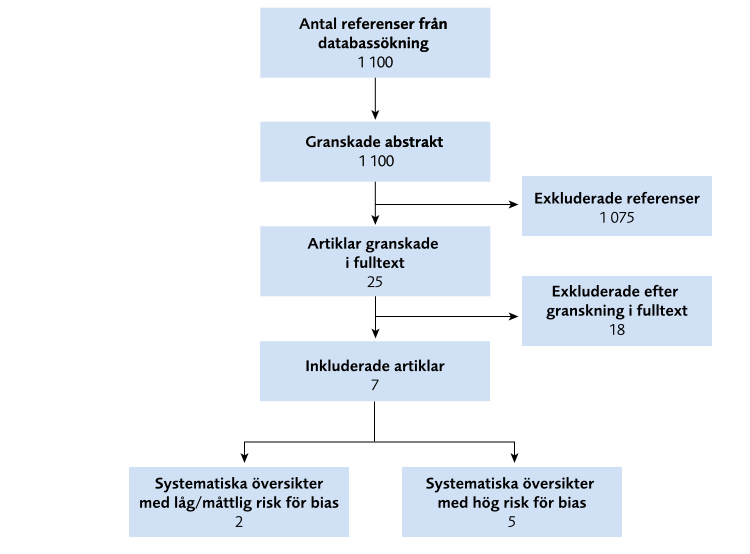
Vi inkluderade två systematiska översikter med måttlig risk för bias [4] [5]. Det innebär att vi anser att de är tillräckligt välgjorda för att presentera resultaten. Vi identifierade också fem översikter som var relevanta för frågan men som vi bedömde ha hög risk för bias [6] [7] [8] [9] [10]. Eftersom hög risk för bias innebär en betydande risk för att resultaten är missvisande presenterar vi inga resultat eller slutsatser från de översikterna.
Sökning och urval av studier, samt bedömning av risk för bias beskrivs i metodavsnittet. Resultaten har inte analyserats utifrån svenska förhållanden.
Lewis och medförfattare publicerade år 2024 en systematisk översikt där en av frågeställningarna gällde effekten av case management-insatser för att motverka radikalisering till extremistiskt våld [4]. Artikelförfattarna fann inga relevanta studier som kunde inkluderas i översikten. Översikten är en så kallad levande översikt, och författarna planerar att uppdatera litteratursökningen inom fem år.
Zych och medförfattare publicerade år 2022 en systematisk översikt där en av frågeställningarna gällde effekten av familjebaserade insatser för att motverka radikalisering till våld, extremism och terrorism [5]. Inte heller i denna översikt fann författarna några relevanta studier som kunde inkluderas. Även denna är en levande översikt och kommer att uppdateras.
| RCT = randomized controlled study | ||
| Included studies | Population, Intervention, Control | Outcome and Results |
|---|---|---|
| Lewis et al, 2024 [4] Case management interventions seeking to counter radicalisation to violence and related forms of violence: A systematic review |
||
| No eligible primary studies were found concerning effectiveness of case management tools and approaches in intervention seeking to counter radicalisation to violence. Eligible study designs: RCT or stronger quasi-experimental research designs. Relevant research question in review Part I: (objective 1) Synthesise evidence on the effectiveness of case management tools and approaches in interventions seeking to counter radicalisation to violence. |
Population: Participants of any age, gender, ethnicity, religion, or ideological perspective (e.g., right‐wing; Islamist; left‐wing, etc.) Intervention: Case management interventions Case management defined as collaborative process which assesses, plans, implements, coordinates, monitors and evaluates options and services.Containing six components:
|
No results reported on effectiveness of case management tools and approaches to counter radicalisation to violence, but future renewed review is planned within five years. Outcomes: Primary outcomes: risk reduction, disengagement, deradicalisation. Secondary outcomes: any specific tools or approaches on progress toward primary outcomes. |
| Authors' conclusion: “One of the main findings from Part I is that very little is known about the effectiveness of tools and approaches used in this context (Objective 1). [...] The effectiveness of existing case management tools and approaches is poorly understood [...].” |
||
| Zych et al, 2022 [5] Is radicalization a family issue? A systematic review of family-related risk and protective factors, consequences, and interventions against radicalization |
||
| No eligible primary studies were found concerning the impact of radicalisation for families or family‐based interventions. Eligible study designs: RCT or quasi-experimental research with robust designs non-randomized experimental vs. control group including a pre‐test and a post-test measures, and matched designs. No limitations regarding the year, language, or geographical area. Relevant research question in review Are family‐based interventions against radicalisation effective? |
Population: Participants of any age, gender, ethnicity, socioeconomic status, and family structure, from any part of the world. Any type of population with at least one radicalised family member or at-risk of radicalisation. Intervention: Family-based interventions: activity, strategy, technique, training, and program that involves family as a recipient of the intervention focused on risk/protective factors; e.g. family counselling, individual or group interventions. |
No results reported on interventions against radicalisation, but future renewed review is planned within four years. Outcomes: Measures of radicalisation to violence, extremism and terrorism, e.g. right‐wing, left‐wing, religious extremism, and any other type of radicalisation or extremism. Self-reports Official records |
| Authors' conclusion: “This systematic review did not locate any studies focused on the impact of radicalization on families or family‐based interventions. Thus, studying the impact of radicalization on family is urgently needed.” |
||
Metod
Sökning
Upplysningstjänsten gör en systematisk sökning i minst två vetenskapliga databaser. Fullständig sökdokumentation finns i Bilaga 1.
Urval
Bedömning av vilka artiklar som är relevanta sker i två steg och utgår från frågeställningen.
- Två utredare läser titel och sammanfattning av alla identifierade artiklar från sökningen, och gör en oberoende bedömning av artiklarnas relevans.
- Artiklarna som valts ut i steg 1 läses i fulltext av två utredare, som gör en oberoende bedömning av artiklarnas relevans.
Skillnader i bedömningarna löses genom diskussion.
Flödesschema för urval av artiklar finns i Bilaga 2. Om artiklar har granskats i fulltext, finns de artiklar som inte bedömts vara relevanta listade i Bilaga 3.
Bedömning av risk för bias
Risk för bias i relevanta systematiska översikter bedöms av två utredare, oberoende av varandra. Skillnader i bedömningarna löses genom diskussion.
Vid bedömning används granskningsmallen SnabbSTAR2. SnabbSTAR2 har fem steg, där översikter som uppfyller de krav som ställs i steg 1–4 bedöms ha måttlig risk för bias, och om 1–5 är uppfyllda bedöms risken för bias vara låg.
En översikt som har brister i stegen 1–4 bedöms ha hög risk för bias och redovisas inte eftersom resultaten kan vara missvisande.
I de fall vi har identifierat relevanta artiklar och gjort en bedömning av risk för bias, redovisas detta i Bilaga 4. Granskningsmallen SnabbSTAR2 med manual finns tillgänglig på vår hemsida.
Vetenskapliga kunskapsluckor
Om sammanställd forskning av god kvalitet saknas registreras det som en vetenskaplig kunskapslucka i SBU:s databas över vetenskapliga kunskapsluckor. Kunskapsluckan kan bestå i att forskning helt saknas, att primärstudier finns men att det inte finns någon systematisk översikt, eller att de existerande systematiska översikterna inte bedöms leva upp till kraven för låg eller måttlig risk för bias.
Databasen över vetenskapliga kunskapsluckor kan nås via: https://www.sbu.se/sv/kunskapsluckor-sok/
Projektgrupp
Detta svar är sammanställt av Marie Nilsson (utredare), Karin Olsson (utredare), Laura Lintamo (utredare), Sara Fundell (projektadministratör), Emma Wojda (enhetschef), samt Therese Åström (intern sakkunnig) vid SBU.
Referenser
- CVE. Våldsbejakande extremism i Sverige - kunskapsöversikt 2023/2024. Stockholm: Center mot våldsbejakande extremism (CVE); 2024. [updated Sep 10 2026]. Available from: https://cve.se/publikationer/valdsbejakandeextremismisverigekunskapsoversikt
20232024.5.330134c518f384e69b3fb5.html - Center mot våldsbejakande extremism (CVE). [accessed Sep 10 2026]. Available from: https://cve.se/
- CVE. Att stärka det förebyggande arbetet mot våldsbejakande extremism - Metodstöd. Stockholm: Center mot våldsbejakande extremism (CVE); 2024. [updated Sep 10 2026]. Available from: https://cve.se/publikationer/metodstodattstarkadetforebyggandearbetetmot
valdsbejakandeextremism.5.bfcf87518f0fa6f43295e9.html - Lewis J, Marsden S, Cherney A, Zeuthen M, Rahlf L, Squires C, et al. Case management interventions seeking to counter radicalisation to violence and related forms of violence: A systematic review. Campbell Syst Rev. 2024;20(2). Available from: https://doi.org/10.1002/cl2.1386
- Zych I, Nasaescu E. Is radicalization a family issue? A systematic review of family-related risk and protective factors, consequences, and interventions against radicalization. Campbell Syst Rev. 2022;18(3). Available from: https://doi.org/10.1002/cl2.1266
- Brouillette-Alarie S, Hassan G, Varela W, Ousman S, Kilinc D, Savard ÉL, et al. Systematic Review on the Outcomes of Primary and Secondary Prevention Programs in the Field of Violent Radicalization. J Deradicalization. 2022(30):117–68.
- Jugl I, Lösel F, Bender D, King S. Psychosocial Prevention Programs against Radicalization and Extremism: A Meta-Analysis of Outcome Evaluations. Eur J Psychol Appl Legal Context. 2021;13(1):37–46. Available from: https://doi.org/10.5093/EJPALC2021A6
- Mazerolle L, Cherney A, Eggins E, Hine L, Higginson A. Multiagency programs with police as a partner for reducing radicalisation to violence. Campbell Syst Rev. 2021;17(2). Available from: https://doi.org/10.1002/cl2.1162
- Mughal R, DeMarinis V, Nordendahl M, Lone H, Phillips V, Boyd-MacMillan E. Public Mental Health Approaches to Online Radicalisation: An Empty Systematic Review. Int J Environ Res Public Health. 2023;20(16). Available from: https://doi.org/10.3390/ijerph20166586
- Treacy S, Reed A, Glazzard A. A systematic integrative review of counter-messaging communication campaigns targeting terrorism or violent extremism. Behav Sci Terror Polit Aggress. 2024. Available from: https://doi.org/10.1080/19434472.2024.2419390
Bilaga 1 Dokumentation av sökstrategier
Upplysningstjänsten har gjort sökningar i databaserna Medline (Ovid), Scopus och CINAHL, PsycInfo, SOCIndex, Criminal Justice Abstracts, Psychology and Behavioral Sciences Collection samt i INAHTA2:s databas för HTA3-rapporter. Vi har även handsökt publikationer på webbsidor för regionala HTA-organisationer och myndigheter.
Sökningen har begränsats till systematiska översikter.
Nedan redovisas sökningen som gjorts i de vetenskapliga databaserna.
2. International Network of Agencies for Health Technology Assessment (INAHTA)
3. Utvärdering av hälso- och sjukvårdens (och i SBU:s fall socialtjänstens) metoder (engelska: Health Technology Assessment)
Medline via OvidSP 30 June 2026
| / = Term from the MeSH controlled vocabulary; .sh = Term from the MeSH controlled vocabulary; exp = Term from MeSH including terms found below this term in the MeSH hierarchy; .ti,ab = Title or abstract; .tw = Title or abstract; .kf = Keywords; .kw = Keywords, exact; .bt = Book title. NLM Bookshelf; .pt = Publication type; .ja = Journal abbreviation; .af = All fields; adjn = Adjacent. Proximity operator retrieving adjacent words, adj3 retrieves records with search terms within two terms from each other; * or $ = Truncation; “ “ = Citation Marks; searches for an exact phrase | ||
| Search terms | Items found | |
|---|---|---|
| Population: Violent extremism | ||
| 1. | exp Terrorism/ | 14 635 |
| 2. | exp Bioterrorism/ | 4 734 |
| 3. | exp National Socialism/ | 1 935 |
| 4. | OR/1–3 | 16 565 |
| 5. | (extremis* OR terroris* OR extreme right OR far-right OR incel* OR indoctrin* OR white supremac* OR neo-nazi* OR active club* OR nationalis* OR extreme left OR anarc* OR bio-terror* OR salafis* OR islamist* OR jihad* OR radicali* OR extreme violen*).ti,ab,kf,bt. | 16 400 |
| 6. | 4 OR 5 | 29 011 |
| Intervention: Recidivism/Prevention, Deradicalisation, Exit support | ||
| 7. | (program* or rehabilit* or treat* or interven* or therap* or prevent* or manag* or (behav* adj4 (chang* or modif*)) or desistance or deradical* or de-radical* or relaps* or disengag* or desist* or divert* or re-integrat* or reintegrat* or counter* or exit* or recidivis*).ti,ab,kf,bt. | 14 198 461 |
| 8. | exp Social work/ | 19 569 |
| 9. | exp Counseling/ | 52 325 |
| 10. | exp Behavior control/ | 15 208 |
| 11. | Persuasive communication/ | 4 312 |
| 12. | (casework* or case work* or (social adj4 (work* or service* or welfare or care*)) or coun?el*).ti,ab,kf,bt. | 262 408 |
| 13. | OR/7–12 | 14 318 867 |
| Study types: systematic reviews and meta-analysis / randomized controlled trials4 | ||
| 14. | (Systematic Review/ or Meta-Analysis/ or Cochrane Database Syst Rev.ja. or (((systematic or realist or integrative or mixed method* or umbrella) adj4 (review)) or "meta analys*" or metaanalys*).ti,bt,ab.) not (editorial/ or letter/ or case reports/) | 631 067 |
| Final result | ||
| 15. | 6 AND 13 AND 14 | 244 |
4. Cochrane Highly Sensitive Search Strategy for identifying randomized trials in MEDLINE: sensitivity- and precision-maximizing version (2008 revision); Ovid format. The Cochrane Collaboration; 2008. Available from: https://training.cochrane.org/handbook/current/chapter-04-technical-supplement-searching-and-selecting-studies#section-3-6-1. with modifications: the following terms are added: clinical trial, phase iii.pt. ; randomised.ab. ; ("Phase 3" or "phase3" or "phase III" or P3 or "PIII").ti,ab,kw.
Scopus via scopus.com 30 June 2026
| TITLE-ABS-KEY = Title, abstract or keywords (including indexed keywords and author keywords); ALL = All fields; W/n = Within. Proximity operator retrieving terms within n words from each other; PRE/n = Precedes by. Proximity operator, the first term in the search must precede the second by n words; LIMIT-TO (X) = Includes only results of specified type, e.g., publication type or time range; DOCTYPE = Publication type; “re” = review; “le” = letter; “ed” = editorial; “ch” = book chapter; “cp” = conference proceedings; * = Truncation; “ “ = Citation Marks; searches for an exact phrase | ||
| Search terms | Items found | |
|---|---|---|
| Population: Violent extremism | ||
| 1. | TITLE-ABS-KEY (extremis* OR terroris* OR "extreme right" OR far-right OR incel* OR indoctrin* OR "white supremac*" OR neo-nazi* OR "active club*" OR nationalis* OR "extreme left" OR anarc* OR bio-terror* OR salafis* OR islamist* OR jihad* OR radicali* OR "extreme violen*") | 224 565 |
| Intervention: Recidivism/Prevention, Deradicalisation, Exit support | ||
| 2. | TITLE-ABS-KEY (program* OR rehabilit* OR treat* OR interven* OR therap* OR prevent* OR manag* OR (behav* W/3 (chang* OR modif*)) OR desistance OR deradical* OR de-radical* OR disengag* OR desist* OR divert* OR re-integrat* OR reintegrat* OR counter* OR exit* OR recidivis* OR relaps* OR casework* OR "case work*" OR coun?el* OR (social W/3 (work* OR service* OR welfare OR care*))) | 31 274 527 |
| Study types: systematic reviews and meta-analysis / randomized controlled trials | ||
| 3. | TITLE-ABS-KEY (((systematic OR realist OR integrative OR “mixed method*” or umbrella) W/3 review) OR "meta analy*" OR metaanaly*) AND (EXCLUDE (DOCTYPE, “le”) OR EXCLUDE (DOCTYPE, “ed”) OR EXCLUDE (DOCTYPE, “ch”) OR EXCLUDE (DOCTYPE, “cp”)) | 947 937 |
| Final result | ||
| 4. | 1 AND 2 AND 3 | 552 |
SOCIndex/Criminal Justice Abstracts/Psychology and Behavioral Sciences Collection/CINAHL/APA PsycInfo via EBSCO 8 June 2026
| TI = Title; AB = Abstract; SU = Keyword, exact or part (including all other fields for indexed and author keywords); Nn = Near. Proximity operator retrieving terms within n words from each other; * = Truncation; “ “ = Citation Marks; searches for an exact phrase | ||
| Search terms | Items found | |
|---|---|---|
| Population: Violent extremism | ||
| 1. | SU Extremism | 2821 |
| 2. | SU Political violence | 5216 |
| 3. | SU Terrorism | 38 867 |
| 4. | SU Radicalism | 6265 |
| 5. | TI (extremis* OR terroris* OR extreme right OR far-right OR incel* OR indoctrin* OR white supremac* OR neo-nazi* OR active club* OR nationalis* OR extreme left OR anarc* OR bio-terror* OR salafis* OR islam* OR jihad* OR radicali* OR extreme violen*) OR AB (extremis* OR terroris* OR extreme right OR far-right OR incel* OR indoctrin* OR white supremac* OR neo-nazi* OR active club* OR nationalis* OR extreme left OR anarc* OR bio-terror* OR salafis* OR islam* OR jihad* OR radicali* OR extreme violen*) OR SU (extremis* OR terroris* OR extreme right OR far-right OR incel* OR indoctrin* OR white supremac* OR neo-nazi* OR active club* OR nationalis* OR extreme left OR anarc* OR bio-terror* OR salafis* OR islam* OR jihad* OR radicali* OR extreme violen*) | 189 013 |
| 6. | OR/ 1-5 | 192 614 |
| Intervention: Recidivism/Prevention, Deradicalisation, Exit support | ||
| 7. | SU Reintegration | 5559 |
| 8. | SU Social casework | 24 118 |
| 9. | SU Social services | 97 422 |
| 10. | TI ( program* OR rehabilit* OR treat* OR interven* OR therap* OR prevent* OR manag* OR "behavioral change" OR "behavior modification" OR "behavioural change" OR "behaviour modification" OR desistance OR deradical* OR de-radical* OR relaps* OR disengag* OR desist* OR divert* OR re-integrat* OR reintegrat* OR counter* OR exit OR recidivis*) OR AB ( program* OR rehabilit* OR treat* OR interven* OR therap* OR prevent* OR manag* OR "behavioral change" OR "behavior modification" OR "behavioural change" OR "behaviour modification" OR desistance OR deradical* OR de-radical* OR relaps* OR disengag* OR desist* OR divert* OR re-integrat* OR reintegrat* OR counter* OR exit OR recidivis*) OR SU ( program* OR rehabilit* OR treat* OR interven* OR therap* OR prevent* OR manag* OR "behavioral change" OR "behavior modification" OR "behavioural change" OR "behaviour modification" OR desistance or deradical* OR de-radical* OR relaps* OR disengag* OR desist* OR divert* OR re-integrat* OR reintegrat* OR counter* OR exit OR recidivis*) | 8 440 441 |
| 11. | OR/ 7-10 | 8 499 555 |
| Study types: systematic reviews and meta-analysis / randomized controlled trials | ||
| 12. | (TI (((systematic OR realist OR integrative OR “mixed method*” OR umbrella) N3 review) OR "meta analys*" OR metaanalys*) OR AB (((systematic OR realist OR integrative OR “mixed method*” OR umbrella) N3 review) OR "meta analys*" OR metaanalys*) OR SU (((systematic OR realist OR integrative OR “mixed method*” OR umbrella) N3 review) OR "meta analys*" OR metaanalys*)) | 484 705 |
| Final result | ||
| 13. | 6 AND 11 AND 12 | 622 (815 including duplicates) |
Bilaga 2 Flödesschema för urval av artiklar
Bilaga 3 Exkluderade artiklar
| Excluded articles | Reason for exclusion |
|---|---|
| Systematic reviews | |
| Brouillette-Alarie S, Hassan G, Ousman S, Savard ÉL, Kilinc D, Madriaza P, et al. Systematic Review on the Outcomes of Tertiary Prevention Programs in the Field of Violent Radicalization. J Deradicalization. 2025(42):140–93. | No synthesis |
| Bunn M, Christopher E, Polutnik-Smith C, McCoy J, Hanneke R, King M, et al. Rehabilitation and Reintegration of Women and Children Returning from Violent Extremist Contexts: A Rapid Review to Inform Program and Policy Development. Terror Political Violence. 2024;36(4):455–87. Available from: https://doi.org/10.1080/09546553.2023.2169143 | Relevant results not analysed separately |
| Carthy SL, Doody CB, Cox K, O'Hora D, Sarma KM. Counter-narratives for the prevention of violent radicalisation: A systematic review of targeted interventions. Campbell Syst Rev. 2020;16(3). Available from: https://doi.org/10.1002/cl2.1106 | Wrong intervention |
| Charkawi W, Dunn K, Bliuc A-M. Evaluations of countering violent extremism programs: Linking success to content, approach, setting, and participants. Int J Law Crime Justice. 2024;77:N.PAG–N.PAG. Available from: https://doi.org/10.1016/j.ijlcj.2024.100674 | No synthesis |
| Del Pino-Brunet N, Hombrados-Mendieta I, Gomez-Jacinto L, Garcia-Cid A, Millan-Franco M. Systematic Review of Integration and Radicalization Prevention Programs for Migrants in the US, Canada, and Europe. Front Psychiatry. 2021;12:606147. Available from: https://doi.org/10.3389/fpsyt.2021.606147 | No synthesis |
| Effendya KF, Prayitnoa H, Ni'maha SZ, Kowala RR, Khamima M, Ulyab Z. Countering Religious Radicalism: A Systematic Review Of Faith-Based Institutional Strategies And Challenges. J Deradicalization. 2025(45):67–100. | Wrong intervention |
| Haugstvedt H. What can families really do? A scoping review of family directed services aimed at preventing violent extremism. J Fam Ther. 2022;44(3):408–21. Available from: https://doi.org/10.1111/1467-6427.12392 | Not a systematic review |
| Kelly LM, Ware A, Barton G. Principles for Community Development Programming to Address Violent and Hateful Extremism. J Deradicalization. 2024(41):90–127 | No synthesis |
| Lewis J, Marsden S. Counter-radicalisation case management interventions: Findings from a Campbell systematic review. Aggression Violent Behav. 2025;82. Available from: https://doi.org/10.1016/j.avb.2025.102050 | Wrong outcome |
| Lum C, Kennedy L, Sherley A. Are counter-terrorism strategies effective? The results of the Campbell systematic review on counter-terrorism evaluation research. J Exp Crim. 2006;2(4):489–516. Available from: https://doi.org/10.1007/s11292-006-9020-y | Wrong intervention |
| Lum C, Kennedy LW, Sherley A. Is counter-terrorism policy evidence-based? What works, what harms, and what is unknown. Psicothema. 2008;20(1):35–42 | Wrong intervention |
| Ma'arif S, Ibda H, Ahmadi F, Qosim N, Muanayah NA. Islamic moderation in education and the phenomenon of cyberterrorism: a systematic literature review. Indones J Electrical Eng Comput Sci. 2023;31(3):1523–33. Available from: https://doi.org/10.11591/ijeecs.v31.i3.pp1523-1533 | Wrong intervention |
| Madriaza P, Morin D, Hassan G. How Rigorous are Evaluations of Violent Extremism Prevention Programs? Results from a Systematic Methodological Review. Terrorism Polit Violence. 2025. Available from: https://doi.org/10.1080/09546553.2025.2555221 | Wrong outcome |
| Mahdi R, Hakak Y. The impact of the Prevent Agenda on social work: a systematic literature review. Crit Radic Soc Work. 2024;12(4):559–74. Available from: https://doi.org/10.1332/20498608Y2024D000000046 | Wrong intervention |
| Mazerolle L, Eggins E, Cherney A, Hine L, Higginson A, Belton E. Police programmes that seek to increase community connectedness for reducing violent extremism behaviour, attitudes and beliefs. Campbell Syst Rev. 2020;16(3). Available from: https://doi.org/10.1002/cl2.1111 | Updated version of review exists |
| McBride MK, Carroll M, Mellea J, Hughes D, Savoia E. Evaluating Terrorist and Extremist Reintegration Programming: A Systematic Literature Review. J Deradicalization. 2022(32):35–75 | No synthesis |
| Muibu D, Vasaturo A, Spurrell W, Savoia E. The use of psychological interventions in tertiary prevention programs for individuals engaged in violent extremism: a scoping review and interviews. Health Justice. 2025;13(1):17. Available from: https://doi.org/10.1186/s40352-025-00324-w | Not a systematic review |
| Sydes M, Hine L, Higginson A, McEwan J, Dugan L, Mazerolle L. Criminal justice interventions for preventing radicalisation, violent extremism and terrorism: An evidence and gap map. Campbell Syst Rev. 2023;19(4). Available from: https://doi.org/10.1002/cl2.1366 | Not a systematic review |
Bilaga 4 Risk för bias hos relevanta systematiska översikter
 = Critical; = Critical;  = High; = High;  = Moderate; = Moderate;  = Low; = Low;  = Not assessed = Not assessedStep 1 = Research question and literature search Step 2 = Study selection and data extraction Step 3 = Risk of bias and study characteristics Step 4 = Synthesis of results Step 5 = Other methodological concerns |
||||||
| Study | Step 1 | Step 2 | Step 3 | Step 4 | Step 5 | Overall |
|---|---|---|---|---|---|---|
| Brouillette-Alarie 2022 | |
|
|
|
|
|
| Jugl 2021 | |
|
|
|
|
|
| Lewis 2024 | |
|
|
|
|
|
| Mazerolle 2021 | |
|
|
|
|
|
| Mughal 2023 | |
|
|
|
|
|
| Treacy 2024 | |
|
|
|
|
|
| Zych 2022 | |
|
|
|
|
|
The risk of bias in included systematic reviews is appraised using QuickSTAR, an assessment tool based on AMSTAR revised by SBU. The assessment tool is comprised of five steps based on the items in AMSTAR. To be assessed as low risk of bias, a systematic review has to fulfil all requirements for step 1 to 5. A systematic review is of moderate risk of bias if it fulfils all the requirements up to step 4. Systematic reviews that do not meet the requirements in one of the steps 1-4 are considered high risk of bias.
Risk-of-bias plot generated using robvis: McGuinness, LA, Higgins, JPT. Risk-of-bias VISualization (robvis): An R package and Shiny web app for visualizing risk-of-bias assessments. Res Syn Meth. 2020; 1- 7. https://doi.org/10.1002/jrsm.1411
 Statens beredning för medicinsk och social utvärdering
 Dela sidan på Facebook
 Dela sidan på LinkedIn
 Dela sidan via E-post
