 Swedish Agency for Health Technology Assessment and Assessment of Social Services
Workplace harassment, and violence or threats and its associations with mental ill health
An Evidence Map
 Share on Facebook
 Share on LinkedIn
 Share via Email
SBU does not issue recommendations or guidelines on how healthcare, dental care or social services should operate, or on which interventions and methods should be provided. SBU critically appraises and synthesises research on interventions and methods through systematic reviews.
Main message
SBU has conducted an umbrella review based on 19 systematic reviews that were published between 2015 and 2025. These systematic reviews examined associations between workplace bullying, sexual harassment, or discrimination, as well as threats and violence, and mental ill health outcomes. The outcomes include symptoms of depression, anxiety, burnout, and PTSD.
Main results
The main result showed that workplace exposures (including bullying, sexual harassment, discrimination, threats, and violence) were associated with mental ill health (depression, anxiety, burnout, and PTSD). However, substantial heterogeneity between reviews and primary studies within the reviews precludes firm conclusions regarding the magnitude and consistency of these associations. Moreover, the certainty of the results is limited. SBU rated the risk of bias as moderate or high for the majority of the included reviews. There is also insufficient evidence to draw conclusions regarding gender differences or the impact of exposure duration based on this umbrella review.
Aim
The aim of this evidence map was to identify the available scientific evidence and evidence gaps within predefined areas of interest by systematically assessing and categorizing all systematic reviews that meet the inclusion criteria. The map focuses on systematic reviews evaluating associations between workplace bullying, sexual harassment, or discrimination, as well as threats and violence, and mental ill health. The outcomes include symptoms of depression, anxiety, burnout, and PTSD.
Background
In Sweden, a considerable proportion of gainfully employed people report symptoms such as depression, anxiety and burnout. This burden is also reflected in sickness absence statistics, where mental disorders represent the leading cause of long-term absence, and in particular stress-related conditions.
Although occupational exposures are not the sole causes of sickness absence, 88% of individuals on sick leave due to stress-related diagnoses in Sweden, report that work has contributed to their condition. Contributing factors in the work environment include high workload, stress, workplace harassment, and conflicts. This underscores the relevance of examining exposures in the psychosocial work environment and its association mental ill health outcomes.
Method
A study protocol for this project was made a priori.
Inclusion criteria
PECO
- Population: Gainfully employed people between 16 and 69 years.
- Exposure: Workplace bullying, sexual harassment, discrimination, violence and threats.
- Control: Non-exposure or lower rate of exposure.
- Outcome: Symptoms of depression, anxiety, burnout or PTSD.
Study design: Umbrella review including systematic reviews with quantitative study designs. Systematic reviews including primary studies using both cross-sectional and longitudinal study designs were considered for inclusion.
Language: English, and Scandinavian languages.
Search period: From year 2015 to 2025. Final search November 2025.
Databases searched: PsycInfo, Embase, Medline, International HTA Database, Epistemonikos and Scopus were searched in November 2025.
The PECO for this map, as well as the categories used to classify the content in the map, were outlined by the project group. To make sure that a relevant map was drafted, representatives from the relevant field were given the opportunity to review the draft. After considering their comments, the draft was finalized.
A systematic literature search was thereafter designed and performed by an information specialist to identify all published systematic reviews potentially relevant for the PECO. After the literature search was performed, two reviewers independently screened the abstracts and full text articles and selected the relevant systematic reviews. The risk of bias in the included systematic reviews was assessed independently by two reviewers using the ROBIS tool. Any disagreement regarding relevance or risk of bias was solved by discussion.
Depending on the research questions addressed in the identified systematic reviews, they were classified according to the prespecified categories and are presented in the evidence map.
The report was reviewed by an external reviewer.
Results
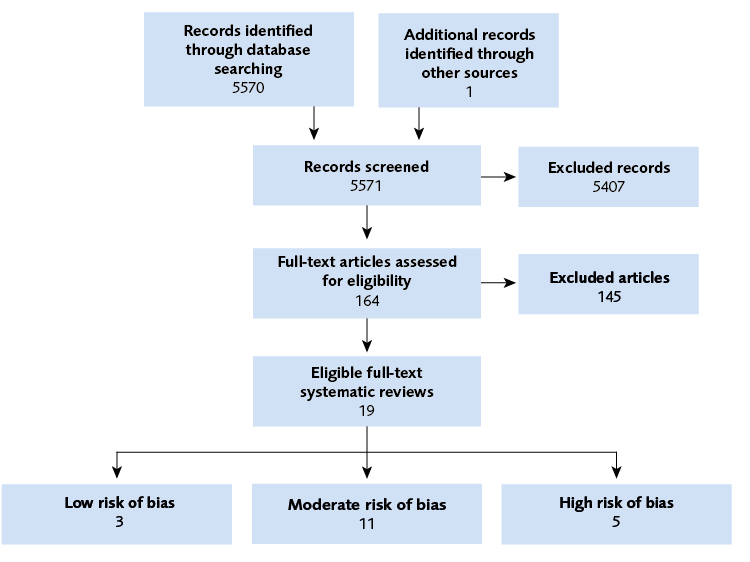
Nineteen relevant systematic reviews were identified and provide the basis for this SBU Evidence Map. Out of these, fourteen were judged to have a low or moderate risk of bias. All systematic reviews are presented in the evidence map.
Of the 19 included systematic reviews, eight addressed the general working population and eight focused on healthcare workers. Five reviews examined sector-specific populations, such as military personnel, emergency services, and the hospitality sector.
Exposure to threats and violence and workplace bullying were examined in nine systematic reviews each. Sexual harassment was addressed in six reviews, and discrimination in three. Outcomes most frequently assessed were symptoms of depression and burnout (12 reviews each), followed by symptoms of anxiety (six reviews) and PTSD (five reviews).
Note that lack of evidence does not mean absence of an association between exposure- and outcome variables. It simply means that there is a scientific uncertainty about the certainty of an association, and that more studies or systematic reviews are needed to provide a reliable measurement.
Link to the The evidence map
Conflicts of Interest
In accordance with SBU’s requirements, the experts and scientific reviewers participating in this project have submitted statements about conflicts of interest. These documents are available at SBU’s secretariat. SBU has determined that the conditions described in the submissions are compatible with SBU’s requirements for objectivity and impartiality.
The full report in Swedish
Kränkande särbehandling, hot och våld i arbetet och dess relation till psykisk ohälsa
Project group
Experts
- Linda Magnusson Hanson, Associate professor, Division for epidemiology, Department of psychology, Stockholm University
- Andreas Stenling, Associate professor, Department of psychology, Umeå University
From SBU
- Magdalena Ramstedt Stadin, project director
- Elin Frögéli, assistant project director
- Maria Ahlberg, project administrator
- Carl Gornitzki, informationspecialist
- Jenny Odeberg, head of unit
Interactive map Workplace harassment, and violence or threats and its associations with mental ill health
Appendices
Flow chart
References
- Bakker AB, Demerouti E, Sanz-Vergel A. Job Demands–Resources Theory: Ten Years Later. Annual Review of Organizational Psychology and Organizational Behavior. 2023;10(Volume 10, 2023):25–53. Available from: https://doi.org/https://doi.org/10.1146/annurev-orgpsych-120920-053933
- Boot CRL, LaMontagne AD, Madsen IEH. Fifty years of research on psychosocial working conditions and health: From promise to practice. Scand J Work Environ Health. 2024;50(6):395–405. Available from: https://doi.org/10.5271/sjweh.4180
- WHO. WHO guidelines on mental health at work. Geneva: World Health Organization; 2022. Available from: https://iris.who.int/server/api/core/bitstreams/6152a556-6893-4c4e-9ed8-094478bb25eb/content
- Daly M, Macchia L. Global trends in emotional distress. Proc Natl Acad Sci U S A. 2023;120(14):e2216207120. Available from: https://doi.org/10.1073/pnas.2216207120
- Steel Z, Marnane C, Iranpour C, Chey T, Jackson JW, Patel V, et al. The global prevalence of common mental disorders: a systematic review and meta-analysis 1980-2013. Int J Epidemiol. 2014;43(2):476–93. Available from: https://doi.org/10.1093/ije/dyu038
- Dalsager L, Sørensen K, Sørensen JK, Burr H, Dragano N, Hanson LM, et al. Time trends in prevalence of depressive disorder in the Danish working population from 2012 to 2018. J Affect Disord. 2025;385:119449. Available from: https://doi.org/10.1016/j.jad.2025.119449
- Försäkringskassan. Försäkringskassans lägesrapport 2026:1 – Psykisk ohälsa i dagens arbetsliv. Stockholm: Försäkringskassan. [accessed March 26 2026]. Available from: https://www.forsakringskassan.se/download/18.9fd5de919ac9bfb0a5395/1768298356577/psykisk-ohalsa-i-dagens-arbetsliv-forsakringskassans-lagesrapport-2026-1.pdf
- Lidwall U, Bill S, Palmer E, Olsson Bohlin C. Mental disorder sick leave in Sweden: A population study. Work. 2018;59(2):259–72. Available from: https://doi.org/10.3233/wor-172672
- Socialstyrelsen. Begrepp inom området psykisk hälsa Version 1.1. Stockholm: Socialstyrelsen; 2024. [accessed March 26 2026]. Available from: https://www.socialstyrelsen.se/contentassets/19112a0be4af4a7ea813f2421c6e465c/2024-6-9186.pdf
- Socialstyrelsen. Klassifikationen ICD-10. Stockholm: Socialstyrelsen. [accessed March 26 2026]. Available from: https://www.socialstyrelsen.se/statistik-och-data/klassifikationer-och-koder/icd-10/
- Folkhälsomyndigheten. Hur mäter man psykisk hälsa i befolkningen? Solna: Folkhälsomyndigheten. [accessed March 26 2026]. Available from: https://dinpsykiskahalsa.se/artiklar/vad-ar-psykisk-halsa/hur-mater-man-psykisk-halsa/
- Socialstyrelsen. Nationella riktlinjer för vård vid depression och ångestsyndrom – Stöd för styrning och ledning. Stockholm: Socialstyrelsen; 2021. Available from: https://www.socialstyrelsen.se/contentassets/5e4ef79d53d34793b4119029c1253bff/2021-4-7339.pdf
- ILO. Conventions, Protocols and Recommendations. Internationl Labour Organization. [accessed March 26 2026]. Available from: https://www.ilo.org/international-labour-standards/conventions-protocols-and-recommendations
- Arbetsmiljöverket. Arbetsmiljöverkets föreskrifter och allmänna råd (AFS 2023:2) om planering och organisering av arbetsmiljöarbete – grundläggande skyldigheter för dig med arbetsgivaransvar. Solna: Arbetsmiljöverket. [accessed March 26 2026]. Available from: https://www.av.se/arbetsmiljoarbete-och-inspektioner/publikationer/foreskrifter/afs-20232/
- Rospenda KM. Workplace harassment, services utilization, and drinking outcomes. Journal of Occupational Health Psychology. 2002;7(2):141–55. Available from: https://doi.org/10.1037/1076-8998.7.2.141
- ILO. International Labour Organization; 2019. [accessed March 26 2026]. Available from: https://normlex.ilo.org/dyn/nrmlx_en/f?p=NORMLEXPUB:1:0::NO
- McDonald P. Workplace Sexual Harassment 30 Years on: A Review of the Literature. International Journal of Management Reviews. 2012;14(1):1–17. Available from: https://doi.org/https://doi.org/10.1111/j.1468-2370.2011.00300.x
- Fitzgerald LF, Gelfand MJ, Drasgow F. Measuring sexual harassment: Theoretical and psychometric advances. Basic and Applied Social Psychology. 1995;17(4):425–45. Available from: https://doi.org/10.1207/s15324834basp1704_2
- Dipboye R, Johnson S. Subtle (and not so subtle) discrimination in organizations. In; 2004.
- Einarsen SV, Hoel H, Zaph D, Cooper CL. Bullying and harassment in the workplace: theory, research and practice. 3rd ed. Boca Raton; 2020.
- Einarsen S, Hoel H, Notelaers G. Measuring exposure to bullying and harassment at work: Validity, factor structure and psychometric properties of the Negative Acts Questionnaire-Revised. Work & Stress. 2009;23(1):24–44. Available from: https://doi.org/10.1080/02678370902815673
- Dhanani LY, LaPalme ML, Joseph DL. How prevalent is workplace mistreatment? A meta-analytic investigation. Journal of Organizational Behavior. 2021;42(8):1082–98. Available from: https://doi.org/https://doi.org/10.1002/job.2534
- Arbetsmiljöverket. Arbetsmijön 2021. Solna: Arbetsmiljöverket. [accessed March 26 2026]. Available from: https://www.av.se/arbetsmiljoarbete-och-inspektioner/arbetsmiljostatistik-officiell-arbetsskadestatstik/arbetsmiljon-2021/
- Nielsen MB, Matthiesen SB, Einarsen S. The impact of methodological moderators on prevalence rates of workplace bullying. A meta-analysis. Journal of Occupational and Organizational Psychology. 2010;83(4):955–79. Available from: https://doi.org/10.1348/096317909X481256
- Arbetsmiljöverket. Arbetsmiljön 2024. Solna: Arbetsmiljöverket. [accessed March 26 2026]. Available from: https://www.av.se/globalassets/filer/statistik/arbetsmiljon-2024/arbetsmiljon-2024-rapport.pdf
- Arbetsmiljöverket. Våld och hot om våld. Solna: Arbetsmiljöverket. [accessed March 26 2026]. Available from: https://www.av.se/halsa-och-sakerhet/vald-och-hot-om-vald/
- Barclay LJ, Aquino K. Workplace aggression and violence. In: APA handbook of industrial and organizational psychology, Vol 3: Maintaining, expanding, and contracting the organization. APA handbooks in psychology®. Washington, DC, US: American Psychological Association; 2011. p. 615–40.
- ILO. C190 - Violence and Harassment Convention, 2019 (No. 190). Geneva: The International Labour Organization; 2019. Available from: https://normlex.ilo.org/dyn/nrmlx_en/f?p=NORMLEXPUB:12100:0::NO::P12100_ILO_CODE:C190
- Liu J, Gan Y, Jiang H, Li L, Dwyer R, Lu K, et al. Prevalence of workplace violence against healthcare workers: a systematic review and meta-analysis. Occupational and Environmental Medicine. 2019;76(12):927–37. Available from: https://doi.org/10.1136/oemed-2019-105849
- Arbetsmiljöverket. Organisatorisk och social arbetsmiljö (AFS 2015:4). Solna: Arbetsmiljöverket; 2015. Available from: https://www.av.se/globalassets/filer/publikationer/foreskrifter/organisatorisk-och-social-arbetsmiljo-foreskrifter-afs2015_4.pdf
- Lazarus RS. Stress, appraisal, and coping: Springer; 1984.
- Siegrist J, Li J. Psychosocial Occupational Health: An Interdisciplinary Textbook: Oxford University Press; 2024.
- Rugulies R, Aust B, Greiner BA, Arensman E, Kawakami N, LaMontagne AD, et al. Work-related causes of mental health conditions and interventions for their improvement in workplaces. The Lancet. 2023;402(10410):1368–81. Available from: https://doi.org/10.1016/S0140-6736(23)00869-3
- Borissov N, Haas Q, Minder B, Kopp-Heim D, von Gernler M, Janka H, et al. Reducing systematic review burden using Deduklick: a novel, automated, reliable, and explainable deduplication algorithm to foster medical research. Syst Rev. 2022;11(1):172. Available from: https://doi.org/10.1186/s13643-022-02045-9
- The PubPeer Foundation. PubPeer the online Journal club. California: The PubPeer Foundation. Available from: https://pubpeer.com/
- Norwegian Directorate for Higher Education and Skills. Norwegian Directorate for Higher Education and Skills. Kanalregistret. Bergen: Norwegian Directorate for Higher Education and Skills. Available from: https://kanalregister.hkdir.no/en
- SBU. Utvärdering av insatser i hälso- och sjukvården och socialtjänsten: En metodbok. Stockholm: Statens beredning för medicinsk och social utvärdering (SBU); 2023. Available from: https://www.sbu.se/metodbok
- Blindow KJ, Cedstrand E, Elling DL, Hagland M, Bodin T. Gender-based violence and harassment at work and health and occupational outcomes. A systematic review of prospective studies. BMC Public Health. 2024;24(1):1788. Available from: https://doi.org/10.1186/s12889-024-19304-0
- Petereit-Haack G, Bolm-Audorff U, Starke KR, Seidler A. Occupational risk for post-traumatic stress disorder and trauma-related depression: A systematic review with meta-analysis. International Journal of Environmental Research and Public Health. 2020;17(24). Available from: https://doi.org/10.3390/ijerph17249369
- Theorell T, Hammarström A, Aronsson G, Träskman Bendz L, Grape T, Hogstedt C, et al. A systematic review including meta-analysis of work environment and depressive symptoms. BMC Public Health. 2015;15:738. Available from: https://doi.org/10.1186/s12889-015-1954-4
- Aronsson G, Theorell T, Grape T, Hammarström A, Hogstedt C, Marteinsdottir I, et al. A systematic review including meta-analysis of work environment and burnout symptoms. BMC Public Health. 2017;17(1):264. Available from: https://doi.org/10.1186/s12889-017-4153-7
- Chireh B, Essien SK, Swerhun K, D'Arcy C, Acharibasam JW. Workplace stressors and mental health outcomes among personal support workers: A systematic review. International journal of nursing studies. 2025;168:105093. Available from: https://doi.org/10.1016/j.ijnurstu.2025.105093
- Grimmond T, King T, LaMontagne AD, Oostermeijer S, Harrap B, Newberry-Dupe J, et al. Workplace-related determinants of mental health in food and bar workers in Western, high-income countries: A systematic review. Am J Ind Med. 2024;67(8):696–711. Available from: https://doi.org/10.1002/ajim.23620
- Igboanugo S, Bigelow PL, Mielke JG. Health outcomes of psychosocial stress within firefighters: A systematic review of the research landscape. J Occup Health. 2021;63(1):e12219. Available from: https://doi.org/10.1002/1348-9585.12219
- Nyberg A, Kecklund G, Hanson LM, Rajaleid K. Workplace violence and health in human service industries: a systematic review of prospective and longitudinal studies. Occupational and environmental medicine. 2021;78(2):69–81. Available from: https://doi.org/10.1136/oemed-2020-106450
- Obradovic T, Rabin S, Murphy D, Fear NT, Sharp ML. Mental health outcomes associated with military sexual trauma in serving and ex-servicewomen: A systematic review. Psychological medicine. 2025;55:e287. Available from: https://doi.org/10.1017/S003329172510175X
- Rudkjoebing LA, Bungum AB, Flachs EM, Eller NH, Borritz M, Aust B, et al. Work-related exposure to violence or threats and risk of mental disorders and symptoms: a systematic review and meta-analysis. Scand J Work Environ Health. 2020;46(4):339–49. Available from: https://doi.org/10.5271/sjweh.3877
- Samsudin EZ, Isahak M, Rampal S. The prevalence, risk factors and outcomes of workplace bullying among junior doctors: A systematic review. European Journal of Work and Organizational Psychology. 2018;27(6):700–18. Available from: https://doi.org/10.1080/1359432X.2018.1502171
- Shields M, Dimov S, Kavanagh A, Milner A, Spittal MJ, King TL. How do employment conditions and psychosocial workplace exposures impact the mental health of young workers? A systematic review. Soc Psychiatry Psychiatr Epidemiol. 2021;56(7):1147–60. Available from: https://doi.org/10.1007/s00127-021-02077-x
- van der Molen HF, Nieuwenhuijsen K, Frings-Dresen MHW, de Groene G. Work-related psychosocial risk factors for stress-related mental disorders: an updated systematic review and meta-analysis. BMJ Open. 2020;10(7):e034849. Available from: https://doi.org/10.1136/bmjopen-2019-034849
- Wang J, Zeng Q, Wang Y, Liao X, Xie C, Wang G, et al. Workplace violence and the risk of post-traumatic stress disorder and burnout among nurses: A systematic review and meta-analysis. Journal of nursing management. 2022;30(7):2854–68. Available from: https://doi.org/10.1111/jonm.13809
- Amiri S, Mahmood N, Mustafa H, Javaid SF, Khan MAB. Occupational Risk Factors for Burnout Syndrome Among Healthcare Professionals: A Global Systematic Review and Meta-Analysis. International Journal of Environmental Research and Public Health. 2024;21(12). Available from: https://doi.org/10.3390/ijerph21121583
- Bambi S, Foa C, De Felippis C, Lucchini A, Guazzini A, Rasero L. Workplace incivility, lateral violence and bullying among nurses. A review about their prevalence and related factors. Acta Biomed Ateneo Parmense. 2018;89(6-S):51–79. Available from: https://doi.org/10.23750/abm.v89i6-S.7461
- Boudrias V, Trépanier SG, Salin D. A systematic review of research on the longitudinal consequences of workplace bullying and the mechanisms involved. Aggression and Violent Behavior. 2021;56. Available from: https://doi.org/10.1016/j.avb.2020.101508
- Grech M. The Effect of the Educational Environment on the rate of Burnout among Postgraduate Medical Trainees - A Narrative Literature Review. J med educ curric dev. 2021;8:23821205211018700. Available from: https://doi.org/10.1177/23821205211018700
- Saade S, Parent-Lamarche A, Bazarbachi Z, Ezzeddine R, Ariss R. Depressive symptoms in helping professions: a systematic review of prevalence rates and work-related risk factors. International archives of occupational and environmental health. 2022;95(1):67–116. Available from: https://doi.org/10.1007/s00420-021-01783-y
- Lanctôt N, Guay S. The aftermath of workplace violence among healthcare workers: A systematic literature review of the consequences. Aggression and Violent Behavior. 2014;19(5):492–501. Available from: https://doi.org/10.1016/j.avb.2014.07.010
- Nielsen MB, Einarsen S. Outcomes of exposure to workplace bullying: A meta-analytic review. Work & Stress. 2012;26(4):309–32. Available from: https://doi.org/10.1080/02678373.2012.734709
- Forskningsrådet för hälsa aov. Våld i arbetslivet inom hälso- och sjukvård, socialt arbete och utbildningssektorn: Kunskapsläge och fortsatt forskningsbehov. 2020. Available from: https://forte.se/upptack-forskning/publikationer/vald-i-arbetslivet-inom-halso--och-sjukvard-socialt-arbete-och-utbildningssektorn
- Arbetsmiljöverket. Motverka kränkande särbehandling och mobbing 2025. Solna: Arbetsmiljöverket. [accessed March 26 2026]. Available from: https://www.av.se/halsa-och-sakerhet/organisatorisk-och-social-arbetsmiljo/motverka-krankande-sarbehandling/
- Rugulies R. Studying the effect of the psychosocial work environment on risk of ill-health: towards a more comprehensive assessment of working conditions. Scand J Work Environ Health. 2012;38(3):187–91. Available from: https://doi.org/10.5271/sjweh.3296
- De Lange AH, Taris TW, Kompier MAJ, Houtman ILD, Bongers PM. The relationships between work characteristics and mental health: Examining normal, reversed and reciprocal relationships in a 4-wave study. Work & Stress. 2004;18(2):149–66. Available from: https://doi.org/10.1080/02678370412331270860
