 Swedish Agency for Health Technology Assessment and Assessment of Social Services
Interventions to strengthen foster family care
A systematic review and evaluation of health-related, social and health economic aspects
Certain interventions to strengthen foster family care may have positive effects for children in care. Promising results include improved mental health and attachment security, as well as reduced serious behavior problems, such as fewer days spent in locked units.
 Share on Facebook
 Share on LinkedIn
 Share via Email
SBU does not issue recommendations or guidelines on how healthcare, dental care or social services should operate, or on which interventions and methods should be provided. SBU critically appraises and synthesises research on interventions and methods through systematic reviews.
Main message
Certain interventions to strengthen foster family care may have positive effects for children in care. Promising results include improved mental health and attachment security, as well as reduced serious behavior problems, such as fewer days spent in locked units.
Conclusions
After reviewing the scientific literature, SBU has drawn the following conclusions:
- Attachment-focused parenting programs may reduce attachment insecurity for children in foster family care.
- Treatment foster care for adolescents – more specifically Treatment Foster Care Oregon (TFCO) – may lead to fewer days in a locked ward, reduce substance use, and improve the mental health of adolescents with serious behavior problems.
- The results also indicate that:
- behavior-focused parenting programs may reduce externalizing symptoms of children in foster family care.
- education-focused tutoring and mentoring programs may improve the reading ability of children in foster family care.
- treatment foster care for adolescents (TFCO) may reduce deliquency of adolescents with serious behavior problems.
Aim
The purpose of this systematic review was to evaluate scientific support for interventions to strengthen foster family care. It also includes an analysis of health economic aspects.
Background
Family foster care is the dominant form of out-of-home care in Sweden, especially for younger children. Previous research has shown that children in care are a particularly vulnerable group with difficulties in several areas of life. For children with particularly extensive needs, more qualified interventions may be required where the foster families receive extra training, support, and supervision to meet children’s needs. Sometimes the children also need special support.
Method
We conducted a systematic review and reported it in accordance with the PRISMA statement. The protocol is registered in Prospero (CRD42024518998). The certainty of evidence was assessed with GRADE.
Inclusion criteria
The following two PICOs were used:
Foster family care and treatment foster care for younger children
Population: Children aged 0–17 placed in foster family care due to parental caregiving limitations, adverse home environments, or the child’s behavioral problems, with at least 70% in non-kinship foster family care
Intervention: Eligible interventions targeted children or foster parents and were delivered during foster family placements. We excluded interventions conducted in group care settings, interventions aimed at preventing placements, supporting family reunification, and at post-placement support
Control: Standard care, waitlist, or alternative intervention
Outcome: Children’s mental health (e.g., internalizing/externalizing symptoms), physical health, psychosocial functioning (e.g., education, substance use), placement stability, quality of life, or foster parents’ parenting skills or mental health
Treatment foster care for adolescents
Population: Adolescents aged 12–17 placed in treatment foster care due to their own behavioral problems
Intervention: Well-described intervention in treatment foster care
Control: Residential care
Outcome: Adolescents’ mental health (e.g., internalizing/externalizing symptoms), physical health, psychosocial functioning (e.g., education, substance use), placement stability
Study design: Prospective controlled trials, with or without randomization
Language: English or Scandinavian languages
Databases searched: MEDLINE (Ovid), PsycINFO, SocINDEX, Sociological Abstracts, and Scopus
Patient involvement: No
Result
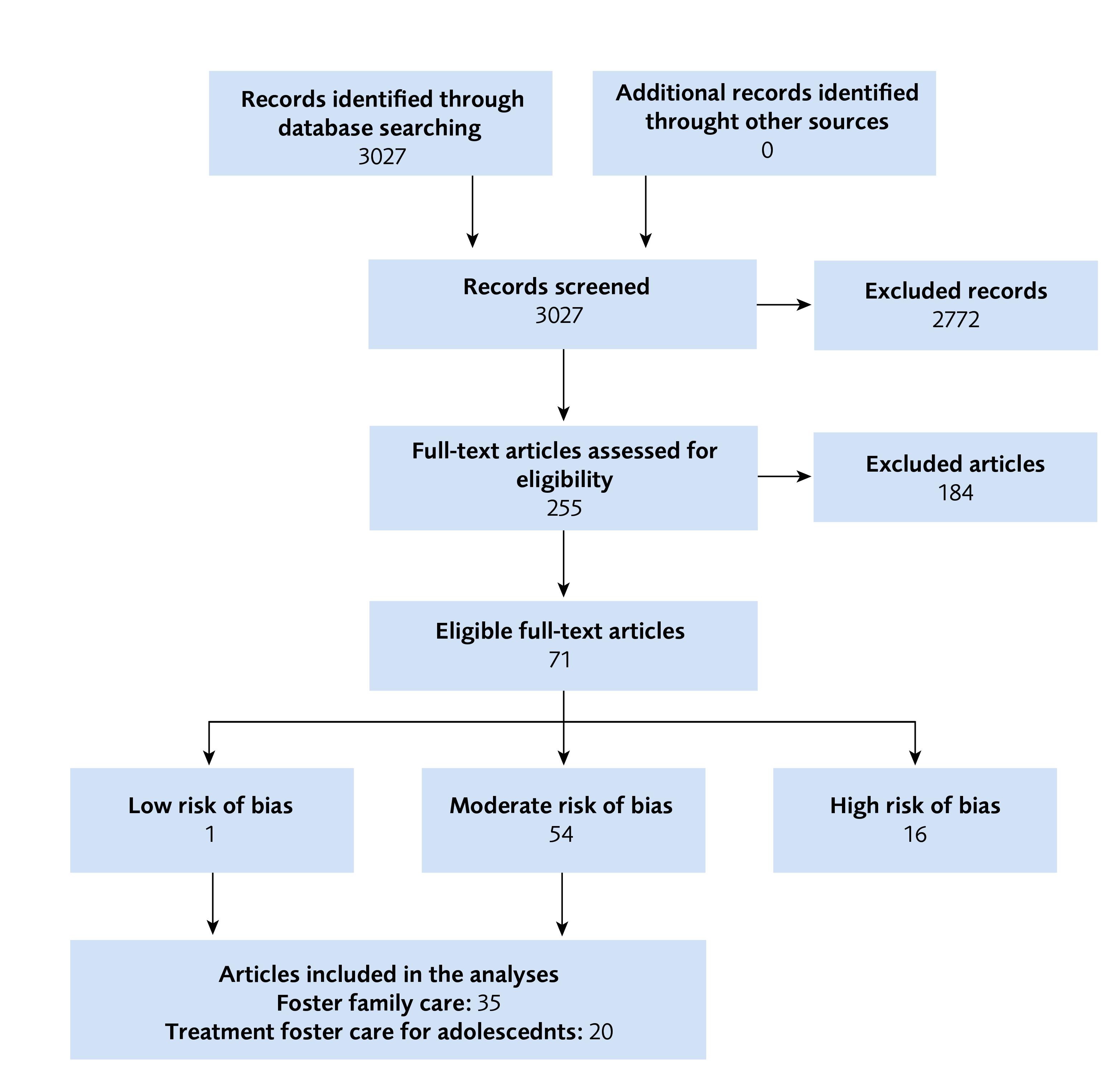
A total of 23 interventions, evaluated in 55 articles, were identified and categorized according to their primary purpose (Flow chart). The categories are: (a) attachment-, or (b) behavior-focused parenting programs, (c) education-focused tutoring and mentoring programs, (d) treatment foster care for younger children or (e) adolescents, and (f) other psychosocial interventions. Overall, there was limited evidence available to assess the effects of the interventions, with few studies for each intervention. Many knowledge gaps were identified, for example regarding methods for assessing families who wish to become foster families, as well as interventions focusing on children’s physical health, including dental health. The conclusions presented above have low certainty. This means that the results may be accurate, but future research may change the picture.
The interventions aimed at strengthening foster care include various activities and strategies to support foster parents and children in care. The available evidence is insufficient to determine which of these components influence the effectiveness of the interventions.
A scientific publication presenting more detailed results is under preparation. A link will be provided below as soon as it has been published.
Health Economic Assessment
We included 2 health economic studies. No conclusions can be drawn about the relationship between costs and effects for interventions aimed at strengthening foster family care. The results from the two identified studies indicated that investing in TFCO is cost‑effective from a societal perspective, but this should be interpreted with caution due to major methodological limitations in the studies.
Discussion
More well‑designed research studies, for example with larger samples and clearer descriptions of the different components of the interventions, are needed to enable more reliable conclusions. There is also a need for studies on interventions aimed at improving the physical health of children in out‑of‑home care.
Conflict of Interest
In accordance with SBU’s requirements, the experts and scientific reviewers participating in this project have submitted statements about conflicts of interest. These documents are available at SBU’s secretariat. SBU has determined that the conditions described in the submissions are compatible with SBU’s requirements for objectivity and impartiality.
The full report in Swedish
Project group
Experts
- Martin Bergström, associate professor, PhD in social work, Faculty of Social Sciences, Lund University
- Hilma Forsman, PhD and associate professor in social work, Department of Social Work, Stockholm University
- Judith Lind, associate professor, Department of Thematic Studies (TEMA), Linköping University
- Anna-Karin Åkerman, PhD and associate professor, Department of Behavioural Sciences and Learning (IBL), Linköping University
SBU
- Annicka Hedman, project director
- Uliana Hellberg, assistant project director until 2025-08-31 and head of unit from 2025-09-01
- Sarah Vigerland, assistant project director from 2024-11-15
- Álfheiður Ástvaldsdóttir, analyst from 2024-12-10
- Carl Gornitzki, information specialist
- Thérèse Eriksson, health economist
- Caroline Jungner, project administrator until 2023-08-22
- Elin Malmer, project administrator from 2023-08-23 until 2023-11-17
- Anna Attergren Granath, project administrator from 2023-11-17 until 2024-12-18
- Sara Fundell, project administrator from 2024-12-18
- Sofia Carlsson, assistant project administrator from 2025-03-19
- Sofia Tranæus, head of department until 2025-08-31
Flow chart
Interactive maps
Two interactive maps were constructed within the project. Each map consists of an interactive table where informaiton on the included studies can be filtered out. The maps aim to provide an overview of the included studies' intervention components and measured outcomes, but can not be used to draw conclusions about intervention effects.
Interactive map:Direction of effect in interventions to strengthen foster family care
Interactive map:Supporting activities in interventions to strengthen foster family care
Appendices
References
- Socialstyrelsen. Placerade barn och unga − Handbok för socialtjänsten. Stockholm: Socialstyrelsen; 2023. Artikelnummer 2023-10-8806. [accessed May 4 2025]. Available from: https://www.socialstyrelsen.se/publikationer/placerade-barn-och-unga--handbok-for-socialtjansten-2023-10-8806/
- Socialstyrelsen. Statistik om socialtjänstinsatser till barn och unga 2024. Stockholm: Socialstyrelsen; 2025. Artikelnummer 2025-10-9726. [accessed Jan 14 2026]. Available from: https://www.socialstyrelsen.se/publikationer/statistik-om-socialtjanstinsatser-till-barn-och-unga-2024-2025-10-9726/
- UN. General Assembly. Guidelines for the Alternative Care of Children: resolution / adopted by the General Assembly. New York: United Nations (UN); 2010. Resolution A/RES/64/142. [accessed Dec 17 2025]. Available from: https://digitallibrary.un.org/record/673583?v=pdf
- UNICEF. Keeping families together in Europe. Switzerland: UNICEF; 2024. Policy brief. [accessed Dec 17 2025]. Available from: https://www.unicef.org/eca/reports/keeping-families-together-europe
- Socialstyrelsen. Instabilitet bland barn och unga placerade i heldygnsvård enligt SoL och LVU. Stockholm: Socialstyrelsen; 2023. Artikelnummer 2023-5-8548. [accessed Jan 14 2026]. Available from: https://www.socialstyrelsen.se/publikationer/instabilitet-bland-barn-och-unga-placerade-i-heldygnsvard-enligt-sol-och-lvu--2023-5-8548/
- Laklija M. Results of a conducted survey: Foster care models in Europe. Zagreb: Forum za kvalitetno udomiteljstvo djece; 2011. [accessed May 4 2025]. Available from: https://www.udomiteljizadjecu.hr/wp-content/uploads/documents/publikacije/Foster%20care%20models%20in%20Europe%20-%20results%20of%20a%20conducted%20survey%20-%20Maja%20Laklija.pdf
- Spesialisert fosterhjem. Oslo: Barne-, ungdoms- og familiedirektoratet (Bufdir). [accessed Dec 18 2025]. Available from: https://www.bufdir.no/fosterhjem/spesialisert-fosterhjem/
- Anbringelsesformer. Odense: Social-og Boligstyrelsen. [accessed Dec 18 2025]. Available from: https://www.social.dk/boern-og-unge/anbringelse/viden-og-temaer/anbringelsesformer
- SOU 2023:66. För barn och unga i samhällsvård. Statens offentliga utredningar. Stockholm: Elanders Sverige AB. [accessed Jan 12 2026]. Available from: https://www.regeringen.se/rattsliga-dokument/statens-offentliga-utredningar/2023/11/sou-202366/
- Socialstyrelsen. Förstärkt familjehemsvård – Kartläggning och analys. Stockholm: Socialstyrelsen; 2026. Artikelnummer 2026-2-9876. [accessed Feb 10 2026]. Available from: https://www.socialstyrelsen.se/publikationer/forstarkt-familjehemsvard--kartlaggning-och-analys-2026-2-9876/
- SBU. Behandlingsfamiljer för ungdomar med allvarliga beteendeproblem – Treatment Foster Care Oregon: en systematisk översikt och utvärdering inklusive ekonomiska och etiska aspekter. Stockholm: Statens beredning för medicinsk och social utvärdering (SBU); 2018. SBU Utvärderar 279. [accessed May 4 2025]. Available from: https://www.sbu.se/279
- Hahn RA, Bilukha O, Lowy J, Crosby A, Fullilove MT, Liberman A, et al. The effectiveness of therapeutic foster care for the prevention of violence: a systematic review. Am J Prev Med. 2005;28(2 Suppl 1):72-90. Available from: https://doi.org/10.1016/j.amepre.2004.10.007
- Europeiska unionen. Europeiska unionens stadga om de grundläggande rättigheterna (2012/C 326/02). Bryssel: Europeiska unionens officiella tidning; 2012. [accessed May 26 2025]. Available from: https://eur-lex.europa.eu/legal-content/SV/TXT/?uri=CELEX%3A12012P%2FTXT
- Europeiska kommissionen. EU:s strategi för barnets rättigheter. Stockholm: Regeringskansliet; 2020. Faktapromemoria 21:FPM98. [accessed May 26 2025]. Available from: https://www.regeringen.se/faktapromemoria/2021/04/202021fpm98/
- Europeiska unionens råd. Rådets rekommendation (EU) 2021/1004 av den 14 juni 2021 om upprättande av en europeisk barngaranti. Luxemburg: Europeiska unionens officiella tidning; 2021. [accessed May 26 2025]. Available from: https://eur-lex.europa.eu/legal-content/SV/TXT/?uri=CELEX%3A32021H1004
- SFS 2018:1197. Lag om Förenta nationernas konvention om barnets rättigheter. Svensk författningssamling. Stockholm: Riksdagen. [accessed May 26 2025]. Available from: https://www.riksdagen.se/sv/dokument-och-lagar/dokument/svensk-forfattningssamling/lag-20181197-om-forenta-nationernas-konvention_sfs-2018-1197/
- SFS 2025:400. Socialtjänstlag. Svensk författningssamling. Stockholm: Riksdagen. [accessed Oct 20 2025]. Available from: https://www.riksdagen.se/sv/dokument-och-lagar/dokument/svensk-forfattningssamling/socialtjanstlag-2025400_sfs-2025-400/#K1
- Pålsson D, Lundström T, Sallnäs M. Nya villkor för ett gammalt problem: Familjehemsrekrytering i en tid av privatisering och professionalisering. Socialvetenskaplig tidskrift. 2023;29(2):173-90. Available from: https://doi.org/10.3384/svt.2022.29.2.4612
- Lind J, Lindgren C, Sköld J. Är intresset för att bli familjehem tillräckligt stort? Socialvetenskaplig tidskrift. 2024;30(4):881-95. Available from: https://doi.org/10.3384/svt.2023.30.4.5188
- Cherry DJ, Orme JG. Vital Few and Useful Many foster families from start to finish. Child Youth Serv Rev. 2019;96:172-80. Available from: https://doi.org/10.1016/j.childyouth.2018.11.041
- Ciarrochi J, Randle M, Miller L, Dolnicar S. Hope for the Future: Identifying the Individual Difference Characteristics of People Who Are Interested In and Intend To Foster-Care. Br J Soc Work. 2011;42(1):7-25. Available from: https://doi.org/10.1093/bjsw/bcr052
- Davi N, Jones J, Gillen M. An exploration of the motivations and barriers to being a foster parent in Florida. Child Youth Serv Rev. 2021;131:106261. Available from: https://doi.org/10.1016/j.childyouth.2021.106261
- Raudkivi M. What factors predispose the intention to become a foster family in Estonia: Applying the theory of reasoned action and planned behavior? Child Youth Serv Rev. 2020;118:105445. Available from: https://doi.org/10.1016/j.childyouth.2020.105445
- Lind J, Lindgren C, Sköld J. Is There an Unrecognized Potential Pool of Foster Carers? Child Fam Soc Work. 2025;31(1):201-13. Available from: https://doi.org/10.1111/cfs.13261
- Lind J, Lindgren C, Sköld J. What prevents people from becoming foster carers? Eur J Soc Work. 2025;28(3):603-17. Available from: https://doi.org/10.1080/13691457.2025.2493334
- Socialstyrelsen. Uppföljning av intresset för att engagera sig i olika sociala insatser eller uppdrag. Stockholm: Socialstyrelsen; 2022. Dnr: 37097/2022. [accessed Dec 19 2025].
- SOSFS 2012:11 (S). Socialstyrelsens föreskrifter och allmänna råd om socialnämndens ansvar för barn och unga i familjehem, jourhem eller hem för vård eller boende. Socialstyrelsens författningssamling. Stockholm: Socialstyrelsen. [accessed Dec 19 2025]. Available from: https://www.socialstyrelsen.se/publikationer/sosfs-201211-socialstyrelsens-foreskrifter-och-allmanna-rad-om-socialnamndens-ansvar-for-barn-och-unga-i-familjehem-jourhem-eller-hem-for-vard-eller-boende-2012-6-56/
- Franzen E, Vinnerljung B, Hjern A. The Epidemiology of Out-of-Home Care for Children and Youth: A National Cohort Study. Br J Soc Work. 2008;38(6):1043-59. Available from: https://doi.org/10.1093/bjsw/bcl380
- Khoo E, Skoog V, Dalin R. In and out of care. A profile and analysis of children in the out-of-home care system in Sweden. Child Youth Serv Rev. 2012;34(5):900-7. Available from: https://doi.org/10.1016/j.childyouth.2012.01.019
- Goyette M, Blanchet A, Esposito T, Delaye A. The role of placement instability on employment and educational outcomes among adolescents leaving care. Child Youth Serv Rev. 2021;131:106264. Available from: https://doi.org/10.1016/j.childyouth.2021.106264
- Maguire D, May K, McCormack D, Fosker T. A Systematic Review of the Impact of Placement Instability on Emotional and Behavioural Outcomes Among Children in Foster Care. J Child Adolesc Trauma. 2024;17(2):641-55. Available from: https://doi.org/10.1007/s40653-023-00606-1
- Höjer I, Lindberg H, Nielsen B, Gustafsson J-E, Johansson H. Recognition of education and schooling in case files for children and young people placed in out-of-home care. Child Youth Serv Rev. 2018;93:135-42. Available from: https://doi.org/10.1016/j.childyouth.2018.06.042
- Johansson H, Höjer I, Hill M. Sweden. In: Jackson S, Cameron C, editors. Final report of the YiPPEE project WP12: Young people from a public care background: Pathways to further and higher education in five European countries London: Institute of Education, University of London; 2011. [accessed Jan 16 2026]; p. 78-89. Available from: https://www.udg.edu/ca/portals/47/OContent_Docs/FinalReportYiPPEE.pdf
- Kling S. Fosterbarns hälsa: Det medicinska omhändertagandet av samhällsvårdade barns hälsa i Malmö. Malmö stad: Nordiska Högskolan för Folkhälsovetenskap; 2010. [accessed Dec 17 2025].
- Socialstyrelsen. Dartingtonprojektet : en försöksverksamhet för att stärka och utveckla familjevården. Stockholm: Socialstyrelsen; 2000. SoS-rapport 2000:2.
- Socialstyrelsen. Hälsoundersökningar av placerade barn och unga – Nationell kartläggning av hälsoundersökningar av placerade barn och unga. Stockholm: Socialstyrelsen; 2024. Artikelnummer 2024-2-8949. [accessed Dec 17 2025]. Available from: https://www.socialstyrelsen.se/publikationer/halsoundersokningar-av-placerade-barn-och-unga--nationell-kartlaggning-av-halsoundersokningar-av-placerade-barn-och-unga-2024-2-8949/
- Tideman E, Vinnerljung B, Hintze K, Isaksson AA. Improving Foster Children's School Achievements: Promising Results from a Swedish Intensive Study. Adopt Foster. 2011;35(1):44-56. Available from: https://doi.org/10.1177/030857591103500106
- Karlsson P, Lundström T, Wiklund S. Hur bristfällig är samhällsvården egentligen? Några mätproblem i observationsstudier av placerade barn. Socialvetenskaplig tidskrift. 2021;27(2):137-55. Available from: https://doi.org/10.3384/svt.2020.27.2.3519
- Gypen L, Vanderfaeillie J, De Maeyer S, Belenger L, Van Holen F. Outcomes of children who grew up in foster care: Systematic-review. Child Youth Serv Rev. 2017;76:74-83. Available from: https://doi.org/10.1016/j.childyouth.2017.02.035
- Kääriälä A, Hiilamo H. Children in out-of-home care as young adults: A systematic review of outcomes in the Nordic countries. Child Youth Serv Rev. 2017;79:107-14. Available from: https://doi.org/10.1016/j.childyouth.2017.05.030
- Brännstrom L, Vinnerljung B, Hjern A. Outcomes in Adulthood After Long-Term Foster Care: A Sibling Approach. Child Maltreat. 2020;25(4):383-92. Available from: https://doi.org/10.1177/1077559519898755
- Forsman H, Brännström L. Timing of higher education completion in out-of-home care experienced individuals: On schedule or delayed? Dev Child Welf. 2023;5(4):190-203. Available from: https://doi.org/10.1177/25161032231197228
- Hossein G. A prospective examination of offending trajectories in men and women with out-of-home care experience followed up until retirement age. Child Abuse Negl. 2025;161:107253. Available from: https://doi.org/10.1016/j.chiabu.2025.107253
- Sariaslan A, Kääriälä A, Pitkanen J, Remes H, Aaltonen M, Hiilamo H, et al. Long-term Health and Social Outcomes in Children and Adolescents Placed in Out-of-Home Care. JAMA Pediatr. 2022;176(1):e214324. Available from: https://doi.org/10.1001/jamapediatrics.2021.4324
- Berzin Stephanie C. Difficulties in the Transition to Adulthood: Using Propensity Scoring to Understand What Makes Foster Youth Vulnerable. Soc Serv Rev. 2008;82(2):171-96. Available from: https://doi.org/10.1086/588417
- Berzin SC. Understanding foster youth outcomes. Is propensity score better than traditional methods? Research on Social Work Practice. 2010;20:100-11. Available from: https://doi.org/10.1177/104973150933187
- Doyle JJ. Child Protection and Child Outcomes: Measuring the Effects of Foster Care. Am Econ Rev. 2007;97(5):1583-610. Available from: https://doi.org/10.1257/aer.97.5.1583
- Doyle Jr Joseph J. Child Protection and Adult Crime: Using Investigator Assignment to Estimate Causal Effects of Foster Care. J Polit Econ. 2008;116(4):746-70. Available from: https://doi.org/10.1086/590216
- Lindquist MJ, Santavirta T. Does placing children in foster care increase their adult criminality? Labour Econ. 2014;31:72-83. Available from: https://doi.org/10.1016/j.labeco.2014.10.001
- Olsen R, Egelund, T, Lausten, M. Tidligere anbragte som unge voxne. København: SFI - Den Nationale Forskningscenter For Velfærd; 2011. Report 11:35. [accessed Jan 16 2026]. Available from: https://www.vive.dk/da/udgivelser/tidligere-anbragte-som-unge-voksne-3vy5oqzy/
- Vinnerljung B. Fosterbarn som vuxna. [Doctoral Thesis (monograph)]. Lund: Lunds universitet; 1996. [accessed Jan 16 2026]. Available from: https://portal.research.lu.se/sv/publications/fosterbarn-som-vuxna/
- Warburton W, Warburton, R, Sweetman, A, Hertzman, C. The impact of placing adolescent males into foster care on education, income assistance and convictions. Can J Econ. 2014;47:35-69.
- Engler AD, Sarpong KO, Van Horne BS, Greeley CS, Keefe RJ. A Systematic Review of Mental Health Disorders of Children in Foster Care. Trauma Violence Abuse. 2022;23(1):255-64. Available from: https://doi.org/10.1177/1524838020941197
- Socialstyrelsen. Psykisk ohälsa hos barn och unga placerade i samhällsvård – En kartläggning med fokus på barn och unga födda 2002–2016 och placerade under 2022. Stockholm: Socialstyrelsen; 2025. Artikelnummer 2025-5-9586. [accessed Nov 11 2025]. Available from: https://www.socialstyrelsen.se/publikationer/psykisk-ohalsa-hos-barn-och-unga-placerade-i-samhallsvard--en-kartlaggning-med-fokus-pa-barn-och-unga-fodda-20022016-och-placerade-under-2022.-2025-5-9586/
- Socialstyrelsen. Att lyssna på barn i familjehem – en nationell brukarundersökning. Stockholm: Socialstyrelsen; 2021. Artikelnummer 2021-3-7251. [accessed May 23 2025]. Available from: https://www.socialstyrelsen.se/publikationer/att-lyssna-pa-barn-i-familjehem--en-nationell-brukarundersokning-2021-3-7251/
- Brukarundersökningar inom socialtjänst. Placerade barn och unga 2025. Stockholm: SKR. [accessed May 23 2025]. Available from: https://skr.se/statistikochanalys/brukarundersokningarinomsocialtjanst.9695.html#h-Placeradebarnochunga2025
- Engh L, Janson S, Svensson B, Bornehag CG, Eriksson UB. Swedish population-based study of pupils showed that foster children faced increased risks for ill health, negative lifestyles and school failure. Acta Paediatr. 2017;106(10):1635-41. Available from: https://doi.org/10.1111/apa.13966
- Forsman H. Mental health problems among adolescents in foster family care: Prevalence and trends from 2004 to 2022. Soc Sci Med. 2025;382:118345. Available from: https://doi.org/10.1016/j.socscimed.2025.118345
- Tordön R, Svedin CG, Fredlund C, Jonsson L, Priebe G, Sydsjo G. Background, experience of abuse, and mental health among adolescents in out-of-home care: a cross-sectional study of a Swedish high school national sample. Nord J Psychiatry. 2019;73(1):16-23. Available from: https://doi.org/10.1080/08039488.2018.1527397
- Folkhälsomyndigheten. Barn som bor i familjehem – livsvillkor, levnadsvanor och hälsa. Resultat från studien Skolbarns hälsovanor 2021/2022. Stockholm: Folkhälsomyndigheten; 2023. Artikelnummer 23251. [accessed May 4 2025]. Available from: https://www.folkhalsomyndigheten.se/publikationer-och-material/publikationsarkiv/b/barn-som-bor-i-familjehem-livsvillkor-levnadsvanor-och-halsa-resultat-fran-studien-skolbarns-halsovanor-2021-2022/
- Brännström, L., Vinnerljung B, Forsman H, Almquist YB. Children Placed In Out-of-Home Care as Midlife Adults: Are They Still Disadvantaged or Have They Caught Up With Their Peers? Child Maltreat. 2017;22(3):205-14. Available from: https://doi.org/10.1177/1077559517701855
- Vinnerljung B, Hjern A, Lindblad F. Suicide attempts and severe psychiatric morbidity among former child welfare clients-a national cohort study. J Child Psychol Psychiatry. 2006;47(7):723-33. Available from: https://doi.org/10.1111/j.1469-7610.2005.01530.x
- Vinnerljung B, Hjern A. Consumption of psychotropic drugs among adults who were in societal care during their childhood-A Swedish national cohort study. Nord J Psychiatry. 2014;68(8):611-9. Available from: https://doi.org/10.3109/08039488.2014.902501
- van Ijzendoorn MH, Schuengel C, Bakermans-Kranenburg MJ. Disorganized attachment in early childhood: meta-analysis of precursors, concomitants, and sequelae. Dev Psychopathol. 1999;11(2):225-49. Available from: https://doi.org/10.1017/s0954579499002035
- Fearon RP, Bakermans-Kranenburg MJ, van Ijzendoorn MH, Lapsley AM, Roisman GI. The significance of insecure attachment and disorganization in the development of children's externalizing behavior: a meta-analytic study. Child Dev. 2010;81(2):435-56. Available from: https://doi.org/10.1111/j.1467-8624.2009.01405.x
- Riggs SA. Childhood Emotional Abuse and the Attachment System Across the Life Cycle: What Theory and Research Tell Us. J Aggress Maltreat Trauma. 2010;19(1):5-51. Available from: https://doi.org/10.1080/10926770903475968
- Broberg A, Almqvist K, Svensson P. Anknytning och socialt arbete : om föräldraförmåga och barns behov. Stockholm: Natur & Kultur; 2025.
- Chernoff R, Combs-Orme T, Risley-Curtiss C, Heisler A. Assessing the health status of children entering foster care. Pediatrics. 1994;93(4):594-601.
- Hochstadt NJ, Jaudes PK, Zimo DA, Schachter J. The medical and psychosocial needs of children entering foster care. Child Abuse Negl. 1987;11(1):53-62. Available from: https://doi.org/10.1016/0145-2134(87)90033-0
- Kling S, Vinnerljung, B, Hjern, A. Hälsokontroll för SiS-ungdomar. En studie av hälsoproblem och vårdbehov hos ungdomar på fyra särskilda ungdomshem. Stockholm, SiS. 4. Stockholm: Statens institutionsstyrelse (SiS); 2016. Institutionsvård i Fokus Nr 4. [accessed Jan 16 2026]. Available from: https://www.stat-inst.se/webbshop/4-2016-halsokontroll-for-sis-ungdomar/
- Köhler M, Emmelin M, Hjern A, Rosvall M. Children in family foster care have greater health risks and less involvement in Child Health Services. Acta Paediatr. 2015;104(5):508-13. Available from: https://doi.org/10.1111/apa.12901
- Schneiderman JU, Leslie LK, Arnold-Clark JS, McDaniel D, Xie B. Pediatric health assessments of young children in child welfare by placement type. Child Abuse Negl. 2011;35(1):29-39. Available from: https://doi.org/10.1016/j.chiabu.2010.06.007
- Socialstyrelsen. Munhälsa och tandvård för placerade barn. Stockholm: Socialstyrelsen; 2020. Artikelnummer 2020-11-7024. [accessed Oct 8 2025]. Available from: https://www.socialstyrelsen.se/publikationer/munhalsa-och-tandvard-for-placerade-barn-2020-11-7024/
- Hansen RL, Mawjee FL, Barton K, Metcalf MB, Joye NR. Comparing the health status of low-income children in and out of foster care. Child Welfare. 2004;83(4):367-80.
- Egelund T, Andersen, D, Hestbæk, A-D, Lausten, M, Knudsen, L, Olsen, R, Gerstoft, F. Anbragte Børns udvikling og Vilkår. Resultater fra SFI’s Forløbsundersøgelser af Årgang 1995. København: SFI - Det Nationale Forskningscenter for Velfærd; 2008. Report 08:23. [accessed Jan 16 2026]. Available from: https://www.vive.dk/en/publications/anbragte-boerns-udvikling-og-vilkaar-3vydoqvy/
- Zlotnick C, Tam TW, Soman LA. Life course outcomes on mental and physical health: the impact of foster care on adulthood. Am J Public Health. 2012;102(3):534-40. Available from: https://doi.org/10.2105/AJPH.2011.300285
- Vinnerljung B, Forsman H, Jacobsen H, Kling S, Kornor H, Lehman S Barn kan inte vänta. Översikt av kunskapsläget och exempel på genomförbara förbättringar. Stockholm: Nordens Välfärdscenter; 2015. Projekt: Nordens barn – fokus på barn i fosterhem. [accessed Jan 16 2026]. Available from: https://nordicwelfare.org/publikationer/barn-kan-inte-vanta/
- Vinnerljung B, Berlin M, Hjern A. Skolbetyg, utbildning och risker för ogynnsam utveckling hos barn. In: Socialstyrelsen, editor. Social Rapport 2010. Stockholm: Socialstyrelsen; 2010. p. 227-66.
- Forsman H, Brännström L, Vinnerljung B, Hjern A. Does poor school performance cause later psychosocial problems among children in foster care? Evidence from national longitudinal registry data. Child Abuse Negl. 2016;57:61-71. Available from: https://doi.org/10.1016/j.chiabu.2016.06.006
- Berlin M, Vinnerljung B, Hjern A. School performance in primary school and psychosocial problems in young adulthood among care leavers from long term foster care. Child Youth Serv Rev. 2011;33(12):2489-97. Available from: https://doi.org/10.1016/j.childyouth.2011.08.024
- Forsman H. Exploring educational pathways over the life course in children with out-of-home care experience: A multi-group path analysis. Child Youth Serv Rev. 2020;111:104852. Available from: https://doi.org/10.1016/j.childyouth.2020.104852
- Vinnerljung B, Hjern A. Cognitive, educational and self-support outcomes of long-term foster care versus adoption. A Swedish national cohort study. Child Youth Serv Rev. 2011;33(10):1902-10. Available from: https://doi.org/10.1016/j.childyouth.2011.05.016
- Bülow W, Kihlbom U, Bergström M, Bywall KS, Helgesson G. Defending the Principle of the Best Interest of the Child as the Moral Standard for Restricting Social Contact Between Parents and Children in out-of-home Care. Ethics Soc Welf. 2025:1-15. Available from: https://doi.org/10.1080/17496535.2025.2573456
- Molin R, Palmer S. Consent and participation: ethical issues in the treatment of children in out-of-home care. Am J Orthopsychiatry. 2005;75(1):152-7. Available from: https://doi.org/10.1037/0002-9432.75.1.152
- Socialstyrelsen. Etiska aspekter på att lyssna på barn i familjehem – Mål, komplikationer och konflikter. Stockholm: Socialstyrelsen; 2015. Artikelnummer 2015-1-15. [accessed May 6 2025]. Available from: https://www.socialstyrelsen.se/publikationer/etiska-aspekter-pa-att-lyssna-pa-barn-i-familjehem--mal-komplikationer-och-konflikter-2015-1-15/
- SBU. Insatser för bättre psykisk och fysisk hälsa hos familjehemsplacerade barn: en systematisk litteraturöversikt och utvärdering av ekonomiska, samhälleliga och etiska aspekter. Stockholm: Statens beredning för medicinsk och social utvärdering (SBU); 2017. SBU Utvärderar 265. [accessed May 4 2025]. Available from: https://www.sbu.se/265
- SBU. Utvärdering av insatser i hälso- och sjukvården och socialtjänsten: En metodbok. Stockholm: Statens beredning för medicinsk och social utvärdering (SBU); 2023. 279. [accessed Jan 16 2026]. Available from: https://www.sbu.se/metodbok
- Moher D, Liberati A, Tetzlaff J, Altman DG, Group P. Preferred reporting items for systematic reviews and meta-analyses: the PRISMA statement. BMJ. 2009;339:b2535. Available from: https://doi.org/10.1136/bmj.b2535
- Borissov N, Haas Q, Minder B, Kopp-Heim D, von Gernler M, Janka H, et al. Reducing systematic review burden using Deduklick: a novel, automated, reliable, and explainable deduplication algorithm to foster medical research. Syst Rev. 2022;11(1):172. Available from: https://doi.org/10.1186/s13643-022-02045-9
- NICE. Looked-after children and young people. London: National Institute for Health and Care Excellence (NICE); 2021. NICE Guideline No. 205. [accessed Jun 13 2024]. Available from: https://www.nice.org.uk/guidance/ng205
- Bergsund HB, Hestevik CH. Hva bidrar til stabile plasseringer når barn er plassert i fosterhjem eller på institusjon? Systematisk litteratursøk med sortering. [What contributes to stable placements when children are placed in foster homes or institutions? Systematic literature search with sorting]. Oslo: Folkehelseinstituttet; 2023. Forskningskartlegging. [accessed Jun 13 2024]. Available from: https://www.fhi.no/publ/2023/hva-bidrar-til-stabile-plasseringer-nar-barn-er-plassert-i-fosterhjem-eller/
- Dalgaard NT, Filges T, Viinholt BCA, Pontoppidan M. Parenting interventions to support parent/child attachment and psychosocial adjustment in foster and adoptive parents and children: A systematic review. Campbell Syst Rev. 2022;18(1):e1209. Available from: https://doi.org/10.1002/cl2.1209
- Wilson DB. Practical meta-analysis effect size calculator (Version 2023.11.27). 2023. Available from: https://www.campbellcollaboration.org/calculator/
- Review Manager (RevMan). Version 9.12.2. Copenhagen: The Nordic Cochrane Centre, The Cochrane Collaboration; 2014.
- Higgins JPT TJ, Chandler J, Cumpston M, Li T, Page MJ, Welch VA, editor. Cochrane Handbook for Systematic Reviews of Interventions version 6.5: Cochrane; 2024. [updated Aug 2024; accessed Jan 16 2026]. Available from: https://www.cochrane.org/authors/handbooks-and-manuals/handbook/current
- Schünemann H BJ, Guyatt G, Oxman A, editor. GRADE handbook for grading quality of evidence and strength of recommendations: The GRADE Working Group; 2013. [updated Oct 2013; accessed Jan 16 2026]. Available from: https://gdt.gradepro.org/app/handbook/handbook.html
- Guyatt G, Zeng L, Brignardello-Petersen R, Prasad M, De Beer H, Murad MH, et al. Core GRADE 2: choosing the target of certainty rating and assessing imprecision. BMJ. 2025;389:e081904. Available from: https://doi.org/10.1136/bmj-2024-081904
- Guyatt GH, Oxman AD, Kunz R, Brozek J, Alonso-Coello P, Rind D, et al. GRADE guidelines 6. Rating the quality of evidence--imprecision. J Clin Epidemiol. 2011;64(12):1283-93. Available from: https://doi.org/10.1016/j.jclinepi.2011.01.012
- Guyatt G, Oxman AD, Kunz R, Brozek J, Alonso-Coello P, Rind D, et al. Corrigendum to GRADE guidelines 6. Rating the quality of evidence-imprecision. J Clin Epidemiol 2011;64:1283-1293. J Clin Epidemiol. 2021;137:265. Available from: https://doi.org/10.1016/j.jclinepi.2021.04.014
- Olsson TM, Kapetanovic S, Hollertz K, Starke M, Skoog T. Advancing Social Intervention Research Through Program Theory Reconstruction. Res Soc Work Pract. 2023;33(6):642-55. Available from: https://doi.org/10.1177/10497315221149976
- Maden M, Cunliffe A, McMahon N, Booth A, Carey GM, Paisley S, et al. Use of programme theory to understand the differential effects of interventions across socio-economic groups in systematic reviews-a systematic methodology review. Syst Rev. 2017;6(1):266. Available from: https://doi.org/10.1186/s13643-017-0638-9
- Rogers PJ. Using Programme Theory to Evaluate Complicated and Complex Aspects of Interventions. Evaluation (Lond). 2008;14(1):29-48. Available from: https://doi.org/10.1177/1356389007084674
- Hasson H, von Thiele Schwarz U. Användbar evidens: om följsamhet och anpassningar. 1 ed. Stockholm: Natur & kultur; 2017.
- Gautam VK, Gautam J. Qualitative Research Approaches in Social Sciences. In: Gangrade A, Ara J, Banerjee A, editors. Recent Applied Research in Humanities and Social Science. 1 ed. Lucknow India: MKSES Publication Lucknow; 2023.
- Sutcliffe K, Thomas J, Stokes G, Hinds K, Bangpan M. Intervention Component Analysis (ICA): a pragmatic approach for identifying the critical features of complex interventions. Syst Rev. 2015;4(1):140. Available from: https://doi.org/10.1186/s13643-015-0126-z
- Search Filters Database. Economic - Narrow - MEDLINE, Embase. Ottawa: Canada's Drug Agency; 2025. Available from: https://searchfilters.cda-amc.ca/link/20
- SBU:s hälsoekonomiska granskningsmall. Stockholm: Statens beredning för medicinsk och social utvärdering (SBU); 2025. [accessed Jan 18 2026]. Available from: https://www.sbu.se/sv/metod/halsoekonomi/
- Bick J, Dozier M. The effectiveness of an attachment-based intervention in promoting foster mothers' sensitivity toward foster infants. Infant Ment Health J. 2013;34(2):95-103. Available from: https://doi.org/10.1002/imhj.21373
- Dozier M, Lindhiem O, Lewis E, Bick J, Bernard K, Peloso E. Effects of a Foster Parent Training Program on Young Children's Attachment Behaviors: Preliminary Evidence from a Randomized Clinical Trial. Child Adolesc Soc Work J. 2009;26(4):321-32. Available from: https://doi.org/10.1007/s10560-009-0165-1
- Dozier M, Peloso E, Lindhiem O, Gordon MK, Manni M, Sepulveda S, et al. Developing Evidence‐Based Interventions for Foster Children: An Example of a Randomized Clinical Trial with Infants and Toddlers. J Soc Issues. 2006;62(4):767-85. Available from: https://doi.org/10.1111/j.1540-4560.2006.00486.x
- Lind T, Lee Raby K, Caron EB, Roben CK, Dozier M. Enhancing executive functioning among toddlers in foster care with an attachment-based intervention. Dev Psychopathol. 2017;29(2):575-86. Available from: https://doi.org/10.1017/S0954579417000190
- Midgley N, Besser SJ, Fearon P, Wyatt S, Byford S, Wellsted D. The Herts and Minds study: feasibility of a randomised controlled trial of Mentalization-Based Treatment versus usual care to support the wellbeing of children in foster care. BMC Psychiatry. 2019;19(1):215. Available from: https://doi.org/10.1186/s12888-019-2196-2
- Oliveira P, Barge L, Stevens E, Byford S, Shearer J, Spies R, et al. Children in foster care with symptoms of reactive attachment disorder: feasibility randomised controlled trial of a modified video-feedback parenting intervention. BJPsych Open. 2022;8(4):e134. Available from: https://doi.org/10.1192/bjo.2022.538
- Raby KL, Freedman E, Yarger HA, Lind T, Dozier M. Enhancing the language development of toddlers in foster care by promoting foster parents' sensitivity: Results from a randomized controlled trial. Dev. 2019;22(2):e12753. Available from: https://doi.org/10.1111/desc.12753
- Schoemaker NK, Juffer F, Rippe RCA, Vermeer HJ, Stoltenborgh M, Jagersma GJ, et al. Positive parenting in foster care: Testing the effectiveness of a video-feedback intervention program on foster parents' behavior and attitudes. Child Youth Serv Rev. 2020;110. Available from: https://doi.org/10.1016/j.childyouth.2020.104779
- Van Andel H, Post W, Jansen L, Van der Gaag RJ, Knorth E, Grietens H. Optimizing foster family placement for infants and toddlers: A randomized controlled trial on the effect of the foster family intervention. Am J Orthopsychiatry. 2016;86(3):332-44. Available from: https://doi.org/10.1037/ort0000162
- Bywater T, Hutchings J, Linck P, Whitaker C, Daley D, Yeo ST, et al. Incredible Years parent training support for foster carers in Wales: a multi-centre feasibility study. Child Care Health Dev. 2011;37(2):233-43. Available from: https://doi.org/10.1111/j.1365-2214.2010.01155.x
- Job AK, Ehrenberg D, Hilpert P, Reindl V, Lohaus A, Konrad K, et al. Taking Care Triple P for Foster Parents With Young Children in Foster Care: Results of a 1-Year Randomized Trial. J Interpers Violence. 2022;37(1-2):322-48. Available from: https://doi.org/10.1177/0886260520909196
- Maaskant AM, van Rooij FB, Overbeek GJ, Oort FJ, Arntz M, Hermanns JMA. Effects of PMTO in Foster Families with Children with Behavior Problems: A Randomized Controlled Trial. J. 2017;26(2):523-39. Available from: https://doi.org/10.1007/s10826-016-0579-2
- Maaskant AM, van Rooij FB, Overbeek GJ, Oort FJ, Hermanns JMA. Parent training in foster families with children with behavior problems: Follow-up results from a randomized controlled trial. Child Youth Serv Rev. 2016;70:84-94. Available from: https://doi.org/10.1016/j.childyouth.2016.09.005
- Mersky JP, Topitzes J, Grant-Savela SD, Brondino MJ, McNeil CB. Adapting Parent–Child Interaction Therapy to Foster Care. Res Soc Work Pract. 2016;26(2):157-67. Available from: https://doi.org/10.1177/1049731514543023
- Moody G, Coulman E, Brookes-Howell L, Cannings-John R, Channon S, Lau M, et al. A pragmatic randomised controlled trial of the fostering changes programme. Child Abuse Negl. 2020;108:104646. Available from: https://doi.org/10.1016/j.chiabu.2020.104646
- Nilsen W. Fostering futures: a preventive intervention program for school-age children in foster care. Clin Child Psychol Psychiatry. 2007;12(1):45-63. Available from: https://doi.org/10.1177/1359104507071055
- Linares LO, Montalto D, Li M, Oza VS. A promising parenting intervention in foster care. J Consult Clin Psychol. 2006;74(1):32–41. Available from: https://doi.org/10.1037/0022-006X.74.1.32
- Geenen S, Powers LE, Powers J, Cunningham M, McMahon L, Nelson M, et al. Experimental Study of a Self-Determination Intervention for Youth in Foster Care. Career Dev Transit Except Individ. 2013;36(2):84-95. Available from: https://doi.org/10.1177/2165143412455431
- Powers LE, Geenen S, Powers J, Pommier-Satya S, Turner A, Dalton LD, et al. My Life: Effects of a longitudinal, randomized study of self-determination enhancement on the transition outcomes of youth in foster care and special education. Child Youth Serv Rev. 2012;34(11):2179-87. Available from: https://doi.org/10.1016/j.childyouth.2012.07.018
- Eiberg M, Scavenius C. Fostering educational prosperity: A randomized controlled trial of home tutoring in foster care. Child Fam Soc Work. 2023;28(3):774-87. Available from: https://doi.org/10.1111/cfs.13003
- Connolly P, Sebba J, Winter K, Roberts J, Tah P, Millen S. The effectiveness of book-gifting programmes to enhance the reading skills of children in care: A randomised controlled trial of ‘Reading Together’ in England. Child Youth Serv Rev. 2023;153. Available from: https://doi.org/10.1016/j.childyouth.2023.107097
- Flynn RJ, Marquis RA, Paquet M-P, Peeke LM, Aubry TD. Effects of individual direct-instruction tutoring on foster children's academic skills: A randomized trial. Child Youth Serv Rev. 2012;34(6):1183-9. Available from: https://doi.org/10.1016/j.childyouth.2012.01.036
- Hickey AJ, Flynn RJ. Effects of the TutorBright tutoring programme on the reading and mathematics skills of children in foster care: a randomised controlled trial. Oxf Rev Educ. 2019;45(4):519-37. Available from: https://doi.org/10.1080/03054985.2019.1607724
- Hickey AJ, Flynn RJ. A randomized evaluation of 15 versus 25 weeks of individual tutoring for children in care. Child Youth Serv Rev. 2020;109. Available from: https://doi.org/10.1016/j.childyouth.2019.104697
- Harper J, Schmidt F. Effectiveness of a group-based academic tutoring program for children in foster care: A randomized controlled trial. Child Youth Serv Rev. 2016;67:238-46. Available from: https://doi.org/10.1016/j.childyouth.2016.06.009
- Fisher PA, Burraston B, Pears K. The early intervention foster care program: permanent placement outcomes from a randomized trial. Child Maltreat. 2005;10(1):61-71. Available from: https://doi.org/10.1177/1077559504271561
- Jonkman CS, Schuengel C, Oosterman M, Lindeboom R, Boer F, Lindauer RJL. Effects of Multidimensional Treatment Foster Care for Preschoolers (MTFC-P) for Young Foster Children with Severe Behavioral Disturbances. J. 2017;26(5):1491-503. Available from: https://doi.org/10.1007/s10826-017-0661-4
- Fisher PA, Stoolmiller M, Gunnar MR, Burraston BO. Effects of a therapeutic intervention for foster preschoolers on diurnal cortisol activity. Psychoneuroendocrinology. 2007;32(8-10):892-905. Available from: https://doi.org/10.1016/j.psyneuen.2007.06.008
- Fisher PA, Kim HK. Intervention effects on foster preschoolers' attachment-related behaviors from a randomized trial. Prev Sci. 2007;8(2):161-70. Available from: https://doi.org/10.1007/s11121-007-0066-5
- Chamberlain P. Comparative evaluation of specialized foster care for seriously delinquent youths: A first step. Community Alternatives: International Journal of Family Care. 1990;2(2):21-36.
- Biehal N, Ellison S, Sinclair I. Intensive fostering: An independent evaluation of MTFC in an English setting. Child Youth Serv Rev. 2011;33(10):2043-9. Available from: https://doi.org/10.1016/j.childyouth.2011.05.033
- Bergström M, Höjman L. Is multidimensional treatment foster care (MTFC) more effective than treatment as usual in a three-year follow-up? Results from MTFC in a Swedish setting. Eur J Soc Work. 2016;19(2):219-35. Available from: https://doi.org/10.1080/13691457.2015.1030361
- Hansson K, Olsson M. Effects of multidimensional treatment foster care (MTFC): Results from a RCT study in Sweden. Child Youth Serv Rev. 2012;34(9):1929-36. Available from: https://doi.org/10.1016/j.childyouth.2012.06.008
- Green JM, Biehal N, Roberts C, Dixon J, Kay C, Parry E, et al. Multidimensional Treatment Foster Care for Adolescents in English care: randomised trial and observational cohort evaluation. Br J Psychiatry. 2014;204(3):214-21. Available from: https://doi.org/10.1192/bjp.bp.113.131466
- Leve LD, Chamberlain P. Association with delinquent peers: Intervention effects for youth in the juvenile justice system. J Abnorm Child Psychol. 2005;33(3):339-47. Available from: https://doi.org/10.1007/s10802-005-3571-7
- Chamberlain P, Reid JB. Comparison of two community alternatives to incarceration for chronic juvenile offenders. J Consult Clin Psychol. 1998;66(4):624-33. Available from: https://doi.org/10.1037/0022-006X.66.4.624
- Eddy JM, Whaley RB, Chamberlain P. The Prevention of Violent Behavior by Chronic and Serious Male Juvenile Offenders: A 2-Year Follow-up of a Randomized Clinical Trial. J Emot Behav Disord. 2004;12(1):2-8. Available from: https://doi.org/10.1177/10634266040120010101
- Smith DK, Chamberlain P, Eddy JM. Preliminary Support for Multidimensional Treatment Foster Care in Reducing Substance Use in Delinquent Boys. J Child Adolesc Subst Abuse. 2010;19(4):343-58. Available from: https://doi.org/10.1080/1067828X.2010.511986
- Leve LD, Chamberlain P, Reid JB. Intervention outcomes for girls referred from juvenile justice: Effects on delinquency. J Consult Clin Psychol. 2005;73(6):1181-4. Available from: https://doi.org/10.1037/0022-006X.73.6.1181
- Chamberlain P, Leve LD, DeGarmo DS. Multidimensional treatment foster care for girls in the juvenile justice system: 2-Year follow-up of a randomized clinical trial. J Consult Clin Psychol. 2007;75(1):187-93. Available from: https://doi.org/10.1037/0022-006X.75.1.187
- Van Ryzin MJ, Leve LD. Affiliation with delinquent peers as a mediator of the effects of multidimensional treatment foster care for delinquent girls. J Consult Clin Psychol. 2012;80(4):588-96. Available from: https://doi.org/10.1037/a0027336
- Jenkins DL, Leve LD, Oro V. The Role of Homework Completion During Adolescence on Education and Income Levels in Emerging Adulthood: Results From a Randomized Controlled Trial With Females in Out-Of-Home Care. Emerg Adulthood. 2025. Available from: https://doi.org/10.1177/21676968251327250
- Kerr DCR, Degarmo DS, Leve LD, Chamberlain P. Juvenile justice girls' depressive symptoms and suicidal ideation 9 years after multidimensional treatment foster care. J Consult Clin Psychol. 2014;82(4):684-93. Available from: https://doi.org/10.1037/a0036521
- Leve L, Van Ryzin M, Chamberlain P. Sexual Risk Behavior and STI Contraction Among Young Women With Prior Juvenile Justice Involvement. J HIV/AIDS Soc Serv. 2015;14(2):171-87. Available from: https://doi.org/10.1080/15381501.2014.912171
- Leve LD, Kerr DCR, Harold GT. Young Adult Outcomes Associated With Teen Pregnancy Among High-Risk Girls in a Randomized Controlled Trial of Multidimensional Treatment Foster Care. J Child Adolesc Subst Abuse. 2013;22(5):421-34. Available from: https://doi.org/10.1080/1067828X.2013.788886
- Leve LD, Schweer-Collins M, Bates E. Criminal offense charges in women: A 10-year follow-up of an RCT of treatment foster care Oregon. J Consult Clin Psychol. 2022;90(12):901-10. Available from: https://doi.org/10.1037/ccp0000764
- Poulton R, Van Ryzin MJ, Harold GT, Chamberlain P, Fowler D, Cannon M, et al. Effects of Multidimensional Treatment Foster Care on psychotic symptoms in girls. J Am Acad Child Adolesc Psychiatry. 2014;53(12):1279-87. Available from: https://doi.org/10.1016/j.jaac.2014.08.014
- Rhoades KA, Leve LD, Harold GT, Kim HK, Chamberlain P. Drug use trajectories after a randomized controlled trial of MTFC: Associations with partner drug use. J Res Adolesc. 2014;24(1):40-54. Available from: https://doi.org/10.1111/jora.12077
- Saldana L, Campbell M, Leve L, Chamberlain P. Long-Term Economic Benefit of Treatment Foster Care Oregon (TFCO) for Adolescent Females Referred to Congregate Care for Delinquency. Child Welfare. 2019;97(5):179-95.
- Landsman MJ, Boel-Studt S, Malone K. Results from a family finding experiment. Child Youth Serv Rev. 2014;36:62-9. Available from: https://doi.org/10.1016/j.childyouth.2013.10.025
- Taussig HN, Culhane SE, Garrido E, Knudtson MD. RCT of a mentoring and skills group program: placement and permanency outcomes for foster youth. Pediatrics. 2012;130(1):e33-9. Available from: https://doi.org/10.1542/peds.2011-3447
- Clark HB, Prange ME, Lee B, Boyd LA, McDonald BA, Stewart ES. Improving Adjustment Outcomes For Foster Children With Emotional And Behavioral Disorders: Early Findings From A Controlled Study On Individualized Services. J Emot Behav Disord. 1994;2(4):207-18. Available from: https://doi.org/10.1177/106342669400200403
- Clark HB, Lee B, Prange ME, McDonald BA. Children lost within the foster care system: Can wraparound service strategies improve placement outcomes? J. 1996;5(1):39-54. Available from: https://doi.org/10.1007/bf02234677
- Rast J, Rast JE. Neighbor to Family: Supporting Sibling Groups in Foster Care. Fam Soc. 2014;95(2):83-91. Available from: https://doi.org/10.1606/1044-3894.2014.95.11
- Unrau YA, Wells MA, Hartnett MA. Removing Barriers to Service Delivery: An Outcome Evaluation of a ‘Remodelled’ Foster Care Programme1. Adopt Foster. 2004;28(2):20-30. Available from: https://doi.org/10.1177/030857590402800204
- Hultkrantz L, Vimefall E. Samhällsekonomisk nyttokostnadsanalys. Lund: Studentlitteratur; 2020.
- Netten A, Burge P, Malley J, Potoglou D, Towers AM, Brazier J, et al. Outcomes of social care for adults: developing a preference-weighted measure. Health Technol Assess. 2012;16(16). Available from: https://doi.org/https://doi.org/10.3310/hta16160
- Al-Janabi H, Flynn TN, Coast J. Development of a self-report measure of capability wellbeing for adults: the ICECAP-A. Qual Life Res. 2012;21(1):167-76. Available from: https://doi.org/10.1007/s11136-011-9927-2
- Grewal I, Lewis J, Flynn T, Brown J, Bond J, Coast J. Developing attributes for a generic quality of life measure for older people: preferences or capabilities? Soc Sci Med. 2006;62(8):1891-901. Available from: https://doi.org/10.1016/j.socscimed.2005.08.023
- Sutton EJ, Coast J. Development of a supportive care measure for economic evaluation of end-of-life care using qualitative methods. Palliat Med. 2014;28(2):151-7. Available from: https://doi.org/10.1177/0269216313489368
- Meili KW, Månsdotter A, Sundberg LR, Hjelte J, Lindholm L. An initiative to develop capability-adjusted life years in Sweden (CALY-SWE): Selecting capabilities with a Delphi panel and developing the questionnaire. PLoS One. 2022;17(2):e0263231. Available from: https://doi.org/10.1371/journal.pone.0263231
- The POE. Correction: An initiative to develop capability-adjusted life years in Sweden (CALY-SWE): Selecting capabilities with a Delphi panel and developing the questionnaire. PLoS One. 2025;20(3):e0321980. Available from: https://doi.org/10.1371/journal.pone.0321980
- Henriksson M, Siverskog J, Johannesen K, Eriksson T. Tröskelvärden och kostnadseffektivitet innebörd och implikationer för ekonomiska utvärderingar och beslutsfattande i hälso- och sjukvården. Linköping: Centrum för utvärdering av medicinsk teknologi (CMT), Linköpings universitet; 2018. CMT Rapport: 3. [accessed Jan 21 2026]. Available from: http://liu.diva-portal.org/smash/get/diva2:1267099/FULLTEXT01
- Gyrd-Hansen D. Willingness to pay for a QALY: theoretical and methodological issues. Pharmacoeconomics. 2005;23(5):423-32. Available from: https://doi.org/10.2165/00019053-200523050-00002
- Ryen L, Svensson M. The Willingness to Pay for a Quality Adjusted Life Year: A Review of the Empirical Literature. Health Econ. 2015;24(10):1289-301. Available from: https://doi.org/10.1002/hec.3085
- Siverskog J, Henriksson M. The health cost of reducing hospital bed capacity. Soc Sci Med. 2022;313:115399. Available from: https://doi.org/10.1016/j.socscimed.2022.115399
- Vimefall E, Sahrblom F, Nordlöf K. Costs and benefits of an early intervention for juvenile offenders – The ‘Treatment Foster Care Oregon Program’. Child Youth Serv Rev. 2022;142. Available from: https://doi.org/10.1016/j.childyouth.2022.106452
- Riksbanken. Sök räntor och valutakurser. Stockholm: Riksbanken. [accessed Dec 8 2025]. Available from: https://www.riksbank.se/sv/statistik/rantor-och-valutakurser/sok-rantor-och-valutakurser/?s=g130-SEKUSDPMI&a=Y&from=2016-01-04&to=2016-12-30&fs=3#result-section
- Durbeej N, Hellner C. Improving school performance among Swedish foster children: A quasi-experimental study exploring outcomes of the Skolfam model. Child Youth Serv Rev. 2017;82:466-76. Available from: https://doi.org/10.1016/j.childyouth.2017.10.014
- Eiberg M, Scavenius C. Striving to thrive: a randomized controlled trial of educational support interventions for children in out-of-home care. Eur J Psychol Educ. 2023;39(1):31-54. Available from: https://doi.org/10.1007/s10212-023-00682-9
- Gutterswijk RV, Kuiper CHZ, Lautan N, Kunst EG, van der Horst FCP, Stams GJJM, et al. The outcome of non-residential youth care compared to residential youth care: A multilevel meta-analysis. Child Youth Serv Rev. 2020;113:104950. Available from: https://doi.org/10.1016/j.childyouth.2020.104950
- Li D, Chng GS, Chu CM. Comparing Long-Term Placement Outcomes of Residential and Family Foster Care: A Meta-Analysis. Trauma Violence Abuse. 2019;20(5):653-64. Available from: https://doi.org/10.1177/1524838017726427
- Leijten P, Gardner F, Melendez-Torres GJ, van Aar J, Hutchings J, Schulz S, et al. Meta-Analyses: Key Parenting Program Components for Disruptive Child Behavior. J Am Acad Child Adolesc Psychiatry. 2019;58(2):180-90. Available from: https://doi.org/10.1016/j.jaac.2018.07.900
- Salcher-Konrad M, Nguyen M, Savovic J, Higgins JPT, Naci H. Treatment Effects in Randomized and Nonrandomized Studies of Pharmacological Interventions: A Meta-Analysis. JAMA Netw Open. 2024;7(9):e2436230. Available from: https://doi.org/10.1001/jamanetworkopen.2024.36230
- Tanner-Smith EE, Durlak JA, Marx RA. Empirically Based Mean Effect Size Distributions for Universal Prevention Programs Targeting School-Aged Youth: A Review of Meta-Analyses. Prev Sci. 2018;19(8):1091-101. Available from: https://doi.org/10.1007/s11121-018-0942-1
- Vinnerljung B, Hjern A. Health and health care for children in out-of-home care. Int J Soc Welfare. 2018;27(4):321-4. Available from: https://doi.org/https://doi.org/10.1111/ijsw.12352
- Teater B. Social Work Research and Its Relevance to Practice: “The Gap Between Research and Practice Continues to be Wide”. J Soc Serv Res. 2017;43(5):547-65. Available from: https://doi.org/10.1080/01488376.2017.1340393
Scientific article
Forsman H, Bergström M, Eriksson T, Fundell S, Gornitzki C, Hedman A, et al. Interventions to strengthen foster family care: a systematic review of effects, evidence gaps, and future directions. Children and Youth Services Review. 2026;189:109169. Available from: https://doi.org/https://doi.org/10.1016/j.childyouth.2026.109169
