 Swedish Agency for Health Technology Assessment and Assessment of Social Services
Interventions to prevent and reduce coercive measures in psychiatric care and residential care for children and young people
A systematic review including ethical aspects
 Share on Facebook
 Share on LinkedIn
 Share via Email
SBU does not issue recommendations or guidelines on how healthcare, dental care or social services should operate, or on which interventions and methods should be provided. SBU critically appraises and synthesises research on interventions and methods through systematic reviews.
Main message
Interventions targeting organisational culture and staff practice may reduce coercive measures (restraint and seclusion) in child and adolescent psychiatric care as well as in residential care.
Conclusions
- Interventions focusing on organisational culture and staff practice may have an effect on moderate to large reductions in coercive measures, whereas child-focused behavioural interventions appear to have more limited or uncertain effects.
- Reports from children (including adolescents) and staff highlight the importance of relational care, collaboration, staff reflexivity, and organisational support, in prevention of coercive measures.
Aim
The main purpose of this systematic review was to (1) evaluate the scientific evidence regarding effective interventions aiming to reduce the use of coercive measures in child and adolescent psychiatric care and residential care and (2) investigate experiences of such interventions among children/adolescents and staff. The systematic review includes an ethical discussion.
Background
The use of coercive measures is particularly complex in relation to children and young people, whose emotional, mental, and intellectual immaturity increases their vulnerability and limits their ability to assert autonomy.
Coercive measures continue to be widely used in youth services, despite efforts to reduce their use. Such services include residential and juvenile justice settings, as well as child and adolescent psychiatric care.
Across youth psychiatric inpatient and residential settings, previous reviews report that multi-component or trauma-informed programmes often coincide with reductions in restraint/seclusion, but the evidence base is small, heterogeneous, and subject to risk of bias.
Method
We conducted a systematic review and reported it in accordance with the PRISMA statement. The protocol is registered in Prospero (CRD42024537890). Quantitative findings were synthesized using Synthesis Without Meta-analysis (SWiM), while qualitative findings were thematically synthesized into analytical themes. The certainty of evidence was assessed with GRADE and Grade CERQual.
Inclusion criteria
PICOs:
Population: Children and young people (aged <25 years)
Intervention: Interventions to reduce the use of coercive measures
Control: Treatment as usual or other intervention
Outcome: Restraint, seclusion, forced medication
Study design: Controlled studies, with or without randomization
Language: English, Swedish, Norwegian, Danish
Databases searched: Academic Search Premier (EBSCO), Campbell Library, Cochrane Library, Criminal Justice Abstracts (EBSCO), Embase (Elsevier), ERIC (EBSCO), Medline (Ovid), PsycInfo (EBSCO), Scopus (Elsevier), SocIndex (EBSCO)
Patient involvement: Yes
SPICE:
Setting: Child and adolescent psychiatric care and residential care
Perspective: Children and young people (aged <25 years) and staff
Intervention: Interventions to reduce the use of coercive measures
Comparison: None
Evaluation: Children and young people’s experiences and staff attitudes and experiences regarding the implementation of preventive interventions
Result
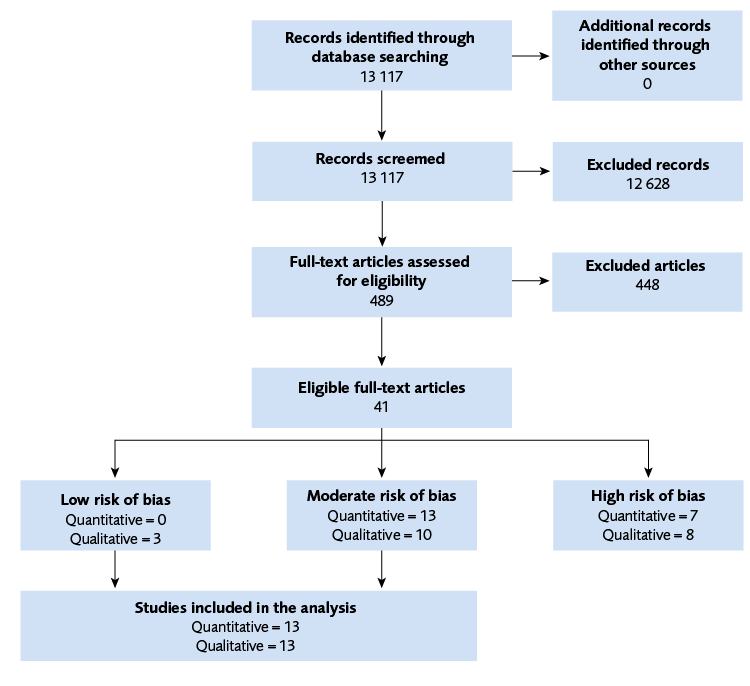
We included 26 studies concerning intervention effects and reported experiences (Flow chart).
Quantitative findings showed that interventions targeting organisational culture and staff practice were associated with moderate to large reductions in coercive measures, whereas child-focused behavioural interventions showed more limited or uncertain effects (Table 1 and 2).
Qualitative synthesis highlighted the importance of relational care, collaboration, staff reflexivity, and organisational support. Integration through joint display indicated that organisational and staff-focused interventions were most closely aligned with the qualitative themes.
| Abbreviations: CPS = Collaborative Problem Solving; TI-PRT = Trauma-Informed Psychiatric Residential Treatment; TARGET, Sanctuary model, DtG = Do-the-Good, Neurosequential Model of Therapeutics; NRSI = Non-Randomized Studies of Interventions; md = median; IQR = Interquartil Range | ||||
| Outcome (Interventions. Type of institution) |
Number of participants (Number of studies, Study design) |
Effect (95% KI) (Synthesis without meta-analysis) |
Grade | Interpretation |
|---|---|---|---|---|
| Seclusion (CPS, TI-PRT, TARGET, Sanctuary model, DtG. Psychiatric and residential care) |
1 777 (7, NRSI) |
Cohen’s d: md (IQR) = −0,55 (−0,96 to −0,51) | ⊕⊕◯◯ | Seclusion decreased |
| Restraint (CPS, NMT, TI-PRT, TARGET, Sanctuary model, DtG. Psychiatric and residential care) |
1 463 (7, NRSI) |
Cohen’s d: md (IQR) = −1,07 (−2,01 to −0,26) | ⊕⊕◯◯ | Restraint decreased |
| Abbreviations: DBT = Dialectical behavior therapy; BMP= Behavior Modification Program; M-PBIS = Modified Positive Behavioral Interventions and Supports; ASD-CP = Autism Spectrum Disorder Care Pathway; NRSI = Non-Randomized Studies of Interventions; md = median; IQR = Interquartil Range |
||||
| Outcome (Interventions. Type of institution) |
Number of participants (Number of studies, Study design) |
Effect (95% KI) Synthesis without meta-analysis) |
Grade | Interpretation |
|---|---|---|---|---|
| Seclusion (DBT, Sensory room. Psychiatric care) |
881 (2, NRSI) |
Cohen’s d: md (IQR) = −0,23 (−0,42 to 0,04) | ⊕⊕◯◯ | Seclusion decreased |
| Restraint or seclusion (BMP, M-PBIS. Psychiatric care) |
1 995 (2, NRSI) |
Cohen’s d: md (IQR) = −0,60 (−0,93 to −0,27) |
⊕⊕◯◯ | Restraint or seclusion decreased |
| Restraint (DBT, ASD-CP. Psychiatric care) |
891 (2, NRSI) |
Cohen’s d: md (IQR) = −0,57 (−0,65 to −0,48) |
⊕⊕◯◯ | Restraint decreased |
Ethics
The use of coercive measures in psychiatric and institutional care involves a conflict between, on one hand, the individual's right to privacy and autonomy, and on the other hand, society's responsibility to protect and care for those deemed unable to take care of themselves. Reduced use of coercive measures does not automatically mean better care. Instead it depends on the overall quality of care and on children having equal access to effective and non-coercive interventions.
Discussion
The interventions that are most successful in reducing the use of coercive measures (those focusing on organisational culture and staff practice) are also those that to a greater extent meet the expressed needs of children, young people, and staff. The working methods are based on a set of values that acknowledge the participation of children and young people, promote supportive relationships and a safe care environment, while also providing staff with tools and support to act consciously and preventively.
The content of the interventions can be described at both the individual level (treatment components, such as training the child to manage difficult emotions) and the structural level (organisational components, such as management support for change initiatives, including the reduced use of coercive measures).
Conflict of Interest
In accordance with SBU’s requirements, the experts and scientific reviewers participating in this project have submitted statements about conflicts of interest. These documents are available at SBU’s secretariat. SBU has determined that the conditions described in the submissions are compatible with SBU’s requirements for objectivity and impartiality.
The full report in Swedish
Project group
Experts
- Astrid Moell, MD, Department of Clinical Neuroscience, Karolinska Institute, Stockholm
- Sofia Enell PhD, Department of Social Work, Linnaeus University, Växjö
- Maria A. Vogel, PhD, Department of Criminology, Stockholm University
- Sebastian Gabrielsson, PhD, Department of Health, Education and Technology, Luleå University of Technology
- Antoinette Lundahl, MD, PhD, Department of Learning, Informatics, Management and Ethics, Karolinska institute
SBU
- Uliana Hellberg, project manager
- Elizabeth Åhsberg, assistant project manager
- Elin Malmer, project administrator
- Maria Hoppe, project administrator
- Hanna Olofsson, information specialist
- Johanna Wiss, health economist
- Jonas Bergström, head of department
- Johan Wallin, analyst
- Maral Jolstedt, analyst
Flow chart
.
Scientific article
Moell A, Åhsberg E, Enell S, Vogel MA, Gabrielsson S, Malmer E, et al. Interventions to prevent and reduce coercive measures in psychiatric and residential care for youth: a mixed-methods systematic review. The Lancet Psychiatry. Available from: https://doi.org/10.1016/S2215-0366(26)00056-8
References
- SBU. Förstudie avseende alternativa metoder till tvångsåtgärder inom Statens institutionsstyrelse, den psykiatriska tvångsvården och den rättspsykiatriska vården. Statens beredning för medicinsk och social utvärdering (SBU); 2023. Förstudie SBU 2023/33.
- SBU. Alternativa metoder och arbetssätt till tvångsåtgärder. 2023.
- SBU. Alternativa metoder och arbetssätt till tvångsåtgärder. Delredovisning 2 (2024). 2024.
- SBU. Norsk kartläggning om användningen av tvång och gränssättning på institution och inom familjehem. Statens beredning för medicinsk och social utvärdering (SBU); 2024. SBU Kommenterar: 2024/12. Available from: https://www.sbu.se/sv/publikationer/sbu-kommentar/norsk-kartlaggning-av-anvandningen-av-tvang-och-granssattning-pa-barnavardsinstitutioner-och-fosterhem/
- SBU. Implementeringsstrategier för traumainformerade insatser (TIC) inom psykiatrisk heldygns- och institutionsvård för barn och unga. 2025. 2025_3. Available from: https://www.sbu.se/2025_03
- FN. Kommittén för barnets rättigheter. Sammanfattande slutsatser och rekommendationer avseende Sveriges femte periodiska rapport. Förenta nationerna (FN); 2015. CRC/C/SWE/CO/5. Available from: https://www.regeringen.se/globalassets/regeringen/dokument/socialdepartementet/barnets-rattigheter/sammanfattande-slutsatser-och-rekommendationer-avseende-sveriges-femte-periodiska-rapport_svensk-oversattning.pdf
- FN. Kommittén för barnets rättigheter. Sammanfattande slutsatser och rekommendationer om Sveriges kombinerade sjätte och sjunde periodiska rapport. Förenta nationerna (FN); 2023. CRC/C/SWE/CO/6-7 Available from: https://www.regeringen.se/globalassets/regeringen/dokument/socialdepartementet/barnets-rattigheter/crc_c_swe_co_6-7_51663_svensk-version-final.pdf
- FN. Kommittén för rättigheter för personer med funktionsnedsättning. Sammanfattande slutsatser avseende Sveriges första rapport. Förenta nationerna (FN); 2014. CRPD/C/SWE/CO/1. [accessed Sep 22 2025]. Available from: https://www.regeringen.se/contentassets/c6e42825cbcc4985b771934a7b8248e4/crpd-kommittens-slutsatser-och-rekommendationer-2014-05-12-svensk-oversattning.pdf
- FN. Kommittén för rättigheter för personer med funktionsnedsättning. Sammanfattande kommentarer avseende Sveriges kombinerade andra och tredje periodiska rapport Förenta nationerna (FN); 2024. CRPD/C/SWE/CO/2-3. [accessed Sep 22 2025]. Available from: https://www.mfd.se/material/publikationer/fns-konvention-och-allmanna-kommentar/sammanfattande-kommentarer-avseende-sveriges-kombinerade-andra-och-tredje-periodiska-rapport/
- RO. Nationellt besöksorgan - NPM. Rapport från verksamheten 2023. Stockholm: Riksdagens ombudsmän - JO; 2024. Available from: https://www.jo.se/app/uploads/2024/06/rapport-opcat-2023-web.pdf
- 2019/Resolution 2291. Ending coercion in mental health: The need for a human rights-based approach: European Parliament [accessed May 14 2025].
- Birkeland S, Steinert T, Whittington R, Gildberg FA. Abolition of coercion in mental health services - A European survey of feasibility. Int J Law Psychiatry. 2024;94:101992. Available from: https://doi.org/10.1016/j.ijlp.2024.101992
- CPT. Means of restraint in psychiatric establishments for adults (revised CPT standards). Strasbourg: Council of Europe: European Committee for the Prevention of Torture and Inhuman or Degrading Treatment or Punishment (CPT); 2017. CPT/Inf(2017)6. Available from: https://rm.coe.int/16807001c3
- IVO. Tillsyn och uppföljning av psykiatrisk tvångsvård och rättspsykiatrisk vård.; 2025. 2025-09. [accessed Aug 26 2025]. Available from: https://www.ivo.se/globalassets/dokument/publikationer/rapporter/rapporter-2023/tillsyn-och-uppfoljning-av-psykiatrisk-tvangsvard-och-rattspsykiatrisk-vard.pdf
- Statskontoret. Myndighetsanalys av Statens institutionsstyrelse. Stockholm; 2020. 2020:7. Available from: https://www.statskontoret.se/siteassets/rapporter-pdf/2020/2020-7.pdf
- Statskontoret. SiS vård av barn och unga enligt LVU - förutsättningar för en trygg och ändamålsenlig vård. Stockholm; 2022. 2022:4. Available from: https://www.statskontoret.se/siteassets/rapporter-pdf/2022/2022_4---utskriftsversion.pdf
- RiR. SiS särskilda ungdomshem - brister i statens tvångsvård av barn och unga. Stockholm; 2024. 2024:7. Available from: https://www.riksrevisionen.se/granskningar/granskningsrapporter/2024/sis-sarskilda-ungdomshem---brister-i-statens-tvangsvard-av-barn-och-unga.html
- IMR. Låsta statliga ungdomshem – vår tids institutioner för barn och unga med funktionsnedsättning? Lund: Institutet för mänskliga rättigheter; 2025. [accessed Oct 1 2025]. Available from: https://mrinstitutet.se/vara--publikationer/rapporter/rapporter/lasta-statliga-ungdomshem
- IVO. Tillsyn av SiS 2024. Stockholm: Inspektionen för vård och omsorg; 2025. IVO 2025-08 Available from: https://www.ivo.se/globalassets/dokument/publikationer/rapporter/rapporter-2025/ivos-tillsyn-av-sis-2024.pdf
- Enell S, Gruber S, Vogel MA. Kontrollerade unga: Tvångspraktiker på institution: Studentlitteratur AB; 2018.
- SiS. SiS i korthet 2023. En samling statistiska uppgifter om SiS. Stockholm: Statens institutionsstyrelse; 2024. [accessed May 14 2025]. Available from: https://www.stat-inst.se/globalassets/arlig-statistik/sis-i-korthet-2024.pdf
- SiS. SiS årsredovisning 2024. Stockholm: Statens institutionsstyrelse; 2025. [accessed May 14 2025]. Available from: https://www.stat-inst.se/globalassets/arsredovisningar/sis-arsredovisning-2024.pdf
- SiS. SiS i korthet 2024. Stockholm: Statens Institutionsstyrelse (SiS); 2025. Dnr 1.1.4-2781-2025.
- SFS 1990:52. Lag med särskilda bestämmelser om vård av unga. Svensk författningssamling. Stockholm: Riksdagen. [updated SFS 2025:410; accessed Aug 8 2025]. Available from: https://www.riksdagen.se/sv/dokument-och-lagar/dokument/svensk-forfattningssamling/lag-199052-med-sarskilda-bestammelser-om-vard_sfs-1990-52/
- SFS 1998:603. Lag om verkställighet av sluten ungdomsvård. Svensk författningssamling. Stockholm: Riksdagen. [updated SFS 2024:1210; accessed Aug 8 2025]. Available from: https://www.riksdagen.se/sv/dokument-och-lagar/dokument/svensk-forfattningssamling/lag-1998603-om-verkstallighet-av-sluten_sfs-1998-603/
- SOU. En översyn av regleringen om frihetsberövande påföljder för unga. Stockholm: Statens offentliga utredningar; 2023. 2023:44. Available from: https://www.regeringen.se/rattsliga-dokument/statens-offentliga-utredningar/2023/08/sou-202344/
- Pettersson T, Andersson Vogel M. Tvångsomhändertaganden av unga–betydelse av kön, härkomst och socioekonomisk bakgrund förbedömningar i LVU-mål: Kriminologiska institutionen, Stockholms universitet; 2023.
- Socialstyrelsen. Heldygnsvård och tvångsvård. Stockholm: Socialstyrelsen; 2022 (2025). [accessed May 14 2025]. Available from: https://www.socialstyrelsen.se/kunskapsstod-och-regler/omraden/psykisk-ohalsa/heldygnsvard-och-tvangsvard/
- SKR. Psykiatrin i siffror. Kartläggning av barn- och ungdomspsykiatrin 2023. Sveriges Kommuner och Regioner; 2023. Available from: https://skr.se/download/18.3b71f76218f94625c628e4d8/1717160466936/Psykiatrin-i-siffror-BUP-2023.pdf
- Signorini G, Singh SP, Boricevic-Marsanic V, Dieleman G, Dodig-Ćurković K, Franic T, et al. Architecture and functioning of child and adolescent mental health services: a 28-country survey in Europe. The Lancet Psychiatry. 2017;4(9):715-24. Available from: https://doi.org/10.1016/S2215-0366(17)30127-X
- SFS 1991:1128. Lag om psykiatrisk tvångsvård. Svensk författningssamling. Stockholm: Riksdagen. [updated SFS 2025:413; accessed Aug 8 2025]. Available from: https://www.riksdagen.se/sv/dokument-och-lagar/dokument/svensk-forfattningssamling/lag-19911128-om-psykiatrisk-tvangsvard_sfs-1991-1128/
- SKR. Psykiatrin i siffror. Kartläggning av vuxenpsykiatrin 2024. Sveriges Kommuner och Regioner; 2025. Available from: https://skr.se/download/18.15d8b5a6196f6d89a2f3daf3/1748265956909/Psykiatrin_i_siffror_VUP_2024_tillganglighetsanpassad.pdf
- SKR. Psykiatrin i siffror. Kartläggning av vuxenpsykiatrin 2023. Sveriges Kommuner och Regioner; 2024. Available from: https://skr.se/download/18.2033a28318f94710b49bc490/1717402787829/Psykiatrin-i-siffror-vuxenpsykiatrin-2023.pdf
- SFS 1991:1129. Lag om rättspsykiatrisk vård. Svensk författningssamling. Stockholm: Riksdagen. [updated SFS 2022:704; accessed Aug 8 2025]. Available from: https://www.riksdagen.se/sv/dokument-och-lagar/dokument/svensk-forfattningssamling/lag-19911129-om-rattspsykiatrisk-vard_sfs-1991-1129/
- Statistikdatabas för psykiatrisk tvångsvård. Stockholm: Socialstyrelsen; 2025. Statistikdatabas för psykiatrisk tvångsvård. [accessed Jun 19 2025]. Available from: https://sdb.socialstyrelsen.se/if_tvangsvard/val.aspx
- Sivak L, Forsman J, Masterman T. Duration of forensic psychiatric care and subsequent criminal recidivism in individuals sentenced in Sweden between 2009 and 2019. Frontiers in Psychiatry. 2023;Volume 14 - 2023. Available from: https://doi.org/10.3389/fpsyt.2023.1129993
- Barnrättsbyrån. Avskiljningar, våld och missförhållanden inom SiS ungdomsvård 2024. Stockholm: Barnrättsbyrån; 2025. Available from: https://barnrattsbyran.se/app/uploads/2025/05/Uppfoljning_SISrapport_2024_FINALDigital.pdf
- Ward-Stockham K, Kapp S, Jarden R., Gerdtz M, Daniel C. Effect of Safewards on reducing conflict and containment and the experiences of staff and consumers: A mixed-methods systematic review. international Journal of Mental Health Nursing. 2022;31(1):199-221.
- Stensgaard L, Andersen MK, Nordentoft M, Hjorthoj C. Implementation of the safewards model to reduce the use of coercive measures in adult psychiatric inpatient units: An interrupted time-series analysis. Journal of psychiatric research. 2018;105:147-52. Available from: https://doi.org/10.1016/j.jpsychires.2018.08.026
- Socialstyrelsen. Psykiatrisk tvångsvård och rättspsykiatrisk vård: Kartläggning och utvecklingsförslag. Stockholm: Socialstyrelsen; 2023. 2023-8-868.
- Socialstyrelsen. Stärka och utveckla den psykiatriska tvångsvården och rättspsykiatriska vården. Delredovisning av regeringsuppdrag. Stockholm: Socialstyrelsen; 2024.
- Enell S, Maria AV, Eske HA-K, Tarja P, Päivi H, Bård M-O, et al. Confinement and restrictive measures against young people in the Nordic countries – a comparative analysis of Denmark, Finland, Norway, and Sweden. Nordic Journal of Criminology. 2022;23(2):174-91. Available from: https://doi.org/10.1080/2578983X.2022.2054536
- Mattsson T, Enell S. State Provision of Resilience in Social Compulsory Care: A Vulnerability Analysis of Physical Constraint of Children and Youth Without Consent. Int J Semiot Law. 2023:1-17. Available from: https://doi.org/10.1007/s11196-023-09987-w
- SOU 2015:71. Barns och ungas rätt till tvångsvård. Förslag till ny LVU. Statens offentliga utredningar. Stockholm: Fritzes. [accessed May 14 2025]. Available from: https://www.regeringen.se/rattsliga-dokument/statens-offentliga-utredningar/2015/06/sou-201571/
- SOU. För barnets bästa? Utredningen om tvångsåtgärder mot barn i psykiatrisk tvångsvård. Stockholm: Statens offentliga utredningar; 2017. 2017:111. Available from: https://www.regeringen.se/contentassets/c67ed758215e444b8cd4ef42a1d73997/sou-2017_111_for-barnets-basta.pdf
- Souverein F, Hales H, Anderson P, Argent SE, Bartlett A, Blower A, et al. Mental health, welfare or justice: An introductory global overview of differences between countries in the scale and approach to secure placements of children and young people. Crim Behav Ment Health. 2022;32(3):238-47. Available from: https://doi.org/10.1002/cbm.2234
- De Hert M, Dirix N, Demunter H, Correll CU. Prevalence and correlates of seclusion and restraint use in children and adolescents: a systematic review. European Child & Adolescent Psychiatry. 2011;20(5):221-30. Available from: https://doi.org/10.1007/s00787-011-0160-x
- Moell A, Lyle MS, Rozental A, Långström N. Rates and risk factors of coercive measure use in inpatient child and adolescent mental health services: a systematic review and narrative synthesis. The Lancet Psychiatry. 2024;11(10):839-52. Available from: https://doi.org/https://doi.org/10.1016/S2215-0366(24)00204-9
- WHO. Strategies to end seclusion and restraint. WHO QualityRights Specialized training. Luxembourg: World Health Organization; 2019. [accessed May 14 2025]. Available from: https://www.who.int/publications/i/item/9789241516754
- Henriksen A-K, Øye C. The ambiguities of coercion: Mapping adolescents' experiences of coercion in institutional everyday life. Children & Society. 2023;37(5):1376-91. Available from: https://doi.org/10.1111/chso.12699
- Bengtsson TT. Boredom and Action—Experiences from Youth Confinement. Journal of Contemporary Ethnography. 2012;41(5):526-53. Available from: https://doi.org/10.1177/0891241612449356
- Pollastri AR, Lieberman RE, Boldt SL, Ablon JS. Minimizing seclusion and restraint in youth residential and day treatment through site-wide implementation of Collaborative Problem Solving. Residential Treatment for Children & Youth. 2016;33(3-4):186-205. Available from: https://doi.org/10.1080/0886571X.2016.1188340
- Fraser SL, Archambault I, Parent V. Staff Intervention and Youth Behaviors in a Child Welfare Residence. Journal of Child and Family Studies. 2016;25(4):1188-99. Available from: https://doi.org/10.1007/s10826-015-0312-6
- Collin-Vézina D, Carnevale FA. Questioning the Value of Compliance-Oriented Programs With Traumatized Children and Youth: A Childhood Ethics Perspective. JAMA Pediatr. 2022;176(10):961-2. Available from: https://doi.org/10.1001/jamapediatrics.2022.2648
- Cox A. Doing the programme or doing me? The pains of youth imprisonment. Punishment & Society. 2011;13:592-610. Available from: https://doi.org/10.1177/1462474511422173
- Schliehe AK. Inside ‘the Carceral’: Girls and Young Women in the Scottish Criminal Justice System. Scottish Geographical Journal. 2014;130(2):71-85. Available from: https://doi.org/10.1080/14702541.2013.838639
- Enell S, Allgurin M. Villkorad normalitet: Berättelser om det (o) normala under och efter placering på särskilt ungdomshem. Socialvetenskaplig tidskrift. 2023;30(3):701-18.
- Nolbeck K, Wijk H, Lindahl G, Olausson S. "If you don't behave, you're in real shit, you don't get outside the doors"-a phenomenological hermeneutic study of adolescents' lived experiences of the socio-spatial environment of involuntary institutional care. International journal of qualitative studies on health and well-being. 2020;15(1):1726559. Available from: https://doi.org/10.1080/17482631.2020.1726559
- Steckley L, Kendrick A. Physical restraint in residential childcare: The experiences of young people and residential workers. Childhood: A Global Journal of Child Research. 2008;15(4):552-69. Available from: https://doi.org/10.1177/0907568208097207
- Steckley L. Catharsis, containment and physical restraint in residential child care. British Journal of Social Work. 2018;48(6):1645-63. Available from: https://doi.org/10.1093/bjsw/bcx131
- Engström I, Engström K, Sellin T. Adolescents' experiences of the staff's different interaction styles in coercive youth care in Sweden: A qualitative study. Issues in Mental Health Nursing. 2020;41(11):1027-37. Available from: https://doi.org/10.1080/01612840.2020.1757794
- Harder AT, Knorth EJ, Kalverboer ME. A secure base? The adolescent–staff relationship in secure residential youth care. Child & Family Social Work. 2013;18(3):305-17. Available from: https://doi.org/https://doi.org/10.1111/j.1365-2206.2012.00846.x
- Henriksen A, Degner J, Oscarsson L. Youths in coercive residential care: attitudes towards key staff members' personal involvement, from a therapeutic alliance perspective. European Journal of Social Work. 2008;11(2):145-59. Available from: https://doi.org/10.1080/13691450701531976
- de Valk S, Kuiper C, van der Helm GHP, Maas AJJA, Stams GJJM. Repression in residential youth care: A qualitative study examining the experiences of adolescents in open, secure and forensic institutions. Journal of Adolescent Research. 2019;34(6):757-82. Available from: https://doi.org/10.1177/0743558417719188
- Steckley L. Containment and holding environments: Understanding and reducing physical restraint in residential child care. Children and Youth Services Review. 2010;32(1):120-8. Available from: https://doi.org/10.1016/j.childyouth.2009.08.007
- Moell A, Rozental A, Buchmayer S, Kaltiala R, Långström N. Perceived determinants of the use of coercion in inpatient child and adolescent psychiatry: a qualitative interview study with staff. BMC Psychiatry. 2025;25(1):246. Available from: https://doi.org/10.1186/s12888-025-06690-x
- Eder N, Nordenberg K, Långström N, Rozental A, Moell A. Moral distress among inpatient child and adolescent psychiatry staff: a mixed-methods study of experiences and associated factors. Child and Adolescent Psychiatry and Mental Health. 2025;19(1):16. Available from: https://doi.org/10.1186/s13034-025-00868-7
- Kodua M, Mackenzie JM, Smyth N. Nursing assistants' experiences of administering manual restraint for compulsory nasogastric feeding of young persons with anorexia nervosa. Int J Ment Health Nurs. 2020;29(6):1181-91. Available from: https://doi.org/10.1111/inm.12758
- Yurtbasi MK, Melvin G, Pavlou C, Gordon M. Staff perspectives on the effects of seclusion in adolescent psychiatric inpatient care. International journal of mental health nursing. 2023;32(2):567-78. Available from: https://doi.org/10.1111/inm.13102
- Wästerfors D. Vanskligt och kort: Om våldshändelser bland unga på institution: Studentlitteratur AB; 2019.
- Andersson P. Hot, våld och emotionellt arbete på de särskilda ungdomshemmen: Personalens berättelser: Institutionen för socialt arbete, Stockholms universitet; 2021.
- Borissov N, Haas Q, Minder B, Kopp-Heim D, von Gernler M, Janka H, et al. Reducing systematic review burden using Deduklick: a novel, automated, reliable, and explainable deduplication algorithm to foster medical research. Systematic Reviews. 2022;11(1):172. Available from: https://doi.org/https://doi.org/10.1186/s13643-022-02045-9
- Kanalregisteret. Norwegian Register for Scientific Journals, Series and Publishers. Bergen: The Norwegian Directorate for Higher Education and Skills. [updated Apr 23 2025]. Mar 6 2024:[Available from: https://kanalregister.hkdir.no/en/informasjonsartikler/search-in-the-register
- Ouzzani M, Hammady H, Fedorowicz Z, Elmagarmid A. Rayyan-a web and mobile app for systematic reviews. 2016. Available from: https://www.ncbi.nlm.nih.gov/pubmed/27919275
- Covidence. Covidence systematic review software. Melbourne, Australia: Veritas Health Innovation. Available from: www.covidence.org
- Sterne JA, Hernán MA, Reeves BC, Savović J, Berkman ND, Viswanathan M, et al. ROBINS-I: a tool for assessing risk of bias in non-randomised studies of interventions. Bmj. 2016;355:i4919. Available from: https://doi.org/10.1136/bmj.i4919
- SBU. Bedömning av studier med kvalitativ metodik. Stockholm: Statens beredning för medicinsk och social utvärdering; 2022. Available from: https://www.sbu.se/globalassets/ebm/bedomning_studier_kvalitativ_metodik.pdf
- Campbell M, McKenzie JE, Sowden A, Katikireddi SV, Brennan SE, Ellis S, et al. Synthesis without meta-analysis (SWiM) in systematic reviews: reporting guideline. Bmj. 2020;368:l6890. Available from: https://doi.org/10.1136/bmj.l6890
- Wilson DB. Practical Meta Analysis Effect Size Calculator. United States: Campbell Collaboration; 2023. Available from: https://www.campbellcollaboration.org/calculator/d-means-sds
- McKenzie J, Brennan S. Chapter 12: Synthesizing and presenting findings using other methods [last updated October 2019]. In: Higgins J, Thomas J, Chandler J, Cumpston M, Li T, Page M, et al., editors. Cochrane Handbook for Systematic Reviews of Interventions version 65: Cochrane; 2024. Available from: https://training.cochrane.org/handbook/current/chapter-12
- Cohen J. Statistical power analysis for the behavioral sciences. New York: Routledge; 2013.
- Thomas J, Harden A. Methods for the thematic synthesis of qualitative research in systematic reviews. BMC Med Res Methodol. 2008;8(1):45. Available from: https://doi.org/https://doi.org/10.1186/1471-2288-8-45
- SBU. Utvärdering av insatser i hälso- och sjukvården och socialtjänsten: En metodbok. Stockholm: Statens beredning för medicinsk och social utvärdering (SBU). 2023. Available from: https://www.sbu.se/metodbok
- Schünemann HB, J., Guyatt G, Oxman A, editors. GRADE handbook for grading quality of evidence and strength of recommendations; 2013. [accessed Feb 29 2024]. Available from: https://gdt.gradepro.org/app/handbook/handbook.html
- Guyatt GH, Oxman AD, Vist GE, Kunz R, Falck-Ytter Y, Alonso-Coello P, et al. GRADE: an emerging consensus on rating quality of evidence and strength of recommendations. BMJ. 2008;336(7650):924. Available from: https://doi.org/10.1136/bmj.39489.470347.AD
- Group G-CP. GRADE CERQual. 2018. [accessed Jun 6 2025]. Available from: https://www.cerqual.org/
- Lewin S, Booth A, Glenton C, Munthe-Kaas H, Rashidian A, Wainwright M, et al. Applying GRADE-CERQual to qualitative evidence synthesis findings: introduction to the series. Implementation Science. 2018;13(1):2. Available from: https://doi.org/10.1186/s13012-017-0688-3
- Lewin S, Bohren M, Rashidian A, Munthe-Kaas H, Glenton C, Colvin CJ, et al. Applying GRADE-CERQual to qualitative evidence synthesis findings—paper 2: how to make an overall CERQual assessment of confidence and create a Summary of Qualitative Findings table. Implementation Science. 2018;13(1):10. Available from: https://doi.org/10.1186/s13012-017-0689-2
- Schunemann H, Cuello C, Akl E, Mustafa R, Meerpohl J, Thayer K, et al. GRADE guidelines: 18. How ROBINS-I and other tools to assess risk of bias in nonrandomized studies should be used to rate the certainty of a body of evidence. Journal of Clinical Epidemiology. 2019;111:105 - 14. Available from: https://doi.org/https://doi.org/10.1016/j.jclinepi.2018.01.012
- Munthe-Kaas H, Nøkleby H, Lewin S, Glenton C. The TRANSFER Approach for assessing the transferability of systematic review findings. BMC Medical Research Methodology. 2020;20(1):11. Available from: https://doi.org/10.1186/s12874-019-0834-5
- SBU. Utvärdering av metoder i hälso- och sjukvården och insatser i socialtjänsten: En metodbok. Stockholm: Statens beredning för medicinsk och social utvärdering (SBU); 2023. Available from: https://www.sbu.se/metodbok
- Gautam V, Gautam J. Qualitative research approaches in social sciences. In: Recent Applied Research in Humanities and Social Science MKSES Publication; 2023.
- Bragge P, Grimshaw JM, Lokker C, Colquhoun H. AIMD - a validated, simplified framework of interventions to promote and integrate evidence into health practices, systems, and policies. BMC Med Res Methodol. 2017;17(1):38. Available from: https://doi.org/10.1186/s12874-017-0314-8
- Sutcliffe K, Thomas J, Stokes G, Hinds K, Bangpan M. Intervention Component Analysis (ICA): a pragmatic approach for identifying the critical features of complex interventions. Syst Rev. 2015;4:140. Available from: https://doi.org/10.1186/s13643-015-0126-z
- Candy B, King M, Jones L, Oliver S. Using qualitative synthesis to explore heterogeneity of complex interventions. BMC Med Res Methodol. 2011;11:124. Available from: https://doi.org/10.1186/1471-2288-11-124
- SBU. Mall för kvalitets- granskning av empiriska hälsoekonomiska studier. Stockholm: Statens beredning för medicinsk och social utvärdering; 2017. Available from: https://www.sbu.se/globalassets/ebm/mall_empirisk_halsoekonomi.pdf
- SBU. Etiska aspekter på insatser inom det sociala området: En vägledning för att identifiera relevanta etiska frågor. Statens beredning för medicinsk och social utvärdering; 2019. Available from: https://www.sbu.se/globalassets/ebm/etiska_aspekter_sociala_omradet.pdf
- SBU. Etiska aspekter på insatser inom hälso- och sjukvården: En vägledning för att identifiera relevanta etiska aspekter. Stockholm: Statens beredning för medicinsk och social utvärdering; 2013. [updated 2021; accessed May 13 2025]. Available from: https://www.sbu.se/globalassets/ebm/etiska_aspekter_halso_sjukvarden.pdf
- SKR. Innovationsguiden. Sveriges Kommuner och Regioner 2022. [accessed Jun 6 2025]. Available from: https://innovationsguiden.se/innovationsguiden.60637.html
- Ercole-Fricke E, Fritz P, Hill LE, Snelders J. Effects of a Collaborative Problem-Solving Approach on an Inpatient Adolescent Psychiatric Unit. Journal of child and adolescent psychiatric nursing : official publication of the Association of Child and Adolescent Psychiatric Nurses, Inc. 2016;29(3):127-34. Available from: https://doi.org/10.1111/jcap.12149
- Martin A, Krieg H, Esposito F, Stubbe D, Cardona L. Reduction of restraint and seclusion through collaborative problem solving: a five-year prospective inpatient study. Psychiatric services (Washington, DC). 2008;59(12):1406-12. Available from: https://doi.org/10.1176/appi.ps.59.12.1406
- Boel-Studt SM. A quasi-experimental study of trauma-informed psychiatric residential treatment for children and adolescents. Research on Social Work Practice. 2017;27(3):273-82. Available from: https://doi.org/10.1177/1049731515614401
- Elwyn LJ, Esaki N, Smith CA. Safety at a girls secure juvenile justice facility. Therapeutic Communities. 2015;36(4):209-18. Available from: https://doi.org/10.1108/TC-11-2014-0038
- Marrow MT, Knudsen KJ, Olafson E, Bucher SE. The Value of Implementing TARGET within a Trauma-Informed Juvenile Justice Setting. Journal of Child & Adolescent Trauma. 2012;5(3):257-70. Available from: https://doi.org/10.1080/19361521.2012.697105
- Ford JD, Hawke J. Trauma Affect Regulation Psychoeducation Group and Milieu Intervention Outcomes in Juvenile Detention Facilities. Journal of Aggression, Maltreatment & Trauma. 2012;21(4):365-84. Available from: https://doi.org/10.1080/10926771.2012.673538
- Bakken A-KN, Johannessen KN, Hambrick EP, Solbakken OA. Reduction in Restraint and Critical Incidents in a Norwegian Residential Treatment Facility for Children Aged 7–13 Following the Implementation of the Neurosequential Model of Therapeutics. Youth (2673-995X). 2024;4(4):1582-90. Available from: https://doi.org/10.3390/youth4040101
- D'Andrea W, Bergholz L, Fortunato A, Spinazzola J. Play to the whistle: A pilot investigation of a sports-based intervention for traumatized girls in residential treatment. Journal of Family Violence. 2013;28(7):739-49. Available from: https://doi.org/10.1007/s10896-013-9533-x
- Tebbett-Mock AA, McGee M, Saito E. Efficacy and sustainability of dialectical behaviour therapy for inpatient adolescents: a follow-up study. General psychiatry. 2021;34(4):e100452. Available from: https://doi.org/10.1136/gpsych-2020-100452
- Tebbett-Mock AA, Saito E, McGee M, Woloszyn P, Venuti M. Efficacy of Dialectical Behavior Therapy Versus Treatment as Usual for Acute-Care Inpatient Adolescents. Journal of the American Academy of Child and Adolescent Psychiatry. 2020;59(1):149-56. Available from: https://doi.org/10.1016/j.jaac.2019.01.020
- Cervantes P, Kuriakose S, Donnelly L, Filton B, Marr M, Okparaeke E, et al. Sustainability of a Care Pathway for Children and Adolescents with Autism Spectrum Disorder on an Inpatient Psychiatric Service. Journal of autism and developmental disorders. 2019;49(8):3173-80. Available from: https://doi.org/10.1007/s10803-019-04029-6
- Kuriakose S, Filton B, Marr M, Okparaeke E, Cervantes P, Siegel M, et al. Does an Autism Spectrum Disorder Care Pathway Improve Care for Children and Adolescents with ASD in Inpatient Psychiatric Units? Journal of autism and developmental disorders. 2018;48(12):4082-9. Available from: https://doi.org/10.1007/s10803-018-3666-y
- West M, Melvin G, McNamara F, Gordon M. An evaluation of the use and efficacy of a sensory room within an adolescent psychiatric inpatient unit. Australian occupational therapy journal. 2017;64(3):253-63. Available from: https://doi.org/10.1111/1440-1630.12358
- Carlson GA, Chua J, Pan K, Hasan T, Bied A, Martin A, et al. Behavior Modification Is Associated With Reduced Psychotropic Medication Use in Children With Aggression in Inpatient Treatment: A Retrospective Cohort Study. Journal of the American Academy of Child and Adolescent Psychiatry. 2020;59(5):632-41.e4. Available from: https://doi.org/10.1016/j.jaac.2019.07.940
- Reynolds EK, Grados MA, Praglowski N, Hankinson JC, Deboard-Lucas R, Goldstein L, et al. Use of Modified Positive Behavioral Interventions and Supports in a Psychiatric Inpatient Unit for High-Risk Youths. Psychiatric services (Washington, DC). 2016;67(5):570-3. Available from: https://doi.org/10.1176/appi.ps.201500039
- Lee-Aube A, Vakili A, Padhi A, Joseph S, Norcott J, Yap K. Reducing seclusion and restraint in an acute adolescent psychiatric ward: A feasibility study. Journal of psychiatric and mental health nursing. 2023. Available from: https://doi.org/10.1111/jpm.13000
- Bjønness S, Grønnestad T, Storm M. I'm not a diagnosis: Adolescents' perspectives on user participation and shared decision-making in mental healthcare. Scand J Child Adolesc Psychiatr Psychol. 2020;8:139-48. Available from: https://doi.org/10.21307/sjcapp-2020-014
- Montreuil M, Thibeault C, McHarg L, Carnevale FA. Children's moral experiences of crisis management in a child mental health setting. International Journal of Mental Health Nursing. 2018;27(5):1440-8. Available from: https://doi.org/10.1111/inm.12444
- Slaatto A, Baugerud GA, Mellblom AV. ‘I never win': How children and staff in residential facilities experience meaningful participation. Child & Family Social Work. 2023:1. Available from: https://doi.org/10.1111/cfs.13090
- McKenna NC, Anderson VR. Paradox and Punishment: Implementing Trauma-Informed Care in Juvenile Detention Facilities. Fem Crim. 2025. Available from: https://doi.org/10.1177/15570851251313786
- Slaatto A, Mellblom AV, Kleppe LC, Baugerud GA. Safety in residential youth facilities: Staff perceptions of safety and experiences of the 'basic training program in safety and security'. Residential Treatment for Children & Youth. 2022;39(2):212-37. Available from: https://doi.org/10.1080/0886571X.2021.1978035
- Yates NJ, Lathlean J. Exploring factors that influence success when introducing "The Safewards Model" to an acute adolescent ward: A qualitative study of staff perceptions. Journal of child and adolescent psychiatric nursing : official publication of the Association of Child and Adolescent Psychiatric Nurses, Inc. 2022;35(3):218-29. Available from: https://doi.org/10.1111/jcap.12365
- Simpson A, Ali RA, Chadwick M, Foye U, Brennan G. Implementing Safewards on Children and Young People's Wards: A Process and Outcomes Evaluation. Issues in mental health nursing. 2024;45(6):563-79. Available from: https://doi.org/10.1080/01612840.2024.2347507
- Steinkopf H, Nordanger D, Stige B, Milde AM. Experiences of becoming emotionally dysregulated: A qualitative study of staff in youth residential care. Child & Youth Services. 2022;43(2):187-205. Available from: https://doi.org/10.1080/0145935X.2021.1918541
- Hidalgo J, Maravić MC, Milet RC, Beck JC. Promoting collaborative relationships in residential care of vulnerable and traumatized youth: A playfulness approach integrated with trauma systems therapy. Journal of Child & Adolescent Trauma. 2016;9(1):17-28. Available from: https://doi.org/10.1007/s40653-015-0076-6
- Elwyn LJ, Esaki N, Smith CA. Importance of Leadership and Employee Engagement in Trauma-Informed Organizational Change at a Girls' Juvenile Justice Facility. Hum Serv Organ Manag leadersh gov. 2017;41(2):106-18. Available from: https://doi.org/10.1080/23303131.2016.1200506
- Vamvakos C, Berger E. Residential care worker perceptions on the implementation of trauma-informed practice. Children and Youth Services Review. 2024;159:1-11. Available from: https://doi.org/10.1016/j.childyouth.2024.107513
- Brubaker SJ, Cleary HMD. Connection and caring through a therapeutic juvenile corrections model: Staff and youth resident perceptions of structural and interpersonal dimensions. International Journal of Offender Therapy and Comparative Criminology. 2023;67(4):373-97. Available from: https://doi.org/10.1177/0306624X211065586
- Larson TC, Sheitman BB, Kraus JE, Mayo J, Leidy L. Managing treatment resistant violent adolescents: A step forward by substituting seclusion for mechanical restraint? Administration and Policy in Mental Health and Mental Health Services Research. 2008;35(3):198-203. Available from: https://doi.org/10.1007/s10488-007-0156-5
- Smith GM, Altenor A, Altenor RJ, Davis RH, Steinmetz W, Adair DK, et al. Effects of Ending the Use of Seclusion and Mechanical Restraint in the Pennsylvania State Hospital System, 2011-2020. Psychiatric services (Washington, DC). 2023;74(2):173-81. Available from: https://doi.org/10.1176/appi.ps.202200004
- Smith GM, Ashbridge DM, Davis RH, Steinmetz W. Correlation between reduction of seclusion and restraint and assaults by patients in Pennsylvania's state hospitals. Psychiatric services (Washington, DC). 2015;66(3):303-9. Available from: https://doi.org/10.1176/appi.ps.201400185
- Staggs VS. Trends in Use of Seclusion and Restraint in Response to Injurious Assault in Psychiatric Units in U.S. Hospitals, 2007-2013. Psychiatric services (Washington, DC). 2015;66(12):1369-72. Available from: https://doi.org/10.1176/appi.ps.201400490
- Siponen U, Välimäki, M, Kaltiala-Heino, R. The use of coercive measures in adolescent psychiatric inpatient treatment: a nation-wide register study. Soc Psychiatry Psychiatr Epidemiol. 2012;Sep;47(9):1401-8. Available from: https://doi.org/doi: 10.1007/s00127-011-0456-7.
- Välimäki M, Yang M, Vahlberg T, Lantta T, Pekurinen V, Anttila M, et al. Trends in the use of coercive measures in Finnish psychiatric hospitals: a register analysis of the past two decades. BMC Psychiatry. 2019;19(230).
- Højlund M, Hogh L, Bojesen AB, Munk-Jorgensen P, Stenager E. Use of antipsychotics and benzodiazepines in connection to minimising coercion and mechanical restraint in a general psychiatric ward. The International journal of social psychiatry. 2018;64(3):258-65. Available from: https://doi.org/10.1177/0020764018760650
- Flammer E, Hirsch S, Steinert T. Effect of the introduction of immediate judge's decisions in 2018 on the use of coercive measures in psychiatric hospitals in Germany: a population-based study. The Lancet Regional Health - Europe. 2021;11:100233. Available from: https://doi.org/https://doi.org/10.1016/j.lanepe.2021.100233
- Verlinde AA, Noorthoorn EO, Snelleman W, van den Berg H, Snelleman-van der Plas M, Lepping P. Seclusion and enforced medication in dealing with aggression: A prospective dynamic cohort study. European psychiatry : the journal of the Association of European Psychiatrists. 2017;39:86-92. Available from: https://doi.org/10.1016/j.eurpsy.2016.08.002
- Hochstrasser L, Frohlich D, Schneeberger AR, Borgwardt S, Lang UE, Stieglitz RD, et al. Long-term reduction of seclusion and forced medication on a hospital-wide level: Implementation of an open-door policy over 6 years. European psychiatry : the journal of the Association of European Psychiatrists. 2018;48:51-7. Available from: https://doi.org/10.1016/j.eurpsy.2017.09.008
- Bath H. The three pillars of traumawise care: Healing in the other 23hours. Reclaiming Children and Youth. 2015;23(1):5-11. Available from: https://doi.org/https://www.traumebevisst.no/kompetanseutvikling/filer/23_4_Bath3pillars.pdf
- SAMHSA. SAMHSA’s Concept of Trauma and Guidance for a Trauma-Informed Approach. Rockville, MD: Substance Abuse and Mental Health Services Administration; 2014. SMA (14-4884). Available from: https://library.samhsa.gov/sites/default/files/sma14-4884.pdf
- Charles C, Gafni A, Whelan T. Shared decision-making in the medical encounter: what does it mean? (or it takes at least two to tango). Soc Sci Med. 1997;44(5):681-92. Available from: https://doi.org/10.1016/s0277-9536(96)00221-3
- Stokes Y, Lewis KB, Tricco AC, Hambrick E, Jacob JD, Demery Varin M, et al. Trauma-Informed Care Interventions Used in Pediatric Inpatient or Residential Treatment Mental Health Settings and Strategies to Implement Them: A Scoping Review. Trauma, Violence, & Abuse. 2024;25(3):1737-55. Available from: https://doi.org/10.1177/15248380231193444
- Reynolds EK, Grados MA, Praglowski N, Hankinson JC, Parrish C, Ostrander R. Implementation of Modified Positive Behavioral Interventions and Supports in a youth psychiatric partial hospital program. Journal of Patient Safety & Risk Management. 2019;24(2):64-70. Available from: https://doi.org/10.1177/2516043518811758
- Funnell S, Rogers P. Purposeful Program Theory: Effective Use of Theories of Change and Logic Models; 2011.
- Beauchamp T, Childress J. Principles of Biomedical Ethics. 8th ed. Oxford: Oxford University Press; 2019.
- Dir 2004:51. Skyddet för den personliga integriteten. Kommittédirektiv. Stockholm: Regeringskansliet. [accessed Aug 25 2025]. Available from: https://www.riksdagen.se/sv/dokument-och-lagar/dokument/kommittedirektiv/skyddet-for-den-personliga-integriteten_gsb151/
- Munthe C. Precautionary Principle. In: International Encyclopedia of Ethics. p. 1-10.
- IVO. Iakttagelser i korthet: Brister i psykiatrisk tvångsvård av barn. Stockholm: Inspektionen för vård och omsorg; 2023. [accessed Aug 25 2025]. Available from: https://www.ivo.se/globalassets/dokument/publikationer/iakttagelser-i-korthet/2023/ivo-brister-i-psykiatrisk-tvangsvard-av-barn.pdf
- Looi G-ME, Engström Å, Sävenstedt S. A Self-Destructive Care: Self-Reports of People Who Experienced Coercive Measures and their Suggestions for Alternatives. Issues in Mental Health Nursing. 2015;36(2):96-103. Available from: https://doi.org/10.3109/01612840.2014.951134
- NSPH. Patienters och anhörigas erfarenheter av psykiatrins tvångsvård och tvångsåtgärder. Stockholm: Nationell Samverkan för Psykisk Hälsa; 2022. [accessed Aug 25 2025]. Available from: https://nsph.se/butik/rapport/patienters-och-anhorigas-erfarenheter-av-psykiatrins-tvangsvard-och-tvangsatgarder/
- Kersting XAK, Hirsch S, Steinert T. Physical Harm and Death in the Context of Coercive Measures in Psychiatric Patients: A Systematic Review. Front Psychiatry. 2019;10:400. Available from: https://doi.org/10.3389/fpsyt.2019.00400
- Hennessy B, Hunter A, Grealish A. A qualitative synthesis of patients' experiences of re-traumatization in acute mental health inpatient settings. J Psychiatr Ment Health Nurs. 2023;30(3):398-434. Available from: https://doi.org/10.1111/jpm.12889
- Frueh BC, Knapp RG, Cusack KJ, Grubaugh AL, Sauvageot JA, Cousins VC, et al. Special Section on Seclusion and Restraint: Patients' Reports of Traumatic or Harmful Experiences Within the Psychiatric Setting. Psychiatric Services. 2005;56(9):1123-33. Available from: https://doi.org/10.1176/appi.ps.56.9.1123
- Hallett N, Dickinson R, Eneje E, Dickens GL. Adverse mental health inpatient experiences: Qualitative systematic review of international literature. International Journal of Nursing Studies. 2025;161:104923. Available from: https://doi.org/https://doi.org/10.1016/j.ijnurstu.2024.104923
- Scholes A, Price O, Berry K. Women's experiences of restrictive interventions within inpatient mental health services: A qualitative investigation. International journal of mental health nursing. 2022;31(2):379-89. Available from: https://doi.org/10.1111/inm.12966
- Jordan JT, McNiel DE. Perceived Coercion During Admission Into Psychiatric Hospitalization Increases Risk of Suicide Attempts After Discharge. Suicide Life Threat Behav. 2020;50(1):180-8. Available from: https://doi.org/10.1111/sltb.12560
- NSPH. Tvångsvård och självvald inläggning. Stockholm: Nationell Samverkan för Psykisk Hälsa; 2023. [accessed Oct 1 2025]. Available from: https://nsph.se/butik/rapport/tvangsvard-och-sjalvvald-inlaggning-en-rapport-om-patienters-och-anhorigas-upplevelser/
- Allgurin M, Enell S. Battling parenting: The consequences of secure care interventions on parents. Child & Family Social Work. 2023;28(1):108-16. Available from: https://doi.org/https://doi.org/10.1111/cfs.12945
- Grisso T, Appelbaum PS. The MacArthur Treatment Competence Study. III. Law and Human Behavior. 1995;19(2):149-74. Available from: https://doi.org/10.1007/BF01499323
- SFS 1949:381. Föräldrabalk. Svensk författningssamling. Stockholm: Riksdagen. [accessed Aug 25 2025]. Available from: https://www.riksdagen.se/sv/dokument-och-lagar/dokument/svensk-forfattningssamling/foraldrabalk-1949381_sfs-1949-381/
- SFS 2014:821. Patientlag. Svensk författningssamling. Stockholm: Riksdagen. [updated SFS 2023:42; accessed Aug 25 2025]. Available from: https://www.riksdagen.se/sv/dokument-och-lagar/dokument/svensk-forfattningssamling/patientlag-2014821_sfs-2014-821lag/
- SFS 2025:400. Socialtjänstlag. Svensk författningssamling. Stockholm: Riksdagen. [accessed Aug 8 2025]. Available from: https://www.riksdagen.se/sv/dokument-och-lagar/dokument/svensk-forfattningssamling/socialtjanstlag-2025400_sfs-2025-400/
- Socialstyrelsen. Barn som söker hälso- och sjukvård. Stockholm: Socialstyrelsen; 2020. 2020-12-7117. [accessed Aug 25 2025]. Available from: https://www.socialstyrelsen.se/publikationer/barn-som-soker-halso--och-sjukvard--meddelandeblad-2020-12-7117/
- SFS 2017:30. Hälso- och sjukvårdslag. Svensk författningssamling. Stockholm: Riksdagen. [accessed Aug 25 2025]. Available from: https://www.riksdagen.se/sv/dokument-och-lagar/dokument/svensk-forfattningssamling/halso-och-sjukvardslag-201730_sfs-2017-30/
- SFS 2010:659. Patientsäkerhetslag. Svensk författningssamling. Stockholm: Riksdagen. [updated SFS 2025:439; accessed Aug 25 2025]. Available from: https://www.riksdagen.se/sv/dokument-och-lagar/dokument/svensk-forfattningssamling/patientsakerhetslag-2010659_sfs-2010-659/
- SFS 2018:1197. Lag om Förenta nationernas konvention om barnets rättigheter. Svensk författningssamling. Stockholm: Riksdagen. [accessed Aug 26 2025]. Available from: https://www.riksdagen.se/sv/dokument-och-lagar/dokument/svensk-forfattningssamling/lag-20181197-om-forenta-nationernas-konvention_sfs-2018-1197/
- Ds 2008:23. FN:s konvention om rättigheter för personer med funktionsnedsättning. Departementsskrivelser. Stockholm: Fritzes. [accessed Aug 25 2025]. Available from: https://www.regeringen.se/rattsliga-dokument/departementsserien-och-promemorior/2008/04/ds-200823/
- Richardson G. Mental Disabilities and the Law: From Substitute to Supported Decision-Making? Current Legal Problems. 2012;65(1):333-54. Available from: https://doi.org/10.1093/clp/cus010
- Ryan RM, Deci EL. Self-determination theory and the facilitation of intrinsic motivation, social development, and well-being. Am Psychol. 2000;55(1):68-78. Available from: https://doi.org/10.1037//0003-066x.55.1.68
- Steckermeier LC. The Value of Autonomy for the Good Life. An Empirical Investigation of Autonomy and Life Satisfaction in Europe. Social Indicators Research. 2021;154(2):693-723. Available from: https://doi.org/10.1007/s11205-020-02565-8
- NICE. Borderline Personality Disorder: Treatment and Management. London: The British Psychological Society and The Royal College of Psychiatrists; 2009. National Institute for Health & Clinical Excellence, 78. Available from: https://www.nice.org.uk/guidance/cg78/evidence/full-guideline-pdf-242147197
- Betänkande 1997/97:14. Prioriteringar inom hälso- och sjukvården. Stockholm: Socialdepartementet. [accessed Aug 25 2025]. Available from: https://www.riksdagen.se/sv/dokument-och-lagar/dokument/betankande/prioriteringar-inom-halso-och-sjukvarden_gk01sou14/
- Andersson P. Handling fear among staff: violence and emotion in secure units for adolescents. Nordic Social Work Research. 2020;10(2):158-72. Available from: https://doi.org/10.1080/2156857X.2019.1583598
- Socialstyrelsen. Barn och unga i psykiatrisk tvångsvård – Om rättigheter och tvångsåtgärder. Stockholm: Socialstyrelsen; 2015. 2015-1-31. [accessed Aug 25 2025]. Available from: https://www.socialstyrelsen.se/publikationer/barn-och-unga-i-psykiatrisk-tvangsvard--om-rattigheter-och-tvangsatgarder-2015-1-31/
- Pierson P. Increasing Returns, Path Dependence, and the Study of Politics. The American Political Science Review. 2000;94(2):251-67. Available from: https://doi.org/10.2307/2586011
- Lundahl A, Helgesson G, Juth N. Is compulsory care ethically justified for patients with borderline personality disorder? Clinical Ethics. 2024;19(1):35-46. Available from: https://doi.org/10.1177/14777509231216036
- Bowers L, Whittington R, Nolan P, Parkin D, Curtis S, Bhui K, et al. Relationship between service ecology, special observation and self-harm during acute in-patient care: City-128 study. Br J Psychiatry. 2008;193(5):395-401. Available from: https://doi.org/10.1192/bjp.bp.107.037721
- Björk J, Juth N, Godskesen T. Ethical reflections of healthcare staff on 'consentless measures' in somatic care: A qualitative study. Nurs Ethics. 2025:9697330251328649. Available from: https://doi.org/10.1177/09697330251328649
- Krawitz R, Batcheler M. Borderline personality disorder: a pilot survey about clinician views on defensive practice. Australas Psychiatry. 2006;14(3):320-2. Available from: https://doi.org/10.1080/j.1440-1665.2006.02297.x
- Strehlenert H, Hedberg Rundgren E, Sjunnestrand M, Hasson H. Fidelity to and Adaptation of Evidence-based Interventions in the Social Work Literature: A Scoping Review. The British Journal of Social Work. 2023;54(3):1356-76. Available from: https://doi.org/10.1093/bjsw/bcad170
- Hasson H. Intervention fidelity in clinical trials. In: Richards D, Hallberg I, editors. Complex interventions in health: An overview of research methods. Abingdon, Oxon: Routledge; 2015.
- SFS 1974:152. Kungörelse om beslutad ny regeringsform. Svensk författningssamling. Stockholm: Riksdagen. [updated SFS 2022:1600; accessed Oct 27 2025]. Available from: https://www.riksdagen.se/sv/dokument-och-lagar/dokument/svensk-forfattningssamling/kungorelse-1974152-om-beslutad-ny-regeringsform_sfs-1974-152/
- SFS 1988:870. Lag om vård av missbrukare i vissa fall. Svensk författningssamling. Stockholm: Riksdagen. [accessed Aug 25 2025]. Available from: https://www.riksdagen.se/sv/dokument-och-lagar/dokument/svensk-forfattningssamling/lag-1988870-om-vard-av-missbrukare-i-vissa-fall_sfs-1988-870/
- SFS 2004:168. Smittskyddslag. Svensk författningssamling. Stockholm: Regeringen. [updated SFS 2025:734; accessed Aug 25 2025]. Available from: https://www.riksdagen.se/sv/dokument-och-lagar/dokument/svensk-forfattningssamling/smittskyddslag-2004168_sfs-2004-168tadaaa/
- Dahlin M, Juth N, Sjöström S. Tvång på gott och ont. En forskningsantologi om tvång i välfärden. 1st ed. Uppsala: Iustus Förlag AB; 2025.
- Borecky A, Thomsen C, Dubov A. Reweighing the Ethical Tradeoffs in the Involuntary Hospitalization of Suicidal Patients. Am J Bioeth. 2019;19(10):71-83. Available from: https://doi.org/10.1080/15265161.2019.1654557
- Walker S, Barnett P, Srinivasan R, Abrol E, Johnson S. Clinical and social factors associated with involuntary psychiatric hospitalisation in children and adolescents: a systematic review, meta-analysis, and narrative synthesis. Lancet Child Adolesc Health. 2021;5(7):501-12. Available from: https://doi.org/10.1016/s2352-4642(21)00089-4
- Lundahl A. Suicide-preventive compulsory admission is not a proportionate measure - time for clinicians to recognise the associated risks. Monash Bioeth Rev. 2024. Available from: https://doi.org/10.1007/s40592-024-00190-6
- Hakala K, Vranetič T, Moell A, Fagert J, Drobnič Radobuljac M, Vermeiren R, et al. Legislative differences regarding coercive measures in mental health care for children and adolescents across European countries. [submitted]. 2025.
- Ju2023/02157. Uppdrag att förbereda inrättandet av särskilda enheter för unga i åldern 15 – 17 år inom Kriminalvården. [accessed Aug 27 2025]. Available from: https://www.regeringen.se/regeringsuppdrag/2023/10/uppdrag-att-forbereda-inrattandet-av-sarskilda-enheter-for-unga-i-aldern-15--17-ar-inom-kriminalvarden/
- SOU 2025:84. Hem för barn och unga. Statens offentliga utredningar. Stockholm: Fritzes. [accessed Aug 27 2025]. Available from: https://www.regeringen.se/rattsliga-dokument/statens-offentliga-utredningar/2025/06/sou-202584/
- Socialstyrelsen. Psykisk ohälsa hos barn och unga placerade i samhällsvård. Stockholm: Socialstyrelsen; 2025. 2025-5-9586 Available from: https://www.socialstyrelsen.se/contentassets/551eb7bb1d9a4e57ac8515e99eaf36b3/2025-5-9586.pdf
- Brännström L, Olsson M, Hansson K. Treatment‐as‐usual in effectiveness studies: What is it and does it matter? International Journal of Social Welfare. 2013;22:25-34. Available from: https://doi.org/10.1111/j.1468-2397.2012.00870.x
- WHO. Strategies to end seclusion and restraint: WHO QualityRights Specialized training. 2019. Available from: https://www.who.int/publications/i/item/9789241516754
- FOSTREN. Glossary of key terms relating to coercion in mental health services 2023. [accessed Aug 26 2025]. Available from: https://fostren.eu/wp-content/uploads/2024/03/Glossary.pdf
- Newton-Howes G. Use of seclusion for managing behavioural disturbance inpatients. Advances in Psychiatric Treatment. 2013;19(6):422-8. Available from: https://doi.org/10.1192/apt.bp.112.011114
- Perers C, Bäckström B, Johansson BA, Rask O. Methods and Strategies for Reducing Seclusion and Restraint in Child and Adolescent Psychiatric Inpatient Care. Psychiatr Q. 2022;93(1):107-36. Available from: https://doi.org/10.1007/s11126-021-09887-x
- SBU. Implementeringsstrategier för traumainformerade insatser (TIC) inom psykiatrisk heldygns- och institutionsvård för barn och unga. Stockholm: Statens beredning för medicinsk och social utvärdering (SBU); 2025. SBU Kommenterar 2025_3. [accessed Aug 7 2025]. Available from: https://www.sbu.se/sv/publikationer/sbu-kommentar/kartlaggning-av-implementeringsstrategier-av-traumainformerade-insatser-inom-psykiatrisk-heldygns--och-institutionsvard-for-barn-och-unga/
- SiSFS 2024:2024:1. Statens institutionsstyrelses föreskrifter om vårdavgifter för ungdomar som vistas vid särskilda ungdomshem med stöd av 3 § lagen (1990:52) med särskilda bestämmelser om vård av unga (LVU) m.m. författningssamling Si. Stockholm: Statens institutionsstyrelse. [accessed Oct 1 2025]. Available from: https://www.stat-inst.se/globalassets/forfattningar/sis_foreskrift_sisfs-2024-1_lvu-2025.pdf
- Pris- och produktkatalog 2025 – Akademiska sjukhuset, Lasarettet i Enköping samt primärvård och habilitering Region Uppsala. Region Uppsala; 2025. AS2022-00653 LE2022-00228.
- Utomlänspriser 2025. För vårdtjänster enligt samverkansavtal om hälso- och sjukvård inom Västra Sjukvårds-regionen. Västra sjukvårdsregionen; 2024. Diarienummer: OSN 2024–00745.
- Socialdepartementet S2023/03257 (delvis). Regleringsbrev för budgetåret 2024 avseende Statens institutionsstyrelse Stockholm: Regeringskansliet. [accessed Aug 7 2025]. Available from: https://www.esv.se/Statsliggaren/Regleringsbrev?rbid=24081
- SiS. Verksamhetsplan 2025-2027. Stockholm: Statens Institutionsstyrelse (SiS); 2025.
- Pålsson D, Andersson P, Shanks E, Wiklund S. A professional field? Educational attainments, gender and age among staff in Swedish residential care. Residential Treatment For Children & Youth. 2023;40(4):497-516. Available from: https://doi.org/10.1080/0886571X.2023.2241361
- van Dorp M, Nijhof KS, Popma A, Twisk J, Mulder EA. Change over time: the use of seclusion in secure residential youth care in The Netherlands. Residential Treatment For Children & Youth. 2023;40(3):305-23. Available from: https://doi.org/10.1080/0886571X.2022.2105277
- NASMHPD. Six Core Strategies for Reducing Seclusion and Restraint Use. 2008. [accessed Oct 27 2025]. Available from: https://dam.assets.ohio.gov/image/upload/mha.ohio.gov/SupportingProviders/TrainingandResources/LC-Communications/SAMHSA-Six-Core-Strategies-Reducing-Seclusion-Restraint.pdf
- Al-Maraira OA, Hayajneh FA. Use of Restraint and Seclusion in Psychiatric Settings: A Literature Review. J Psychosoc Nurs Ment Health Serv. 2019;57(4):32-9. Available from: https://doi.org/10.3928/02793695-20181022-01
- SOU 2024:30. En statlig ordning med brottsförebyggande åtgärder för barn och unga. Statens offentliga utredningar. Stockholm: Fritzes. [accessed Aug 8 2025]. Available from: https://www.regeringen.se/rattsliga-dokument/statens-offentliga-utredningar/2024/05/sou-202430/
- Ds 2024:30. En lag om insatser inom socialtjänsten till vårdnadshavare, barn och unga när samtycke saknas. Departementsskrivelser. Stockholm: Fritzes. Available from: https://www.regeringen.se/rattsliga-dokument/departementsserien-och-promemorior/2024/11/nya-verktyg-till-socialtjansten-nar-samtycke-saknas/
- Dir 2024:13. En reform av den statliga barn- och ungdomsvården för en trygg och kvalitativ vård. Kommittédirektiv. Stockholm: Regeringskansliet. [accessed Aug 8 2025]. Available from: https://www.regeringen.se/rattsliga-dokument/kommittedirektiv/2024/02/dir.-202413
- Ds 2024:26. Ökad trygghet och säkerhet på särskilda ungdomshem och LVM-hem. Departementsskrivelser. Stockholm: Fritzes. Available from: https://www.regeringen.se/rattsliga-dokument/departementsserien-och-promemorior/2024/10/ds-202426/
- Sariaslan A, Kääriälä A, Pitkänen J, Remes H, Aaltonen M, Hiilamo H, et al. Long-term Health and Social Outcomes in Children and Adolescents Placed in Out-of-Home Care. JAMA Pediatr. 2022;176(1):e214324. Available from: https://doi.org/10.1001/jamapediatrics.2021.4324
- Seker S, Boonmann C, Gerger H, Jäggi L, d'Huart D, Schmeck K, et al. Mental disorders among adults formerly in out-of-home care: a systematic review and meta-analysis of longitudinal studies. Eur Child Adolesc Psychiatry. 2022;31(12):1963-82. Available from: https://doi.org/10.1007/s00787-021-01828-0
- Large MM, Chung DT, Davidson M, Weiser M, Ryan CJ. In-patient suicide: selection of people at risk, failure of protection and the possibility of causation. BJPsych Open. 2017;3(3):102-5. Available from: https://doi.org/10.1192/bjpo.bp.116.004309
- Mattsson T. Barnet och rättsprocessen : rättssäkerhet, integritetsskydd och autonomi i samband med beslut om tvångsvård [Dissertation]. Lund: Lunds Universitet; 2002. [accessed Aug 8 2025]. Available from: https://portal.research.lu.se/sv/publications/barnet-och-r%C3%A4ttsprocessen-r%C3%A4ttss%C3%A4kerhet-integritetsskydd-och-auto.
- SFS 2010:610. Fängelselag. Svensk författningssamling. Stockholm: Riksdagen. [updated SFS 2025:438; accessed Nov 24 2025]. Available from: https://www.riksdagen.se/sv/dokument-och-lagar/dokument/svensk-forfattningssamling/fangelselag-2010610_sfs-2010-610/
- Sjöström S, Dahlin M, Juth N. Lapptäcke av lagar ger sämre tvångsvård.
Forskning & Framsteg. 2025. - Lundahl A, Helgesson G, Juth N. Against Ulysses contracts for patients with borderline personality disorder. Med Health Care Philos. 2020;23(4):695-703. Available from: https://doi.org/10.1007/s11019-020-09967-y
- Stapleton A, Wright N. The experiences of people with borderline personality disorder admitted to acute psychiatric inpatient wards: a meta-synthesis. J Ment Health. 2019;28(4):443-57. Available from: https://doi.org/10.1080/09638237.2017.1340594
- Flemming K, Noyes J. Qualitative Evidence Synthesis: Where Are We at? International Journal of Qualitative Methods. 2021;20:1609406921993276. Available from: https://doi.org/10.1177/1609406921993276
- Black V, Bobier C, Thomas B, Prest F, Ansley C, Loomes B, et al. Reducing seclusion and restraint in a child and adolescent inpatient area: implementation of a collaborative problem-solving approach. Australasian psychiatry : bulletin of Royal Australian and New Zealand College of Psychiatrists. 2020;28(5):578-84. Available from: https://doi.org/10.1177/1039856220917081
- Bonnell W, Alatishe YA, Hofner A. The effects of a changing culture on a child and adolescent psychiatric inpatient unit. Journal of the Canadian Academy of Child and Adolescent Psychiatry = Journal de l'Academie canadienne de psychiatrie de l'enfant et de l'adolescent. 2014;23(1):65-9.
- McIntyre K. Evaluation of a DBT group within Adolescent Residential Care. Scottish Journal of Residential Child Care. 2020;19(1):1-23.
- McDonell MG, Tarantino J, Dubose AP, Matestic P, Steinmetz K, Galbreath H, et al. A Pilot Evaluation of Dialectical Behavioural Therapy in Adolescent Long-Term Inpatient Care. Child and Adolescent Mental Health. 2010;15(4):193-6. Available from: https://doi.org/10.1111/j.1475-3588.2010.00569.x
- Wisdom JP, Wenger D, Robertson D, Van Bramer J, Sederer LI. The New York State Office of Mental Health Positive Alternatives to Restraint and Seclusion (PARS) Project. Psychiatric services (Washington, DC). 2015;66(8):851-6. Available from: https://doi.org/10.1176/appi.ps.201400279
- Corsello RM, Hayes BE. "When Can I Call Home?" Coercive Control, Structural Isolation, and Functional Isolation Among Attendees of Residential Behavioral Modification Programs. Journal of interpersonal violence. 2024;39(13-14):2933-58. Available from: https://doi.org/10.1177/08862605231222878
- Heffernan S, O'Malley M, Curtin M, Hawkins A, Murphy R, Goodwin J, et al. An evaluation of a trauma-informed educational intervention to enhance therapeutic engagement and reduce coercive practices in a child and adolescent inpatient mental health unit. International journal of mental health nursing. 2024;33(4):978-91. Available from: https://doi.org/10.1111/inm.13299
- SBU. Bedömning av risk för bias i primärstudier med Single Case Experimental Design. Stockholm: Statens beredning för medicinsk och social utvärdering; 2025. Available from: https://www.sbu.se/contentassets/f1a59cc87b124ba596b09fe01e367ed0/bilaga-2_mall-rob-sced_.arbetsrapport_sced-primarstudier.pdf
- Touyz S, Aouad P, Carney T, Ong SH, Yager J, Newton R, et al. Clinical, legal and ethical implications of coercion and compulsory treatment in eating disorders: do rapid review findings identify clear answers or more muddy waters? J Eat Disord. 2024;12(1):163. Available from: https://doi.org/10.1186/s40337-024-01120-x
- S2024/01004. Uppdrag att genomföra insatser för att stärka och utveckla den psykiatriska tvångsvården och den rättspsykiatriska vården. [accessed Oct 2 2025]. Available from: https://www.regeringen.se/regeringsuppdrag/2024/05/uppdrag-att-genomfora-insatser-for-att-starka-och-utveckla-den-psykiatriska-tvangsvarden-och-den-rattspsykiatriska-varden/
- Scheeres A, Xhezo R, Julius R, Coffman R, Frisby J, Weber L, et al. Changes in voluntary admission and restraint use after a comprehensive tobacco-free policy in inpatient psychiatric health facilities. Substance abuse. 2020;41(2):252-8. Available from: https://doi.org/10.1080/08897077.2019.1635556
- Payne-Gill J, Whitfield C, Beck A. The relationship between ethnic background and the use of restrictive practices to manage incidents of violence or aggression in psychiatric inpatient settings. Int J Ment Health Nurs. 2021;30(5):1221-33. Available from: https://doi.org/10.1111/inm.12873
- Li L, Barnes T. A Visual Dashboard to Monitor Restraint Use in Hospitalized Psychiatry Patients. Jt Comm J Qual Patient Saf. 2021;47(5):282-7. Available from: https://doi.org/10.1016/j.jcjq.2021.01.004
- LeBel J, Stromberg N, Duckworth K, Kerzner J, Goldstein R, Weeks M, et al. Child and adolescent inpatient restraint reduction: A state initiative to promote strength-based care. Journal of the American Academy of Child and Adolescent Psychiatry. 2004;43(1):37-45. Available from: https://doi.org/10.1097/00004583-200401000-00013
