Interventioner rörande psykisk och fysisk hälsa hos adopterade barn och vuxna
Sammanställning av systematiska översikter från SBU:s upplysningstjänst
Observera att det är möjligt att ladda ner hela eller delar av en
publikation. Denna pdf/utskrift behöver därför inte vara komplett.
Hela publikationen och den senaste versionen hittar ni på
www.sbu.se/ut202511
Interventioner rörande psykisk och fysisk hälsa hos adopterade barn och vuxna
Sammanställning av systematiska översikter från SBU:s upplysningstjänst
Vi har identifierat två välgjorda systematiska översikter som studerade effekter av interventioner riktade till familjer med nationellt adopterade barn, respektive internationellt adopterade och familjehemsplacerade barn.
Inkluderade interventioner var familjebaserade respektive föräldrainriktade psykologiska interventioner, och effekten mättes på olika utfall för barn och vuxna, bland annat psykisk hälsa och anknytning.
Översiktsförfattarna konstaterar att resultaten pekar mot en viss positiv effekt av interventioner riktade till gruppen, men stora skillnader i inkluderade primärstudier och delvis låg studiekvalitet begränsar möjligheten att dra slutsatser.
Vi identifierade även sex systematiska översikter som vi bedömde ha hög risk för bias.
Det finns forskning som undersöker effekten av föräldrainterventioner och familjebaserade interventioner specifikt för gruppen adopterade.
Det saknas välgjorda systematiska översikter där man undersökt interventioner riktade till vuxna adopterade, samt välgjorda systematiska översikter som tittar på om behoven av interventioner och effekten av interventioner skiljer sig åt för adopterade barn och deras familjer beroende på barnens olika bakgrund och förutsättningar.
I Sverige lever idag omkring 60 000 personer som har adopterats från andra länder [1]. Internationellt adopterade löper ökad risk för psykisk ohälsa, svårigheter i nära relationer och social utsatthet jämfört med befolkningssnittet, både som unga och vuxna [2].
Insatser specifikt riktade till adopterade kan vara både förebyggande insatser i form av föräldragrupper, rådgivning i anknytningsfrågor och grupper för barn och unga, eller riktade insatser som till exempel stöd vid psykisk ohälsa [3]. Det finns inga riktlinjer framtagna för vilka insatser eller vilken typ av stöd som bör ges till adopterade barn eller vuxna.
Upplysningstjänsten har tillsammans med frågeställaren formulerat frågan enligt följande PIO:
Population: Personer som adopterats som barn, alla åldersgrupper Intervention: Interventioner och stöd till adopterade eller deras föräldrar om målet är utfall hos det adopterade barnet Outcome: Psykisk och fysisk hälsa, neuropsykiatrisk diagnos, kriminalitet eller social utsatthet hos adopterade personer
Upplysningstjänsten har gjort sökningar (Bilaga 1) i databaserna MedLine, Scopus, PsycInfo, SOCIndex, Psychology and Behavioral Sciences Collection, ERIC och Sociological Abstracts.
Vi inkluderar systematiska översikter publicerade i vetenskapliga tidskrifter samt systematiska översikter från myndigheter och HTA-organisationer, som har publicerats på engelska eller ett av de skandinaviska språken.
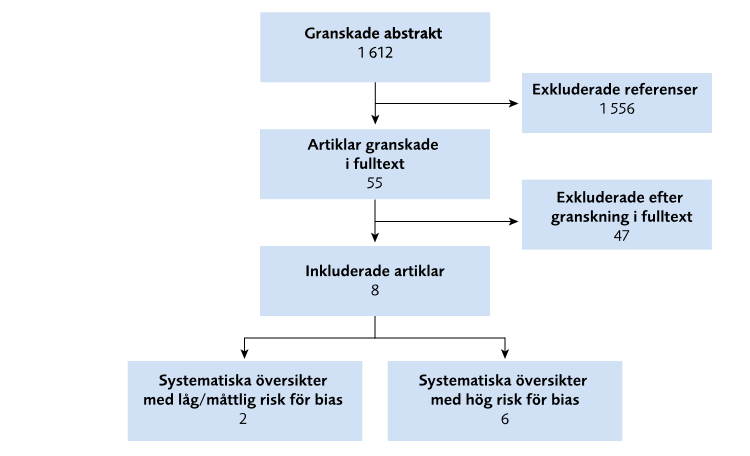
Upplysningstjänstens litteratursökning genererade totalt 1 612 artikelsammanfattningar (abstrakt) efter dubblettkontroll. Ett flödesschema för urvalsprocessen visas i Bilaga 2. Två utredare på SBU läste alla artikelsammanfattningar och bedömde att 55 översikter kunde vara relevanta för frågorna. Dessa artiklar lästes i fulltext av utredarna och de artiklar som inte var relevanta för frågorna exkluderades. Exkluderade artiklar finns listade i Bilaga 3.
SBU:s upplysningstjänst identifierade två relevanta systematiska översikter som bedömdes ha måttlig risk för bias, och sex som bedömdes ha hög risk för bias. Bedömning av risk of bias finns i Bilaga 4. Eftersom hög risk för bias innebär en betydande risk för att resultaten är missvisande presenterar vi inga resultat eller slutsatser från de översikterna.
Sökning och urval av studier, samt bedömning av risk för bias beskrivs i metodavsnittet. Resultaten har inte analyserats utifrån svenska förhållanden.
I nedanstående tabell listas de översikter som vi bedömt vara relevanta för frågan.
Tabell 1. Systematiska översikter med måttlig risk för bias rörande interventioner riktade till adopterade personer/Table 1 Systematic reviews with moderate risk of bias regarding interventions for adoptees.
Included studies
Population, Intervention, Control
Outcome and Results
Dalgaard et al, [4] Parenting interventions to support parent/child attachment and psychosocial adjustment in foster and adoptive parents and children: A systematic review
44 studies with data from 27 different samples.
Meta-analysis included 24 studies analyzing 16 different samples (14 RCT, 2 non-RCT); children n=1302, parents n=1344.
Setting: USA: 14 studies UK: 2 studies The Netherlands: 5 studies Italy: 2 studies Belgium: 1 study
Population: Foster and adoptive families with children aged between 0 and 17 years.
Interventions:
The Attachment and Bio‐behavioral Catch‐up (ABC) intervention (1)
Online Emotional Attachment and Emotional Availability Intervention (1)
Parent‐Child Interaction Therapy (PCIT) (3)
The Foster Family Intervention (1)
Intervention based on Social Learning Theory for foster Parents (1)
Trust‐Based Relational Intervention (1)
Video-feedback Intervention to promote Positive Parenting (VIPP) (3)
Duration: Mean duration 9.69 week (range: 1–12.5 weeks) (reported in 8 studies). Average number of treatment sessions 10.28 (range: 5–18).
Comparison: No treatment, treatment as usual/ other interventions /treatments offered (including normal service provision), or wait-list control
CHILD OUTCOME – overall psychosocial adjustment (10 studies): SMD: 0.37 (95% CI, 0.10 to 0.65), statistically significant positive effect of moderate size in favour of intervention, some heterogeneity I2=56% – externalizing behavior (8 studies): SMD: 0.37 (95% CI, −0.09 to 0.83), large heterogeneity I2=81% – internalizing symptoms (5 studies): SMD: 0.20 (95% CI, −0.02 to 0.42) – attachment security (3 studies): SMD: 0.59 (95% CI, −0.40 to 1.57), some heterogeneity I2=62%
– observed positive child behavior (4 studies): SMD: 0.39 (95% CI, 0.14 to 0.64), statistically significant positive effect of moderate size in favour of intervention, little heterogeneity I2=11%
PARENT OUTCOME
– observed positive parent outcome (10 studies): SMD: 1.56 (95% CI, 0.81 to 2.31), statistically significant positive effect of large size in favour of intervention, large heterogeneity I2=96%
– parenting stress (9 studies): SMD: 0.24 (95% CI, 0.03 to 0.46), statistically significant positive effect of small size in favour of intervention
– parental depression symptoms (3 studies): SMD: 0.59 (95% CI −0.08 to 1.25, inconclusive effect, little heterogeneity I2=35%
FOLLOW-UP (3–6 months post-intervention) Inconclusive evidence on any outcome due to too few studies.
Subgroup analyses: No evidence that the effect differs by foster/ adopted status on any outcome
Authors' conclusion: “Findings from this review indicate that parenting interventions based on attachment theory increase the overall psychosocial adjustment of children in foster and adoptive families as reported by their caregivers after the intervention. Attachment-based parenting interventions also increase positive parent/child interactional behaviours post intervention based on independent observation and decrease self-reported parenting stress. In summary these findings suggest that attachment-based parenting interventions have benefits for foster and adopted children and for foster and adoptive parents”
Purrington et al, [5] Family-based psychological interventions for domestically adoptive families: a systematic review
20 studies with data from 18 samples
Synthesis without meta-analysis (SWiM)
Setting: UK: 9 studies USA: 7 studies Canada: 1 study Poland: 1 study
Population: ≥729 domestically adopted children 0–18 years, ≥829 adoptive parents 4 studies: 0–6 years9 studies: 7–11 years 5 studies: 12–18 years
Interventions: Family-based psychological interventions for adoptive families. Intervention included one or two adoptive parent(s) and their adoptive child(ren). Intervention aimed directly to the parent–child dyad with a specific focus on building attachments and/or processing trauma Single model:
Attachment Regulation and Competence Therapy (ARC)
Dyadic Developmental Psychotherapy (DDP)
Eye-Movement Desensitisation and Reprocessing (EMDR)
Fast Feet Forward (FFF)
Kindermusik
Lifespan Integration (LI)
Mentalisation-Based Therapy for Families (MBT-F)
Multi-Systemtic Therapy (MST)
Post-Milanese Family Therapy (PM-FT)
Integrative:
Eye Movement Desensitisation and Reprocessing and Family Therapy (EMDR-FT)
HC2.0 therapeutic day-camp
Multi-Family Therapy (MFT)
Neuro-Physiological Psycho-therapy (NPP)
Sensory Integration-Theraplay-DDP Parenting and Psycho-education (SI-T-P)
Whole Family Theraplay (WFT)
Duration: 2 weekends to 15 years.
Comparison: Intervention controls, care as usual, retrospective controls,non-equivalent controls, studies with no control
Synthesis of findings organised by age of child at the beginning of the intervention Effective for trauma symptomatology in child: ARC, FFF-EMDR, EMDR-FT, HC2.0, SI-T-P
Effective for externalising difficulties in child; ARC, EMDR-FT, HC2.0, SI-T-P, NPP, WFT
Effective for internalising difficulties in child: MBT-F, EMDR-FT, NPP
Effective for measures of parental change: ARC, EMDR-FT, HC2.0
Participants reported strengthening in attachment: DDP, Kindermusik, NPP
Participants reported positive change in child: DDP, LI, PMFT, NPP
Participants reported positive change in parent: DDP, Kindermusik, LI, MBT-F, MST, MFT Interventions targeting younger children (0–7 years) prioritize relationship building and work with more body-based sensory work and attachment-based play.
Interventions targeting younger schoolchildren (8–11 years) focus on here-and-now, attachment and regulation albeit with shifting focus towards early life history and processing traumatic experiences.
Interventions for older children (12–18 years) commonly focus on problem solving, communication enhancing, trust and relationship building. In addition two interventions concerned developing a coherent life narrative for the child.
Authors' conclusion: “Findings provide preliminary support for integrative interventions which include aspects of sensory activities, attachment-based play, Dyadic Developmental Psychotherapy and Eye Movement Desensitisation and Reprocessing with Therapeutic Input provided to adopted children and adoptive parents separately, alongside the adoptive family. However, risk of bias was high, limiting the conclusions. Future research should examine the feasibility, acceptability and efficacy of integrative therapeutic approaches for adoptive families to further direct clinical practice.”
SMD = standardized mean difference
Vi identifierade även sex systematiska översikter [6-11] där vi bedömde att risken för bias var hög. Översikterna undersökte en stor mängd olika typer av interventioner riktade till adopterade barn och deras adoptivföräldrar, så som anknytningsfokuserad terapi, KBT, familjeterapi och föräldrautbildningsinsatser.
Många översikter lyfter anknytning och ålder vid adoption eller tid på institution som både påverkande faktorer och som teoretisk grund till interventioner riktade till gruppen.
Stora skillnader finns inom gruppen adopterade, men i många av de systematiska översikterna saknas diskussion kring olikheter, både i utformning av interventionsgrupper och kontrollgrupper.
I sökningen har vi identifierat följande referenser som kan vara relevanta för vidare läsning:
Stock och medarbetare rapporterade år 2016 om interventioner som ges efter adoption och i rapporten ges ingående information om interventionerna [12].
Askeland och medarbetare gjorde år 2017 en systematisk översikt rörande mental och fysisk hälsa hos adopterade ungdomar där tre svenska registerstudier ingår [13].
År 2020 publicerades en rapport från SBU:s Upplysningstjänst där även utfall för föräldrar inkluderades [14].
Risk för bias i relevanta systematiska översikter bedöms av två utredare, oberoende av varandra. Skillnader i bedömningarna löses genom diskussion.
Vid bedömning används granskningsmallen SnabbSTAR. SnabbSTAR har fem steg, där översikter som uppfyller de krav som ställs i steg 1–4 bedöms ha måttlig risk för bias, och om 1–5 är uppfyllda bedöms risken för bias vara låg.
En översikt som har brister i stegen 1–4 bedöms ha hög risk för bias och redovisas inte eftersom resultaten kan vara missvisande.
SBU:s bedömning av risk för bias finns redovisad i Bilaga 4. Granskningsmallen SnabbSTAR finns i Bilaga 5.
Om sammanställd forskning av god kvalitet saknas registreras det som en vetenskaplig kunskapslucka i SBU:s databas över vetenskapliga kunskapsluckor. Kunskapsluckan kan bestå i att forskning helt saknas, att primärstudier finns men att det inte finns någon systematisk översikt, eller att de existerande systematiska översikterna inte bedöms leva upp till kraven för låg eller måttlig risk för bias.
Detta svar är sammanställt av Marie Nilsson (utredare), Emma Palmqvist Wojda (utredare, produktsamordnare), Sara Fundell (projektadministratör), Maral Jolstedt (intern sakkunnig) samt Pernilla Östlund (avdelningschef) vid SBU.
Dalgaard NT, Filges T, Viinholt BCA, Pontoppidan M. Parenting interventions to support parent/child attachment and psychosocial adjustment in foster and adoptive parents and children: A systematic review. Campbell Syst Rev. 2022;18(1):e1209. Available from: https://doi.org/10.1002/cl2.1209
Purrington J, Goodall S, Lynch J. Family-based psychological interventions for domestically adoptive families: a systematic review. Eur Child Adolesc Psychiatry. 2024;33(5):1239-56. Available from: https://doi.org/10.1007/s00787-023-02210-y
Cornell T, Hamrin V. Clinical interventions for children with attachment problems. J Child Adolesc Psychiatr Nurs. 2008;21(1):35-47. Available from: https://doi.org/10.1111/j.1744-6171.2008.00127.x
Harris-Waller J, Granger C, Hussain M. Psychological interventions for adoptive parents: a systematic review. Adopt Foster. 2018;42(1):6-21. Available from: https://doi.org/10.1177/0308575918754481
Ni Chobhthaigh S, Duffy F. The effectiveness of psychological interventions with adoptive parents on adopted children and adolescents' outcomes: A systematic review. Clin Child Psychol Psychiatry. 2019;24(1):69-94. Available from: https://doi.org/10.1177/1359104518786339
Rose J, O’Reilly B. A systematic review of attachment-based psychotherapeutic interventions for adopted children. Early Child Dev Care. 2017;187(12):1844-62. Available from: https://doi.org/10.1080/03004430.2016.1204608
Schoemaker NK, Wentholt WGM, Goemans A, Vermeer HJ, Juffer F, Alink LRA. A meta-analytic review of parenting interventions in foster care and adoption. Dev Psychopathol. 2020;32(3):1149-72. Available from: https://doi.org/10.1017/S0954579419000798
Silberfarb MS, Silva PSd, Frizzo GB. Family Intervention in the Initial Adaptation of Adoptive Families: Systematic Review. Psico-USF. 2023;28(1):149-63. Available from: https://doi.org/10.1590/1413-82712023280112
Askeland KG, Hysing M, La Greca AM, Aaro LE, Tell GS, Sivertsen B. Mental Health in Internationally Adopted Adolescents: A Meta-Analysis. Journal of the American Academy of Child & Adolescent Psychiatry. 2017;56(3):203-13.e1. Available from: https://doi.org/10.1016/j.jaac.2016.12.009
Insatser för bättre psykisk och fysisk hälsa hos adopterade barn. Stockholm: Statens beredning för medicinsk och social utvärdering (SBU); 2020. SBU:s upplysningstjänst ut202034.[accessed June 17 2025]. Available from: https://www.sbu.se/ut202034
Title: Interventioner till adopterade barn/vuxna och adopterande föräldrar
Search terms
Items found
Population:
1.
Adoption/
4977
2.
Child, Adopted/
179
3.
((adopted or adoptive) adj3 (child* or infant* or teen* or adolescent* or famil* or parent* or mother* or father* or sibling* or person*)).ab,bt,kf,ti.
3995
4.
(adoption or adoptee*).bt,kw,ti.
10 587
5.
international adoption.ab.
194
6.
internationally adopted.ab,bt,kf,ti.
571
7.
or/1-6
15 909
Study types: systematic reviews and meta-analysis
8.
(Systematic Review/ or Scoping Review/ or Meta-Analysis/ or (((systematic or scoping or literature or realist or integrative or mapping or evidence) adj4 (review or synthes*)) or "meta analy*" or metaanaly*).ti,bt,ab.) not (editorial/ or letter/ or case reports/)
789 284
Combined sets:
9.
7 and 8
686
Final result
10.
686
/= Term from the MeSH controlled vocabulary; .sh = Term from the MeSH controlled vocabulary; exp = Term from MeSH including terms found below this term in the MeSH hierarchy; .ti,ab = Title or abstract; .tw = Title or abstract; .kf = Keywords; .kw = Keywords, exact; .bt = Book title. NLM Bookshelf; .pt = Publication type;.ja = Journal abbreviation; .af = All fields; adjn = Adjacent. Proximity operator retrieving adjacent words, adj3 retrieves records with search terms within two terms from each other; * or $ = Truncation; “ “ = Citation Marks; searches for an exact phrase
TITLE-ABS-KEY ( adopted W/3 ( child* OR infant* OR teen* OR adolescent* OR famil* OR sibling* OR person* ) )
8121
2.
TITLE-ABS-KEY ( adoptive W/3 ( parent OR parents OR mother* OR father* ) )
2781
3.
TITLE (adoption OR adoptee*)
54 593
4.
TITLE-ABS-KEY ( "international adoption" OR "internationally adopted" )
1605
5.
1 OR 2 OR 3 OR 4
63 024
Study types: systematic reviews and meta-analysis
6.
( TITLE-ABS-KEY ( ( ( systematic OR scoping OR realist OR mapping OR integrative OR literature ) W/2 review ) OR "meta analy*" OR metaanaly* OR ( ( systematic OR evidence OR literature ) W/2 synthes* ) ) ) AND ( EXCLUDE ( DOCTYPE , "le" ) OR EXCLUDE ( DOCTYPE , "ed" ) OR EXCLUDE ( DOCTYPE , "ch" ) OR EXCLUDE ( DOCTYPE , "cp" ) )
1 282 222
Limits:
7.
( EXCLUDE ( SUBJAREA , "ENGI" ) OR EXCLUDE ( SUBJAREA , "ENVI" ) OR EXCLUDE ( SUBJAREA , "DECI" ) OR EXCLUDE ( SUBJAREA , "ENER" ) OR EXCLUDE ( SUBJAREA , "ECON" ) OR EXCLUDE ( SUBJAREA , "AGRI" ) OR EXCLUDE ( SUBJAREA , "BIOC" ) OR EXCLUDE ( SUBJAREA , "MATH" ) OR EXCLUDE ( SUBJAREA , "MATE" ) OR EXCLUDE ( SUBJAREA , "CENG" ) OR EXCLUDE ( SUBJAREA , "EART" ) OR EXCLUDE ( SUBJAREA , "PHAR" ) OR EXCLUDE ( SUBJAREA , "PHYS" ) OR EXCLUDE ( SUBJAREA , "COMP" ) OR EXCLUDE ( SUBJAREA , "BUSI" ) )
Combined sets:
8.
5 AND 6
2610
9.
8 AND 7
814
Final result
10.
9
814
TITLE-ABS-KEY = Title, abstract or keywords (including indexed keywords and author keywords); ALL = All fields; W/n = Within. Proximity operator retrieving terms within n words from each other; PRE/n = Precedes by. Proximity operator, the first term in the search must precede the second by n words; LIMIT-TO (X) = Includes only results of specified type, e.g., publication type or time range; DOCTYPE = Publication type; “re” = review “le” = letter; “ed”= editorial;“ch” = book chapter; “cp” = conference proceedings; * = Truncation; “ “ = Citation Marks; searches for an exact phrase
TI = Title; AB = Abstract; SU = Keyword, exact or part (including all other fields for indexed and author keywords); DE = Exact keyword;TX = All text; MR = Methodology; Nn = Near. Proximity operator retrieving terms within n words from each other; * = Truncation; “ “ = Citation Marks; searches for an exact phrase
Search terms
Items found
Population:
1.
DE "Adoption (Child)" OR DE "Adoptees" OR DE "International Adoption" OR DE "Interracial Adoption" OR DE "Adopted Children" OR DE "Adoptive Parents"
6542
2.
TI ( ((adopted OR adoptive) N4 (child* OR infant* OR famil* OR parent* OR mother* OR father* OR person* OR teen* OR adolescent* OR sibling*)) ) OR AB ( ((adopted OR adoptive) N4 (child* OR infant* OR famil* OR parent* OR mother* OR father* OR person* OR teen* OR adolescent* OR sibling*)) ) OR KW ( ((adopted OR adoptive) N4 (child* OR infant* OR famil* OR parent* OR mother* OR father* OR person* OR teen* OR adolescent* OR sibling*)) )
7318
3.
TI ("internationally adopted" OR adoptee* ) OR AB ( "international adoption" OR "internationally adopted" OR adoptee* ) OR KW ( "international adoption" OR "internationally adopted" OR adoptee* )
2512
4.
TI (adoption)
7348
5.
1 OR 2 OR 3 OR 4
14 368
Study types: systematic reviews and meta-analysis
6.
TI (((systematic or scoping or literature or realist or integrative or mapping or evidence) N4 (review or synthes*)) or "meta analy*" or metaanaly*)) OR AB (((systematic or scoping or literature or realist or integrative or mapping or evidence) N4 (review or synthes*)) or "meta analy*" or metaanaly*)) OR KW (((systematic or scoping or literature or realist or integrative or mapping or evidence) N4 (review or synthes*)) or "meta analy*" or metaanaly*))
TI = Title; AB = Abstract; SU = Keyword, exact or part (including all other fields for indexed and author keywords); Nn = Near. Proximity operator retrieving terms within n words from each other; * = Truncation; “ “ = Citation Marks; searches for an exact phrase
Search terms
Items found
Population:
1.
TI ( ((adopted OR adoptive) N4 (child* OR infant* OR famil* OR parent* OR mother* OR father* OR person* OR teen* OR adolescent* OR sibling*)) ) OR AB ( ((adopted OR adoptive) N4 (child* OR infant* OR famil* OR parent* OR mother* OR father* OR person* OR teen* OR adolescent* OR sibling*)) ) OR SU ( ((adopted OR adoptive) N4 (child* OR infant* OR famil* OR parent* OR mother* OR father* OR person* OR teen* OR adolescent* OR sibling*)) )
7631
2.
TI ("internationally adopted" OR adoptee* ) OR AB ( "international adoption" OR "internationally adopted" OR adoptee* ) OR SU ( "international adoption" OR "internationally adopted" OR adoptee* )
2776
3.
TI (adotion)
7897
4.
1 OR 2 OR 3
Study types: systematic reviews and meta-analysis
5.
TI (((systematic or scoping or literature or realist or integrative or mapping or evidence) N4 (review or synthes*)) or "meta analy*" or metaanaly*)) OR AB (((systematic or scoping or literature or realist or integrative or mapping or evidence) N4 (review or synthes*)) or "meta analy*" or metaanaly*)) OR SU (((systematic or scoping or literature or realist or integrative or mapping or evidence) N4 (review or synthes*)) or "meta analy*" or metaanaly*))
TI = Title; AB = Abstract; SU = Subjects; N/n = Near. Proximity operator retrieving terms within n words from each other; * = Truncation; “ “ = Citation Marks; searches for an exact phrase
Search terms
Items found
Population:
1.
MAINSUBJECT.EXACT.EXPLODE("Adoption") OR (MAINSUBJECT.EXACT("Adopted children") OR MAINSUBJECT.EXACT("Adoptive parents"))
6428
2.
title(((adopted OR adoptive) N/4 (child* OR infant* OR famil* OR parent* OR mother* OR father* OR person* OR teen* OR adolescent* OR sibling*))) OR abstract(((adopted OR adoptive) N/4 (child* OR infant* OR famil* OR parent* OR mother* OR father* OR person* OR teen* OR adolescent* OR sibling*)))
4467
3.
title("internationally adopted" OR adoptee* ) OR abstract("international adoption" OR "internationally adopted" OR adoptee* )
1656
4.
title(adoption)
5474
5.
1 OR 2 OR 3 OR 4
10 862
Study types: systematic reviews and meta-analysis
6.
Subject (((systematic or scoping or literature or realist or integrative or mapping or evidence) N/4 (review or synthes*)) or "meta analy*" or metaanaly*) or title (((systematic or scoping or literature or realist or integrative or mapping or evidence) N/4 (review or synthes*)) or "meta analy*" or metaanaly*) or abstract (((systematic or scoping or literature or realist or integrative or mapping or evidence) N/4 (review or synthes*)) or "meta analy*" or metaanaly*)
115 430
Limits:
7.
EXCLUDE (Dissertations & Theses AND Conference Papers & Proceedings)
Tjugotre artiklar som exkluderats efter fulltextläsning på grund av bristande relevans/Twenty-three articles excluded after full text assessment of relevance
Excluded articles
Reason for exclusion
Systematic reviews
Anbari M, Nazri Bin Abdul Rahman M. The Adoptees’ Behavioral Challenges in Adaptive Families: a systematic review. Payesh (Health Monitor) Journal. 2024;23(5):737-50. Available from: https://doi.org/10.61186/payesh.23.5.737
Wrong language
NICE. Interventions to support looked-after children and young people transitioning out of care to living with adoptive or birth parents or special guardians, or into connected care. National Institute for Health and Care Excellence (NICE). 2021;10:10.
Wrong population
Bakermans-Kranenburg MJ, van Ijzendoorn MH, Juffer F. Earlier is better: a meta-analysis of 70 years of intervention improving cognitive development in institutionalized children. Monogr Soc Res Child Dev. 2008;73(3):279-93. Available from: https://doi.org/10.1111/j.1540-5834.2008.00498.x
Wrong population
Carr A, Duff H, Craddock F. A Systematic Review of Reviews of the Outcome of Severe Neglect in Underresourced Childcare Institutions. Trauma Violence Abuse. 2020;21(3):484-97. Available from: https://doi.org/10.1177/1524838018777788
Not a systematic review
Colom J, Segura-Garcia L, Bastons-Compta A, Astals M, Andreu-Fernandez V, Barcons N, et al. Prevalence of Fetal Alcohol Spectrum Disorders (FASD) among Children Adopted from Eastern European Countries: Russia and Ukraine. Int J Environ Res Public Health. 2021;18(4):1388. Available from: https://doi.org/10.3390/ijerph18041388
Not a systematic review
David R, Dembrey N, Majumder P. Outcomes from attachment-based group interventions for foster carers and adoptive parents: A systematic review. Adopt Foster. 2024;48(2):243-77. Available from: https://doi.org/10.1177/03085759241264065
Relevant results not analysed separately
Drozd F, Bergsund HB, Hammerstrøm KT, Hansen MB, Jacobsen H. A Systematic Review of Courses, Training, and Interventions for Adoptive Parents. J Child Fam Stud. 2017;27(2):339-54. Available from: https://doi.org/10.1007/s10826-017-0901-7
Wrong outcome
Fensbo C. Mental and behavioural outcome of inter-ethnic adoptees: a review of the literature. Eur Child Adolesc Psychiatry. 2004;13(2):55-63. Available from: https://doi.org/10.1007/s00787-004-0358-2
Not a systematic review
Fisher PA. Review: Adoption, fostering, and the needs of looked-after and adopted children. Child Adolesc Ment Health. 2015;20(1):5-12. Available from: https://doi.org/10.1111/camh.12084
Not a systematic review
Freeark K, Rosenberg EB, Bornstein J, Jozefowicz-Simbeni D, Linkevich M, Lohnes K. Gender differences and dynamics shaping the adoption life cycle: review of the literature and recommendations. Am J Orthopsychiatry. 2005;75(1):86-101. Available from: https://doi.org/10.1037/0002-9432.75.1.86
Not a systematic review
Hodge AS, Hook JN, Zhang H, McLaughlin AT, Mostert J, Hancock BR, et al. The effectiveness of faith-based organizations designed to support adoptive and foster care families: A systematic review of the literature. Spiritual Clin Pract. 2025;12(1):57-71. Available from: https://doi.org/10.1037/scp0000290
Wrong outcome
Kerr L, Cossar J. Attachment Interventions with Foster and Adoptive Parents: A Systematic Review. Child Abuse Rev. 2014;23(6):426-39. Available from: https://doi.org/10.1002/car.2313
Relevant results not analysed separately
Koren G, Ornoy A. Institutionalized Children and the Risk of Fetal Alcohol Spectrum Disorder (FASD); A Primer for Clinicians, Adoption Staff and Parents. Glob Pediatr Health. 2021;8:2333794X21989556. Available from: https://doi.org/10.1177/2333794X21989556
Not a systematic review
Liao M. Factors affecting post-permanency adjustment for children in adoption or guardianship placements: An ecological systems analysis. Child Youth Serv Rev. 2016;66:131-43. Available from: https://doi.org/10.1016/j.childyouth.2016.05.009
Not a systematic review
Love L, Minnis H, O'Connor S. Factors Associated with Indiscriminate Friendliness in High-Risk Children. Infant Ment Health J. 2015;36(4):427-45. Available from: https://doi.org/10.1002/imhj.21520
Relevant results not analysed separately
Nickman SL, Rosenfeld AA, Fine P, Macintyre JC, Pilowsky DJ, Howe RA, et al. Children in adoptive families: overview and update. J Am Acad Child Adolesc Psychiatry. 2005;44(10):987-95. Available from: https://doi.org/10.1097/01.chi.0000174463.60987.69
Perry CL, Henry MJ. Family and Professional Considerations for Adoptive Parents of Children with Special Needs. Marriage Fam Rev. 2009;45(5):538-65. Available from: https://doi.org/10.1080/01494920903050938
Wrong population
Peters BR, Atkins MS, McKay MM. Adopted children's behavior problems: a review of five explanatory models. Clin Psychol Rev. 1999;19(3):297-328. Available from: https://doi.org/10.1016/s0272-7358(98)00028-2
Not a systematic review
Roach A, Sherburne E, Snethen J. Intercountry adoption of children with complex health conditions and disabilities: A systematic review. J Spec Pediatr Nurs. 2023;28(1):e12398. Available from: https://doi.org/10.1111/jspn.12398
Wrong outcome
Sánchez-Sandoval Y, Melero S, López-Jiménez AM. Mediating Effects of Social Support in the Association Between Problems in Childhood and Adolescence and Well-Being in Adult Domestic Adoptees. J Happiness Stud. 2019;21(4):1183-98. Available from: https://doi.org/10.1007/s10902-019-00124-8
Not a systematic review
Van Ijzendoorn MH, Bakermans-Kranenburg MJ, Juffer F. Plasticity of growth in height, weight, and head circumference: meta-analytic evidence of massive catch-up after international adoption. J Dev Behav Pediatr. 2007;28(4):334-43. Available from: https://doi.org/10.1097/DBP.0b013e31811320aa
Wrong outcome
Welsh J, Viana A, Petrill S, Mathias M. Interventions for Internationally Adopted Children and Families: A Review of the Literature. Child Adolesc Social Work J. 2007;24(3):285-311. Available from: https://doi.org/10.1007/s10560-007-0085-x

 = High;
  = Moderate;
  = Low;
  =unclear