Observera att det är möjligt att ladda ner hela eller delar av en
publikation. Denna pdf/utskrift behöver därför inte vara komplett.
Hela publikationen och den senaste versionen hittar ni på
www.sbu.se/ut202505
Kostbehandling för posttraumatiskt stressyndrom
Sammanställning av systematiska översikter från SBU:s upplysningstjänst
Publicerad: 8 maj 2025
Vilka effekter har kostbehandling på symtom vid posttraumatiskt stressyndrom?
Frågeställare: Dietist, Region Jönköpings län
- Vi har inte identifierat någon systematisk översikt som är tillräckligt välgjord för att vi ska redovisa resultaten.
Det saknas välgjorda systematiska översikter om kost- och nutritionsbehandling för symtom vid ptsd.
Att vi inte presenterar några resultat ska inte tolkas som att insatsen saknar effekt. Det betyder att det behövs en välgjord översikt som sammanställer befintliga studier och identifierar behovet av ny forskning för att förbättra kunskapsläget.
Se även avsnittet SBU:s kommentarer.
Posttraumatiskt stressyndrom (Post-Traumatic Stress Disorder, ptsd) innebär en förlängd och kraftig stressreaktion och en beteendeförändring som kan uppkomma då en individ har upplevt en eller flera traumatiska händelser [1]. Cirka 10 procent av alla som upplever en potentiellt traumatisk händelse får även symtom på ptsd [2].
Ptsd innefattar fyra symtomkluster:
- påträngande minnesbilder/mardrömmar,
- undvikandebeteende,
- negativa förändringar i sinnesstämningen/kognitionen,
- överspändhet i form av koncentrationssvårigheter eller irritabilitet.
Behandling som ges för ptsd hos vuxna är främst traumafokuserad kognitiv beteendeterapi med exponering (TF-KBT) men även antidepressiva läkemedel, ögonrörelseterapi (eye movement desensitization and reprocessing, EMDR), och basal kroppskännedom kan erbjudas [1]. Vid ptsd försämras både funktions- och aktivitetsförmågan, liksom livskvaliteten, och många aspekter av livet påverkas och begränsas [1]. Att fortsätta ha rutiner och en hälsosam livsstil tas upp som egenvårdsråd vid ptsd. I en hälsosam livsstil ingår regelbunden och varierad kost [3].
Upplysningstjänsten har tillsammans med frågeställaren formulerat frågan enligt följande PICO1:
- Population: Vuxna personer med diagnos posttraumatiskt stressyndrom (ptsd)
- Intervention: Perorala kost- och nutritionsinterventioner inklusive kosttillskott eller kosttillägg såsom näringsdrycker
- Control: Ingen eller annan behandling
- Outcome: Symptom på ptsd, livskvalitet, viktförändring
Vi inkluderar systematiska översikter publicerade i vetenskapliga tidskrifter samt systematiska översikter från myndigheter och HTA-organisationer, som har publicerats på engelska eller ett av de skandinaviska språken.
Vi identifierade ingen systematisk översikt med måttlig eller låg risk för bias. Vi identifierade två översikter som var relevanta för frågan men som vi bedömde ha hög risk för bias [4] [5]. En översikt studerade fleromättade fettsyror som behandling vid ptsd och den andra studerade livsstilsfaktorer och deras koppling till ptsd-symtom, där den enda relevanta primärstudien rörde fiskolja som kosttillskott för att förebygga ptsd-symtom. Eftersom hög risk för bias innebär en betydande risk för att resultaten från översikterna är missvisande presenterar vi inga resultat eller slutsatser från de översikterna. Båda översikterna hade framför allt problem i hur de hanterade risken för bias i deras inkluderade primärstudier.
Sökning och urval av studier, samt bedömning av risk för bias beskrivs i metodavsnittet. Resultaten har inte analyserats utifrån svenska förhållanden.
- Denna litteratursammanställning berör endast personer diagnostiserade med ptsd. Det är möjligt att det finns systematiska översikter om effekterna av kostinterventioner på närliggande psykiatriska tillstånd som skulle kunna vara relevanta även för en patientpopulation med ptsd.
Upplysningstjänsten gör en systematisk sökning i minst två vetenskapliga databaser. Fullständig sökdokumentation finns i Bilaga 1.
Bedömning av vilka artiklar som är relevanta sker i två steg och utgår från frågeställningen.
- Två utredare läser titel och sammanfattning av alla identifierade artiklar från sökningen, och gör en oberoende bedömning av artiklarnas relevans.Artiklarna som valts ut i steg 1 läses i fulltext av två utredare, som gör en oberoende bedömning av artiklarnas relevans.
Skillnader i bedömningarna löses genom diskussion.
Flödesschema för urval av artiklar finns i Bilaga 2. Exkluderade artiklar finns i Bilaga 3.
Risk för bias i relevanta systematiska översikter bedöms av två utredare, oberoende av varandra. Skillnader i bedömningarna löses genom diskussion.
Vid bedömning används granskningsmallen SnabbSTAR. SnabbSTAR har fem steg, där översikter som uppfyller de krav som ställs i steg 1–4 bedöms ha måttlig risk för bias, och om 1–5 är uppfyllda bedöms risken för bias vara låg.
En översikt som har brister i stegen 1–4 bedöms ha hög risk för bias och redovisas inte eftersom resultaten kan vara missvisande.
SBU:s bedömning av risk för bias finns redovisad i Bilaga 4. Granskningsmallen SnabbSTAR finns i Bilaga 5.
Om sammanställd forskning av god kvalitet saknas registreras det som en vetenskaplig kunskapslucka i SBU:s databas över vetenskapliga kunskapsluckor. Kunskapsluckan kan bestå i att forskning helt saknas, att primärstudier finns men att det inte finns någon systematisk översikt, eller att de existerande systematiska översikterna inte bedöms leva upp till kraven för låg eller måttlig risk för bias.
Databasen över vetenskapliga kunskapsluckor kan nås via: https://www.sbu.se/sv/kunskapsluckor-sok/
Detta svar är sammanställt av Lisa Andersson (utredare), Marie Nilsson (utredare), Banafsheh Wells (utredare), Sara Fundell (projektadministratör), Emma Wojda (produktsamordnare), Sarah Vigerland (intern sakkunnig) samt Pernilla Östlund (avdelningschef) vid SBU.
- Nationellt programområde psykisk hälsa. Nationellt vård- och insatsprogram för depression och ångest. Nationellt system för kunskapsstyrning, Hälso- och sjukvård; 2025. [accessed April 22 2025]. Available from: https://www.vardochinsats.se/depression-och-aangestsyndrom
- Kunskapsstöd för vårdgivare. Posttraumatiska stressyndrom - PTSD. Region Stockholms medicinska kunskapswebbar; 2019. [accessed April 22 2025]. Available from: https://kunskapsstodforvardgivare.se/omraden/psykisk-halsa/regionala-vardprogram/posttraumatiska-stressyndrom---ptsd
- Posttraumatiskt stressyndrom, PTSD. Stockholm: 1177. [accessed April 22 2025]. Available from: https://www.1177.se/Stockholm/sjukdomar--besvar/psykiska-sjukdomar-och-besvar/angest/posttraumatiskt-stressyndrom-ptsd/
- Capple KA, Kostas-Polston EA, Engler MB, Lai C, Froelicher ES. Efficacy of Polyunsaturated Fatty Acids as a Treatment for Post-traumatic Stress Disorder: A Systematic Review. Mil Med. 2025;190(1-2):e74-e81. Available from: https://doi.org/10.1093/milmed/usae319
- Hall KS, Hoerster KD, Yancy WS. Post-traumatic stress disorder, physical activity, and eating behaviors. Epidemiol Rev. 2015;37(1):103-15. Available from: https://doi.org/10.1093/epirev/mxu011
Upplysningstjänsten har gjort sökningar i databaserna Medline (Ovid), Scopus och PsycInfo.
Sökningen har begränsats till systematiska översikter. Nedan redovisas sökningen som gjorts i de vetenskapliga databaserna.
| / = Term from the MeSH controlled vocabulary; .sh = Term from the MeSH controlled vocabulary; exp = Term from MeSH including terms found below this term in the MeSH hierarchy; .ti,ab = Title or abstract; .tw = Title or abstract; .kf = Keywords; .kw = Keywords, exact; .bt = Book title. NLM Bookshelf; .pt = Publication type; .ja = Journal abbreviation; .af = All fields; adjn = Adjacent. Proximity operator retrieving adjacent words, adj3 retrieves records with search terms within two terms from each other; * or $ = Truncation; “ “ = Citation Marks; searches for an exact phrase |
| Search terms |
Items found |
| Population: |
| 1. |
exp Stress Disorders, Post-Traumatic/ |
45 286 |
| 2. |
(“post-traumatic stress” or “posttraumatic stress” or PTSD or PTS).ab,ti,kf,bt. |
71 900 |
| 3. |
(“complex post-traumatic stress” or “complex posttraumatic stress” or ”CPTSD” or “C-PTSD” or “complex ptsd” or ”complex pts” or ”DESNOS” or ”EPCACE” or (complex adj3 (trauma* or stress)) or (extreme* adj3 (trauma* or stress*)) or (catastrophic* adj3 (experience* or event*)) or ((trauma* or stress*) adj3 disorder*)).ab,ti,kf,bt. |
69 026 |
| 4. |
Or/1-3 |
104 822 |
| Intervention: Nutrition |
| 5. |
exp Food/ |
1 564 756 |
| 6. |
exp Diet/ |
351 870 |
| 7. |
exp Meals/ |
9889 |
| 8. |
exp Nutritional Sciences/ |
21 112 |
| 9. |
exp Nutrition Therapy/ |
119 192 |
| 10. |
“nutritional therapy” or dietetics or “dietary intervention”.ab,ti,kf,bt. |
22 282 |
| 11. |
((oral or peroral) AND (diet* or nutri*) AND intervention*).ab,ti,kf,bt. |
6718 |
| 12. |
(nutri* adj3 drink).ab,ti,kf,bt. |
281 |
| 13. |
(diet* adj3 suppl*).ab,ti,kf,bt. |
64 718 |
| 14. |
Or/5-13 |
1 866 380 |
| Study types: systematic reviews and meta-analysis |
| 15. |
((Systematic Review/ or Meta-Analysis/ or Cochrane Database Syst Rev.ja. or ((systematic adj4 review) or "meta analys*" or metaanalys*).ti,bt,ab.) not (editorial/ or letter/ or case reports/)) |
530 806 |
| Final result |
| 16. |
4 AND 14 AND 15 |
33 |
| TITLE-ABS-KEY = Title, abstract or keywords (including indexed keywords and author keywords); ALL = All fields; W/n = Within. Proximity operator retrieving terms within n words from each other; PRE/n = Precedes by. Proximity operator, the first term in the search must precede the second by n words; LIMIT-TO (X) = Includes only results of specified type, e.g., publication type or time range; DOCTYPE = Publication type; “re” = review; “le” = letter; “ed” = editorial; “ch” = book chapter; “cp” = conference proceedings; * = Truncation; “ “ = Citation Marks; searches for an exact phrase |
| Search terms |
Items found |
| Population: |
| 1. |
TITLE-ABS-KEY (PTSD OR PTS OR (trauma* W/3 stress*) OR (stress* OR trauma* W/3 disorder*)) |
170 926 |
| 2. |
TITLE-ABS-KEY (“complex post-traumatic stress” OR “complex posttraumatic stress” OR CPTSD OR C-PTSD OR DESNOS OR EPCACE OR ”complex PTSD” OR ”complex PTS” OR (complex* W/4 (trauma* OR stress*)) OR (catastrophic* W/3 (experience* OR event*)) OR (extreme* W/3 (stress* OR trauma*))) |
53 220 |
| 3. |
1 OR 2 |
220 365 |
| Intervention: |
| 4. |
TITLE-ABS-KEY (food OR nutri* OR diet*) |
4 058 254 |
| 5. |
TITLE-ABS-KEY (nutri* OR diet*) W/4 (intervention* OR therap*) |
149 909 |
| 6. |
TITLE-ABS-KEY (nutri* OR diet*) W/4 (suppl* OR drink*) |
281 202 |
| 7. |
4 OR 5 OR 6 |
4 058 254 |
| Study types: systematic reviews and meta-analysis |
| 8. |
TITLE-ABS-KEY ( ( systematic W/2 review ) OR "meta analy*" OR metaanaly* ) AND (EXCLUDE (DOCTYPE, “le”) OR EXCLUDE (DOCTYPE, “ed”) OR EXCLUDE (DOCTYPE, “ch”) OR EXCLUDE (DOCTYPE, “cp”)) |
794 527 |
| Final result |
| 9. |
3 AND 7 AND 8 |
352 |
| TI = Title; AB = Abstract; SU = Keyword, exact or part (including all other fields for indexed and author keywords); DE = Exact keyword; TX = All text; MR = Methodology; Nn = Near. Proximity operator retrieving terms within n words from each other; * = Truncation; “ “ = Citation Marks; searches for an exact phrase |
| Search terms |
Items found |
| Population: |
| 1. |
DE “Posttraumatic Stress Disorder” |
44 076 |
| 2. |
DE “Complex PTSD” |
830 |
| 3. |
DE “Emotional Trauma” |
16 692 |
| 4. |
DE “Traumatic Experiences” |
1661 |
| 5. |
DE “Trauma Treatment” |
719 |
| 6. |
TI(post-traumatic* OR posttraumatic* OR PTSD OR PTS OR ((stress* OR trauma*) N3 disorder*)) |
34 027 |
| 7. |
AB(post-traumatic* OR posttraumatic* OR PTSD OR PTS OR ((stress* OR trauma*) N3 disorder*)) |
75 011 |
| 8. |
SU(post-traumatic* OR posttraumatic* OR PTSD OR PTS OR ((stress* OR trauma*) N3 disorder*)) |
60 455 |
| 9. |
TI(“complex posttraumatic stress” OR “complex post-traumatic stress” OR “complex ptsd” OR “complex pts” OR CPTSD OR C-PTSD OR DESNOS OR EPCACE OR (catastrophic N3 (experience* OR event*)) OR (extreme* N3 (trauma* OR stress*)) |
4277 |
| 10. |
AB(“complex posttraumatic stress” OR “complex post-traumatic stress” OR “complex ptsd” OR “complex pts” OR CPTSD OR C-PTSD OR DESNOS OR EPCACE OR (catastrophic N3 (experience* OR event*)) OR (extreme* N3 (trauma* OR stress*)) |
4355 |
| 11. |
SU(“complex posttraumatic stress” OR “complex post-traumatic stress” OR “complex ptsd” OR “complex pts” OR CPTSD OR C-PTSD OR DESNOS OR EPCACE OR (catastrophic N3 (experience* OR event*)) OR (extreme* N3 (trauma* OR stress*)) |
4282 |
| 12. |
Or/1-11 |
98 325 |
| Intervention: |
| 13. |
DE “Dietary Treatment” |
324 |
| 14. |
DE “Dietary supplements” |
3310 |
| 15. |
DE “Diets” |
16 730 |
| 16. |
DE “Nutritionists” |
116 |
| 17. |
DE “Nutrition” |
14 281 |
| 18. |
TI((food OR nutri* OR diet*) OR ((nutri* OR diet*) N4 (intervention* OR therap*)) OR ((nutri* OR diet*) N4 (suppl* OR drink*))) |
44 631 |
| 19. |
AB((food OR nutri* OR diet*) OR ((nutri* OR diet*) N4 (intervention* OR therap*)) OR ((nutri* OR diet*) N4 (suppl* OR drink*))) |
150 401 |
| 20. |
SU((food OR nutri* OR diet*) OR ((nutri* OR diet*) N4 (intervention* OR therap*)) OR ((nutri* OR diet*) N4 (suppl* OR drink*))) |
95 329 |
| 21. |
Or/13-21 |
171 626 |
| Study types: systematic reviews and meta-analysis |
| 22. |
TI((systematic n3 review) OR "meta analys*" OR metaanalys*) OR AB((systematic n3 review) OR "meta analys*" OR metaanalys*) OR SU((systematic n3 review) OR "meta analys*" OR metaanalys*) OR (MR "Systematic Review" OR MR "meta analysis") |
110 495 |
| Final result |
| 23. |
12 AND 21 AND 22 |
40 |
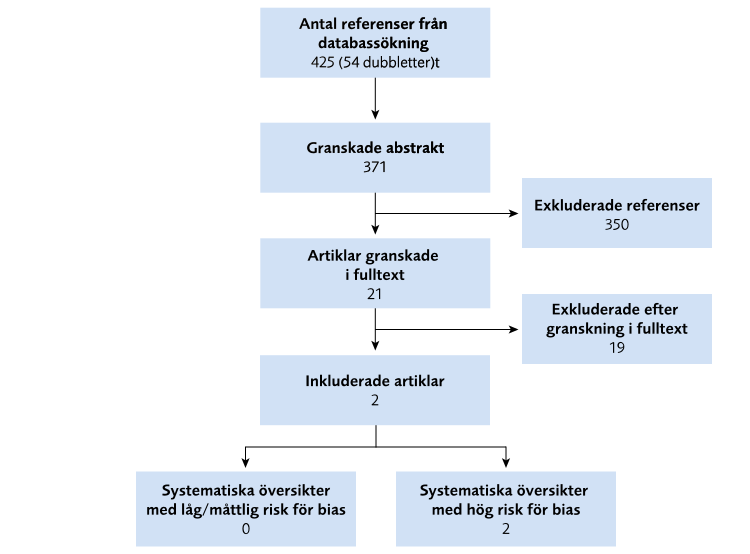
Artiklar som exkluderats efter fulltextläsning på grund av att de inte är relevanta för den här rapportens frågeställning.
| Excluded articles |
Reason for exclusion |
| Systematic reviews |
|
| Ansari F, Pourjafar H, Tabrizi A, Homayouni A. The effects of probiotics and prebiotics on mental disorders: A review on depression, anxiety, alzheimer, and autism spectrum disorders. Curr Pharm Biotechnol. 2020;21(7):555-65. Available from: https://doi.org/10.2174/1389201021666200107113812 |
Not a systematic review |
| Blampied M, Bell C, Gilbert C, Rucklidge JJ. Broad spectrum micronutrient formulas for the treatment of symptoms of depression, stress, and/or anxiety: a systematic review. Expert Rev Neurother. 2020;20(4):351-71. Available from: https://doi.org/10.1080/14737175.2020.1740595 |
Wrong population |
| Bozzatello P, De Rosa ML, Rocca P, Bellino S. Effects of Omega 3 Fatty Acids on Main Dimensions of Psychopathology. Int J Mol Sci. 2020;21(17):1-29. Available from: https://doi.org/10.3390/ijms21176042 |
Not a systematic review |
| Brenner LA, Stearns-Yoder KA, Hoffberg AS, Penzenik ME, Starosta AJ, Hernandez TD, et al. Growing literature but limited evidence: A systematic review regarding prebiotic and probiotic interventions for those with traumatic brain injury and/or posttraumatic stress disorder. Brain Behav Immun. 2017;65:57-67. Available from: https://doi.org/10.1016/j.bbi.2017.06.003 |
Wrong control |
| Firth J, Solmi M, Wootton RE, Vancampfort D, Schuch FB, Hoare E, et al. A meta-review of “lifestyle psychiatry”: the role of exercise, smoking, diet and sleep in the prevention and treatment of mental disorders. World Psychiatry. 2020;19(3):360-80. Available from: https://doi.org/10.1002/wps.20773 |
Wrong intervention |
| Garzone S, Charitos IA, Mandorino M, Maggiore ME, Capozzi L, Cakani B, et al. Can We Modulate Our Second Brain and Its Metabolites to Change Our Mood? A Systematic Review on Efficacy, Mechanisms, and Future Directions of "Psychobiotics". Int J Mol Sci. 2025;26(5). Available from: https://doi.org/10.3390/ijms26051972 |
Wrong population |
| Johnstone JM, Hughes A, Goldenberg JZ, Romijn AR, Rucklidge JJ. Multinutrients for the treatment of psychiatric symptoms in clinical samples: A systematic review and meta-analysis of randomized controlled trials. Nutrients. 2020;12(11):1-35. Available from: https://doi.org/10.3390/nu12113394 |
Wrong population |
| Minayo MS, Miranda I, Telhado RS. A systematic review of the effects of probiotics on depression and anxiety: an alternative therapy? Cien Saude Colet. 2021;26(9):4087-99. Available from: https://doi.org/10.1590/1413-81232021269.21342020 |
Wrong language |
| Moshfeghinia R, Sanaei E, Mostafavi S, Assadian K, Sanaei A, Ayano G. The effects of L-theanine supplementation on the outcomes of patients with mental disorders: a systematic review. BMC Psychiatry. 2024;24(1). Available from: https://doi.org/10.1186/s12888-024-06285-y |
Wrong population |
| Nasir M, Bloch MH. Trim the fat: the role of omega-3 fatty acids in psychopharmacology. Ther Adv Psychopharmacol. 2019;9. Available from: https://doi.org/10.1177/2045125319869791 |
Not a systematic review |
| Pilkington K, Wieland LS. Self-care for anxiety and depression: A comparison of evidence from Cochrane reviews and practice to inform decision-making and priority-setting. BMC Compl MedTherapies. 2020;20(1). Available from: https://doi.org/10.1186/s12906-020-03038-8 |
Wrong population |
| Ribera C, Sanchez-Orti JV, Clarke G, Marx W, Morkl S, Balanza-Martinez V. Probiotic, prebiotic, synbiotic and fermented food supplementation in psychiatric disorders: A systematic review of clinical trials. Neurosci Biobehav Rev. 2024;158:105561. Available from: https://doi.org/10.1016/j.neubiorev.2024.105561 |
Wrong population |
| Rogers MAM, Lemmen K, Kramer R, Mann J, Chopra V. Internet-delivered health interventions that work: Systematic review of meta-analyses and evaluation of website availability. J Med Internet Res. 2017;19(3). Available from: https://doi.org/10.2196/jmir.7111 |
Wrong intervention |
| Rucklidge JJ, Kaplan BJ. Broad-spectrum micronutrient formulas for the treatment of psychiatric symptoms: A systematic review. Expert Rev Neurother. 2013;13(1):49-73. Available from: https://doi.org/10.1586/ern.12.143 |
Relevant results not analysed separately |
| Serhiyenko VA, Oliinyk AY, Pavlovskiy YI, Kruk OS, Serhiyenko AA. Posttraumatic stress disorder and metabolic syndrome: the role of some biofactors in treatment. Int Neurol J. 2024;20(7):364-74. Available from: https://doi.org/10.22141/2224-0713.20.7.2024.1116 |
Wrong language |
| Tabrizi A, Khalili L, Homayouni-Rad A, Pourjafar H, Dehghan P, Ansari F. Prebiotics, as promising functional food to patients with psychological disorders: A review on mood disorders, sleep, and cognition. NeuroQuantology. 2019;17(6):1-9. Available from: https://doi.org/10.14704/nq.2019.17.6.2189 |
Not a systematic review |
| Vitellio P, Chira A, De Angelis M, Dumitrascu DL, Portincasa P. Probiotics in Psychosocial Stress and Anxiety. A Systematic Review. J Gastrointestin Liver Dis. 2020;29(1):77-83. Available from: https://doi.org/10.15403/jgld-352 |
Wrong population |
| Yang B, Wei J, Ju P, Chen J. Effects of regulating intestinal microbiota on anxiety symptoms: A systematic review. Gen Psychiatr. 2019;32(2):e100056. Available from: https://doi.org/10.1136/gpsych-2019-100056 |
Wrong population |
| Ye M, Yang X, Yan J, Yao Y, Lv H, Yue Z, et al. Causal relationship between B vitamins and neuropsychiatric disorders: A systematic review and meta-analysis. Neurosci Biobehav Rev. 2025;170:106068. Available from: https://doi.org/10.1016/j.neubiorev.2025.106068 |
Wrong study design |
| |
Risk of bias |
| Study |
D1 |
D2 |
D3 |
D4 |
D5 |
Overall |
| Capple KA, 2025 |
 |
|
 |
|
|
|
| Hall, 2015 |
|
 |
|
|
|
|
D1 = Step 1; D2= Step 2; D3 = Step 3; D4 = Step 4; D5 = Step 5
= High; = Moderate = Low |
The risk of bias in included systematic reviews is appraised using an assessment tool based on AMSTAR revised by SBU. The assessment tool is comprised of five steps based on the items in AMSTAR. To be assessed as low risk of bias, a systematic review has to fulfil all requirements for step 1 to 6. A systematic review is of moderate risk of bias if it fulfils all the requirements up to step 4. Systematic reviews that do not meet the requirements in one of the steps 1-4 are not assessed further than that step and has a high risk of bias.
Bilaga 5 SNABBSTAR Granskningsmall (PDF)