Start Page / Reports / Drug eluting stents in coronary arteries

Drug eluting stents in coronary arteries

Report type: Alert
Published: 2004-03-17
Contact person SBU: Karin Rydin  E-mail: rydin@sbu.se

This report is currently being updated. Read more »

Findings by SBU Alert

Version: 1

Technology and target group

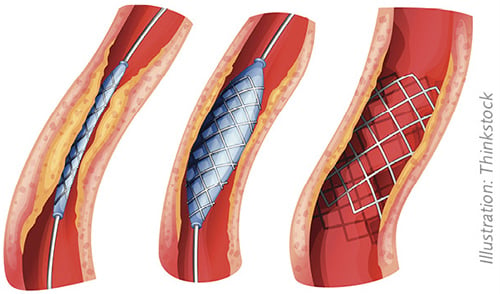
Percutaneous coronary intervention (PCI) is a general concept covering procedures in the coronary arteries carried out via a catheter, eg, balloon angioplasty, for the purpose of widening a narrowed part of a vessel (stenosis). However, narrowing may later recur in a stenosis that has been widened (restenosis). Insertion of a thin, net-shaped, metal prosthesis (stent) has been shown to reduce the risk for restenosis by nearly half in comparison to balloon angioplasty alone. In comparing balloon angioplasty alone versus balloon angioplasty with stents, no differences have been found in the risks for mortality or myocardial infarction. During 2003, approximately 13 000 PCI procedures were performed in Sweden, whereof most involved the use of stents. A continuing problem is that symptoms may return due to tissue growing from the vascular wall in the stent (in-stent restenosis). Methods that involve coating the stent surface with drugs to prevent the growth of tissue in the stent (Drug Eluting Stents – DES) are currently being tested.

Patient benefits and risks

Seven randomized trials, covering 3 559 patients with narrowing in a single vessel, have compared treatment with drug eluting stents (DES) versus treatment with noncoated stents (Bare Metal Stents - BMS). Followup (up to one year) has shown that, on average, 4 percent of the patients treated with DES had undergone at least one repeat intervention in the stenosis. The corresponding percentage in the group treated with BMS varied among the studies, ranging from 11 percent to 21 percent. Some of the restenoses that led to repeat interventions were detected via the followup angiography specified by the protocol. Hence, it is unknown how many of these would have led to repeat intervention if the decision had been based solely on the recurrence of symptoms in the patient. Analysis of a registry of 958 consecutive patients from the Netherlands compared the results from routine treatment using DES and BMS respectively. When patients symptoms were used as the indication for re-intervention, the results showed that 3.7 percent of those receiving DES versus 10.9 percent of those receiving BMS had undergone at least one repeat intervention, eg, PCI or CABG (bypass surgery), within one year.

No comparisons between DES and BMS treatment groups have been reported with respect to symptoms, quality of life, or use of medication following intervention. In followup lasting up to one year, no difference was found in mortality or the occurrence of myocardial infarction between groups treated with DES or BMS, either in randomized trials or the registry. In the randomized trials, the risk for subacute thrombosis was less than 1 percent for both DES and BMS. Compared to BMS, the use of DES is thought to be associated with a higher rate of malapposition ie, on followup examination the entire surface area of the stent was not attached to the vessel wall. At 18-month followup, this was not found to result in any complications.

Economic aspects

A drug eluting stent costs, on average, about 11 000 Swedish kronor (SEK) more than a stent that is not drug eluting. The additional cost to the Swedish health services of changing to DES, at the current volume of PCI, is estimated to be approximately 220 million SEK per year. Part of this cost would be offset by a decrease in the need for repeat procedures to treat restenosis. An analysis has shown cost savings of approximately 8 million SEK per year for every percentage point of decline in the need for repeat procedures. Nevertheless, the savings do not outweigh the additional cost of using DES. No studies were identified that investigated the cost effectiveness of changing to DES.

Scientific evidence

There is strong scientific evidence that DES treatment – in comparison to BMS – reduces the risk for restenosis in the stent (Evidence grade 1)*. Followup lasting up to one year has shown that fewer repeat interventions have been performed in patients treated with DES in comparison to patients treated with BMS (Evidence grade 1)*. The extent to which this has affected patients symptoms, well being, or the use of medication has not been reported. Followup lasting up to one year provides no support for differences in risks of myocardial infarction or death between DES and BMS. Likewise, there is no support for differences in side effects and complications between DES and BMS.

*Grading of the level of scientific evidence for conclusions. The grading scale includes four levels;
Evidence grade 1 = strong scientific evidence,
Evidence grade 2 = moderately strong scientific evidence,
Evidence grade 3 = limited scientific evidence,
Evidence grade 4 = insufficient scientific evidence.

This summary is based on a report prepared at SBU in collaboration with Assoc. Prof. Lars Grip, Sahlgrenska University Hospital, Göteborg and Assoc. Prof. Bengt Brorsson, SBU, Stockholm. It has been reviewed by Assoc. Prof. Per Tornvall, Karolinska Institute, Stockholm. The following manufacturers were given the opportunity to comment on this report: Boston Scientific Nordic AB and Johnson & Johnson.

The complete report is available only in Swedish.

SBU Alert is a service provided by SBU in collaboration with the Medical Products Agency, the National Board of Health and Welfare, and the Federation of Swedish County Councils.

References

  1. Babapulle MN, Eisenberg MJ. Coated stents for the prevention of restenosis: Part I. Circulation 2002;106(21):2734-40.
  2. Babapulle MN, Eisenberg MJ. Coated stents for the prevention of restenosis: Part II. Circulation 2002;106(22):2859-66.
  3. Brophy JM, Belisle P, Joseph L. Evidence for use of coronary stents. A hierarchical bayesian meta-analysis. Ann Intern Med 2003;138(10):777-86.
  4. Colombo A, Drzewiecki J, Banning A, Grube E, Hauptmann K, Silber S et al. Randomized study to assess the effectiveness of slow- and moderate-release polymer-based paclitaxel-eluting stents for coronary artery lesions. Circulation 2003;108(7):788-94.
  5. Degertekin M, Serruys PW, Tanabe K, Lee CH, Sousa JE, Colombo A et al. Long-term follow-up of incomplete stent apposition in patients who received sirolimus-eluting stent for de novo coronary lesions: an intravascular ultrasound analysis. Circulation 2003;108:2747-50.
  6. Doucet S, Malekianpour M, Theroux P, Bilodeau L, Cote G, de Guise P et al. Randomized trial comparing intravenous nitroglycerin and heparin for treatment of unstable angina secondary to restenosis after coronary artery angioplasty. Circulation 2000;101(9):955-61.
  7. Elezi S, Kastrati A, Neumann FJ, Hadamitzky M, Dirschinger J, Schomig A. Vessel size and long-term outcome after coronary stent placement. Circulation 1998;98(18):1875-80.
  8. Elezi S, Kastrati A, Wehinger A, Walter H, Schuhlen H, Hadamitzky M et al. Clinical and angiographic outcome after stent placement for chronic coronary occlusion. Am J Cardiol 1998;82(6):803-6, A9.
  9. Fattori R, Piva T. Drug-eluting stents in vascular intervention. Lancet 2003;361(9353):247-9.
  10. FDA Public Health Web Notification*: Information for Physicians on Sub-acute Thromboses (SAT) and Hypersensitivity Reactions with Use of the Cordis CYPHERT Coronary Stent. In; 2003: Federal Drug Administration; 2003.www.fda.gov/cdrh/safety/cypher.html October 31.
  11. Fischman DL, Savage MP, Goldberg S. Coronary stent placement in patients with de-novo and restenotic native coronary artery lesions. Coron Artery Dis 1994;5(7):571-4.
  12. Grube E, Silber S, Hauptmann KE, Mueller R, Buellesfeld L, Gerckens U et al. TAXUS I: six- and twelve-month results from a randomized, double-blind trial on a slow-release paclitaxel-eluting stent for de novo coronary lesions. Circulation 2003;107(1):38-42.
  13. Hill R, Bagust A, Bakhai A, Dickson R, Dundar Y, Haycox A et al. Coronary artery stents: a rapid systematic review and economic evaluation. Health Technol Assess [in preparation] 2003.
  14. Hoffmann R, Mintz GS. Coronary in-stent restenosis - predictors, treatment and prevention. Eur Heart J 2000;21(21):1739-49.
  15. Hoffman SN, TenBrook JA, Wolf MP, Pauker SG, Salem DN, Wong JB. A meta-analysis of randomized controlled trials comparing coronary artery bypass graft with percutaneous transluminal coronary angioplasty: one- to eight-year outcomes. J Am Coll Cardiol 2003;41(8):1293-304.
  16. Holmes DR Jr., Leon MB, Moses JW, Popma JJ, Cutlip D, Fitzgerald PJ et al. Analysis of 1-year clinical outcomes in the SIRIUS trial: a randomized trial of a sirolimus-eluting stent versus a standard stent in patients at high risk for coronary restenosis. Circulation 2004;109(5):634-40.
  17. Hong MK, Mintz GS, Lee CW, Kim YH, Lee SW, Song JM et al. Incidence, mechanism, predictors, and long-term prognosis of late stent malapposition after bare-metal stent implantation. Circulation 2004;109(7):881-6.
  18. Karlsson C. Johnson & Johnson, Sollentuna. Listpris för BX VelocityT och CypherT stent enligt telefonsamtal 22 januari 2004.
  19. Kastrati A, Elezi S, Dirschinger J, Hadamitzky M, Neumann FJ, Schomig A. Influence of lesion length on restenosis after coronary stent placement. Am J Cardiol 1999;83(12):1617-22.
  20. Kastrati A, Dirschinger J, Boekstegers P, Elezi S, Schuhlen H, Pache J et al. Influence of stent design on 1-year outcome after coronary stent placement: a randomized comparison of five stent types in 1,147 unselected patients. Catheter Cardiovasc Interv 2000;50(3):290-7.
  21. Kastrati A, Mehilli J, Dirschinger J, Pache J, Ulm K, Schuhlen H et al. Restenosis after coronary placement of various stent types. Am J Cardiol 2001;87(1):34-9.
  22. Lemos PA, Serruys PW, van Domburg RT, Saia F, Arampatzis CA, Hoye A et al. Unrestricted utilization of sirolimus-eluting stents compared with conventional bare stent implantation in the \"real world\": the Rapamycin-Eluting Stent Evaluated At Rotterdam Cardiology Hospital (RESEARCH) registry. Circulation 2004;109(2):190-5.
  23. Leon MB, Abizaid A, Moses JW. Subgroup analysis from the Cypher clinical trials. In: The Cypher Stent: A New Gold Standard in the Treatment of Coronary Artery Disease. New York, NY: Cardiovascular Research Foundation; 2003:54-7.
  24. Leon MB, Moses JW. Are Cypher stents associated with increased thrombosis? Perspectives from available data. In: TCT, editor.; 2003; 2003.(www.tctmd.com/journal-synopses/one.html?synopsis_id=3504).
  25. Liistro F, Stankovic G, Di Mario C, Takagi T, Chieffo A, Moshiri S et al. First clinical experience with a paclitaxel derivate-eluting polymer stent system implantation for in-stent restenosis: immediate and long-term clinical and angiographic outcome. Circulation 2002;105(16):1883-6.
  26. Morice MC, Serruys PW, Sousa JE, Fajadet J, Ban Hayashi E, Perin M et al. A randomized comparison of a sirolimus-eluting stent with a standard stent for coronary revascularization. N Engl J Med 2002;346(23):1773-80.
  27. Moses JW, Leon MB, Popma JJ, Fitzgerald PJ, Holmes DR, OShaughnessy C et al. Sirolimus-eluting stents versus standard stents in patients with stenosis in a native coronary artery. N Engl J Med 2003;349(14):1315-23.
  28. Nilsson L. Boston Scientific Nordic AB, Helsingborg. Listpris för ExpressT och TaxusT stent enligt telefonsamtal 21 januari 2004.
  29. Nilsson T. Svenska coronarplastikregistret (SCAAR) 2003 (Muntligt meddelande).
  30. Nobuyoshi M, Kimura T, Nosaka H, Mioka S, Ueno K, Yokoi H et al. Restenosis after successful percutaneous transluminal coronary angioplasty: serial angiographic follow-up of 229 patients. J Am Coll Cardiol 1988;12(3):616-23.
  31. Park SJ, Shim WH, Ho DS, Raizner AE, Park SW, Hong MK et al. A paclitaxel-eluting stent for the prevention of coronary restenosis. N Engl J Med 2003;348(16):1537-45.
  32. Schofer J, Schluter M, Gershlick AH, Wijns W, Garcia E, Schampaert E et al. Sirolimus-eluting stents for treatment of patients with long atherosclerotic lesions in small coronary arteries: double-blind, randomised controlled trial (E-SIRIUS). Lancet 2003;362(9390):1093-9.
  33. Serruys PW, de Jaegere P, Kiemeneij F, Macaya C, Rutsch W, Heyndrickx G et al. A comparison of balloon-expandable-stent implantation with balloon angioplasty in patients with coronary artery disease. Benestent Study Group. N Engl J Med 1994;331(8):489-95.
  34. Serruys PW, Unger F, Sousa JE, Jatene A, Bonnier HJ, Schonberger JP et al. Comparison of coronary-artery bypass surgery and stenting for the treatment of multivessel disease. N Engl J Med 2001;344(15):1117-24.
  35. Serruys PW, Degertekin M, Tanabe K, Abizaid A, Sousa JE, Colombo A et al. Intravascular ultrasound findings in the multicenter, randomized, double-blind RAVEL (RAndomized study with the sirolimus-eluting VElocity balloon-expandable stent in the treatment of patients with de novo native coronary artery Lesions) trial. Circulation 2002;106(7):798-803.
  36. Sousa JE, Serruys PW, Costa MA. New frontiers in cardiology: drug-eluting stents: Part II. Circulation 2003;107(18):2383-9.
  37. Stone GW, Ellis SG, Cox DA, Hermiller J, OShaugnessy C, Tift Mann J et al. A polymer-based, Paclitaxel-eluting stent in patients with coronary artery disease. N Engl J Med 2004;350:221-31.
  38. Virmani R, Liistro F, Stankovic G, Di Mario C, Montorfano M, Farb A et al. Mechanism of late in-stent restenosis after implantation of a paclitaxel derivate-eluting polymer stent system in humans. Circulation 2002;106(21):2649-51.
  39. Virmani R, Kolodgie FD, Farb A, Lafont A. Drug eluting stents: are human and animal studies comparable? Heart 2003;89(2):133-8.