 Swedish Agency for Health Technology Assessment and Assessment of Social Services
Drug-eluting stents in coronary arteries
 Share on Facebook
 Share on LinkedIn
 Share via Email
SBU does not issue recommendations or guidelines on how healthcare, dental care or social services should operate, or on which interventions and methods should be provided. SBU critically appraises and synthesises research on interventions and methods through systematic reviews.
Conclusions
- Compared with bare metal mesh stents, drug-eluting stents prevent the recurrence of narrowing of the coronary artery, without increasing the risk of complications. This applies to both stable and unstable coronary artery disease.
- Various drug-eluting stents may differ in both effect and risks:
- Everolimus-eluting stents give rise to fewer stent thromboses than sirolimus-eluting stents, and fewer myocardial infarctions and stent thromboses than paclitaxel-eluting stents.
- However, in comparative studies, there seem to be no differences in safety or effect of everolimus-, biolimus- or second-generation zotarolimus-eluting stents.
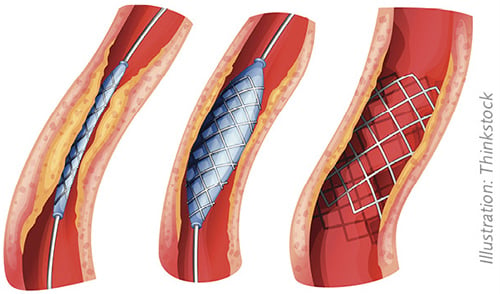
Figure 1 Narrowing in a coronary artery is caused by arteriosclerotic plaque, which can be displaced mechanically by a metal stent expanded by means of a balloon.
SBU Alert is a service provided by SBU in collaboration with the Medical Products Agency, the National Board of Health and Welfare, and the Federation of Swedish County Councils.
How to cite this report: SBU. Drug-eluting stents in coronary arteries. Stockholm: Swedish Council on Health Technology Assessment (SBU); 2014. SBU report no 2014-06 (in Swedish).
Project group
Experts
- Lars Grip, Professor, Sahlgrenska Academy at Gothenburg University
- Rikard Linder, PhD, Danderyds Sjukhus
SBU
- Sofia Tranæus, Project Director
- Anna Attergren Granath, Project Administrator
- Laura Lintamo, Analyst
- Lars-Åke Marké, Health Economist
- Anna Mattsson, Analyst
- Anders Norlund, Assistant Project Director, Health Economist
- Karin Rydin, Project Director
